

Understanding Hip Osteoarthritis and the Decision for Surgery
As a specialist orthopaedic surgeon in London with over 18 years of experience, the most common question I hear is, “How do I know it’s the right time for a hip replacement?” Many people I see in my clinic have been living with hip pain for months, or even years, hoping it will improve on its own. They’ve tried managing it, but the persistent ache in the groin, the stiffness after sitting, and the pain that wakes them at night have started to take over their lives. This is often the result of osteoarthritis, a condition where the protective cartilage on the ends of your bones wears down over time.
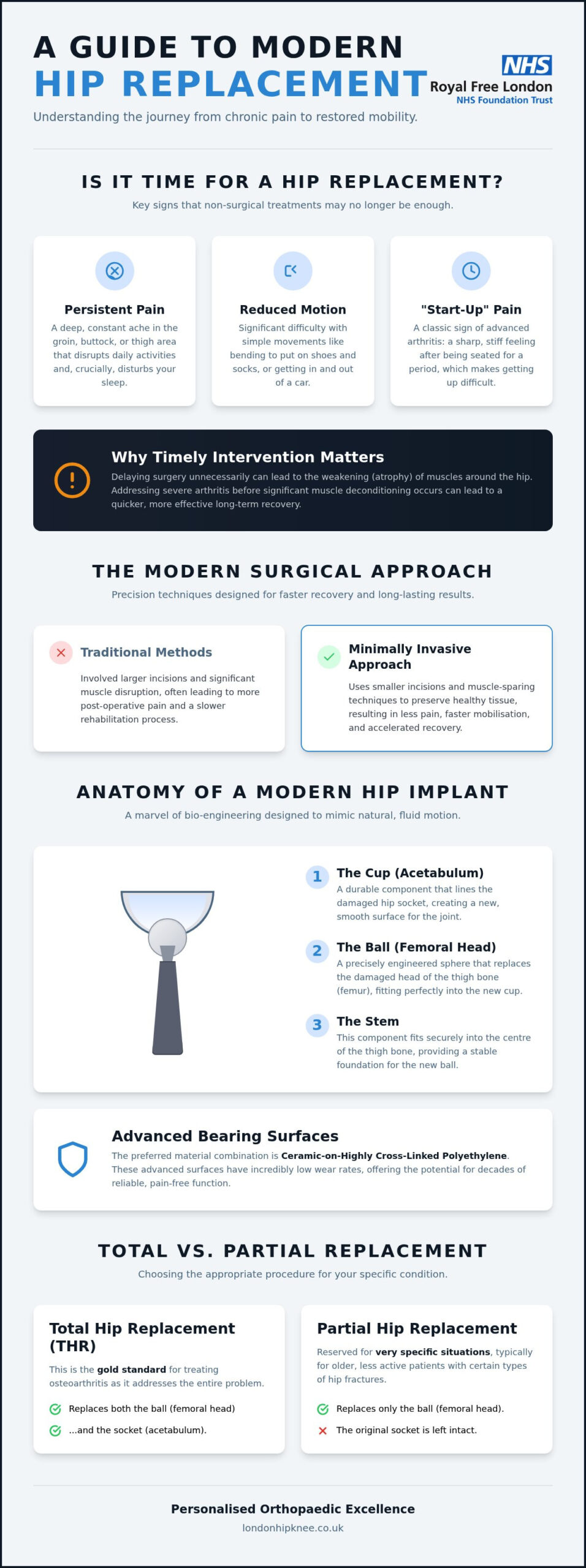
A hip replacement, or total hip arthroplasty, is a procedure where I carefully remove the damaged sections of your hip joint—both the ball (femoral head) and the socket (acetabulum)—and replace them with precisely engineered artificial components. The goal is not just to eliminate pain but to restore the smooth, fluid motion you’ve lost. Whilst surgery is a significant step, I find that delaying it unnecessarily can sometimes lead to further problems, such as muscle weakening (atrophy) around the hip, which can make recovery more challenging. Recognising the signs that your hip is dictating your life is the first step towards reclaiming it. For a more detailed look at the symptoms, you might find my guide on the signs you need a hip replacement helpful.
- Defining hip replacement: In this procedure, I replace the damaged bone and cartilage of the hip joint with a durable, artificial joint designed to restore pain-free movement.
- Common symptoms that signal a consultation is needed: Key indicators I look for include persistent pain that disturbs your sleep, a noticeable reduction in your range of motion, and a deep ache in the groin or buttock area.
- The role of osteoarthritis: This is the primary reason for joint degradation, causing the “wear and tear” that leads to bone-on-bone friction, pain, and stiffness.
- Why timely intervention matters: Addressing severe arthritis before the surrounding muscles become too weak and deconditioned can significantly improve your long-term recovery and the overall function of your new hip.
When is it Time to Move Beyond Non-Surgical Treatments?
Before considering surgery, my approach is always to exhaust appropriate non-operative treatments. Physiotherapy is crucial for strengthening the muscles that support the hip, and anti-inflammatory medications can provide temporary relief. For some patients with early-stage discomfort, specialist injections can also be effective in managing symptoms for a period. However, these treatments are designed to manage the symptoms, not to reverse the underlying joint damage. The “tipping point” for surgery arrives when the impact of your hip pain on your quality of life outweighs your concerns about the operation.
The Impact of Chronic Hip Pain on Your Lifestyle
I often see the frustration in my patients’ faces when they describe how chronic hip pain has chipped away at their independence. It’s the simple things that become monumental challenges: bending down to put on shoes and socks, getting in and out of a car, or simply getting up from a chair after a meal. This “start-up” pain—a sharp, stiff feeling after being seated—is a classic sign of advanced hip arthritis. For active Londoners who are used to being on the go, this loss of mobility can have a significant psychological toll, preventing them from enjoying walks in the park, playing with grandchildren, or pursuing hobbies like golf and gardening.
Modern Hip Replacement Techniques: Precision and Materials
The field of hip replacement has evolved dramatically over the course of my career. The techniques I use today are far less invasive and more precise than traditional methods, which translates into a faster, more comfortable recovery for my patients. My goal is to preserve as much of your healthy bone and soft tissue as possible, which is why I favour minimally invasive approaches. These techniques involve smaller incisions and careful muscle-sparing dissection, leading to less post-operative pain and quicker mobilisation.
The artificial hip joint itself is a marvel of bio-engineering, perfectly mimicking the natural ball-and-socket mechanism. During the procedure, I ensure every component is positioned with absolute precision to restore correct leg length and joint stability, which is fundamental for a balanced and natural gait. The materials used in these implants are chosen for their exceptional durability and biocompatibility.
- The evolution of surgical techniques: I have moved from traditional, larger-incision surgeries to minimally invasive methods that respect the patient’s anatomy, reduce muscle damage, and accelerate recovery.
- Prosthetic components explained: The modern implants I use consist of a stem that fits into the thigh bone, a ball that replaces the femoral head, and a cup that lines the hip socket, all working together seamlessly.
- Materials I use today: My preference is for advanced bearing surfaces like ceramic-on-highly cross-linked polyethylene. These combinations have incredibly low wear rates, offering the potential for decades of reliable function.
- The importance of surgical precision: I use meticulous planning and intra-operative checks to ensure the implant is perfectly aligned, which is critical for preventing complications and ensuring the longevity of the new joint.
Total vs. Partial Hip Replacement: Which is Appropriate?
For the vast majority of my patients suffering from osteoarthritis, a Total Hip Replacement (THR) is the gold standard. This procedure addresses the entire problem by replacing both the ball and the socket, which are equally affected by the disease. A partial hip replacement, or hemiarthroplasty, is a different operation that I typically reserve for very specific situations, such as certain types of hip fractures in older, less active patients, where the socket itself is still healthy. During your consultation, I will conduct a thorough examination and review your scans to determine the precise surgical plan that is best suited to your unique anatomy and lifestyle goals.
The Science of Implant Longevity
A common concern for my patients is, “How long will my new hip last?” It’s a valid question, and the answer today is very reassuring. The implants I use are designed to last for 25 years or even longer. This remarkable longevity is thanks to the advanced “bearing surfaces”—the parts of the ball and socket that move against each other. Materials like polished ceramic and highly cross-linked polyethylene create an exceptionally smooth, low-friction surface that minimises wear and tear over decades of use. Data from national joint registries consistently shows excellent long-term survival rates for these modern implants, giving my patients the confidence that their new hip is a long-term solution.
Navigating Private Hip Replacement in London
Choosing to have your hip replacement surgery privately in London offers several distinct advantages. The primary benefits are speed of access and continuity of care. You avoid lengthy waiting lists, and you have the assurance that I will personally oversee every single step of your journey—from the initial consultation and the surgery itself to your final post-operative check. My team and I focus on creating a personalised rehabilitation plan that is tailored not just to your clinical needs but also to your home environment and personal goals, ensuring a smooth and efficient return to your daily life.
- The benefits of private care: You gain immediate access to a specialist, the choice of a consultant who focuses exclusively on your condition, and a continuous, personal level of care throughout your treatment.
- How to choose a specialist consultant: I always advise patients to look for a surgeon whose practice is dedicated to hip and knee conditions. This focused expertise often leads to better outcomes and a deeper understanding of the patient’s specific needs.
- The patient journey in my clinic: Your path starts with a detailed consultation, followed by necessary scans (X-ray or MRI), the procedure itself, and a series of structured post-operative follow-up appointments to monitor your progress.
- A personalised rehabilitation plan: My team of physiotherapists works with you to create a bespoke recovery programme designed to help you regain strength, mobility, and confidence as quickly and safely as possible.
Using Private Medical Insurance (Bupa, AXA, and others)
If you have private medical insurance, the process is very straightforward. The first step is usually to see your GP to obtain a referral letter to see me. Once you have this, you should contact your insurance provider to confirm that “major joint replacement” is covered under your policy and to request a pre-authorisation code for your consultation and any subsequent treatment. My administrative team is highly experienced in dealing with all major UK insurers, including Bupa and AXA, and they will be on hand to help you navigate the paperwork and ensure the process is seamless.
Self-Funded Surgery: A Clear Path to Mobility
For patients without private insurance or those who wish to bypass long NHS waits, self-funding your surgery offers a direct and transparent route to restoring your mobility. One of the main advantages is the certainty it provides; you know exactly what you are paying for from the outset. A private surgical fee, often called a “package price,” typically includes all the main costs: my surgical fee, the anaesthetist’s fee, the hospital stay, the prosthesis itself, and post-operative physiotherapy sessions. My team will provide you with a clear, itemised quote before you commit to anything, ensuring complete price transparency and peace of mind.
For more information on what’s involved, please see this detailed breakdown of private hip replacement costs in London.
The Recovery Journey: Your Timeline to Returning to Action
Your recovery begins the moment your surgery is complete. In my practice, I follow an “enhanced recovery” protocol, which is a modern, evidence-based approach designed to get you back on your feet as safely and quickly as possible. This involves advanced pain relief techniques to manage post-operative discomfort effectively, allowing you to mobilise sooner. The role of physiotherapy cannot be overstated; it is the engine of your recovery, and starting it early is critical for achieving the best possible outcome.
- The first 24 hours: My goal is to have you standing and walking with the support of a therapist on the same day as your surgery. This early mobilisation helps prevent complications and kick-starts your recovery.
- Managing post-operative discomfort: I use a multi-modal approach to pain relief, combining different types of medication to keep you comfortable and enable you to participate fully in your physiotherapy.
- The critical role of physiotherapy: In the first six weeks, your physiotherapist will guide you through exercises to restore your range of motion, strengthen your hip muscles, and retrain your walking pattern.
- Returning to daily activities: I will provide clear guidance on when you can safely resume activities like driving, returning to work, and engaging in light exercise, based on your individual progress.
The First Fortnight: Building Confidence
The first two weeks after surgery are focused on healing and building confidence in your new hip. My team will give you clear instructions on wound care to ensure it heals cleanly. You will start by walking with crutches, but the aim is to transition away from them as your strength and balance improve. The simple exercises you perform at home are vital during this period to prevent stiffness and promote blood flow. By day 14, my expectation is that you will be walking comfortably indoors with minimal support and be able to manage a flight of stairs.
Long-Term Success: Returning to Sport and Travel
A successful hip replacement is one that allows you to forget you even have it and return to the activities you love. Once you have recovered, you can look forward to getting back to low-impact sports. I typically advise my patients that they can safely return to activities like swimming, cycling, and golf around the three-month mark. If you are planning to travel, it’s generally safe to take a long-haul flight from about six weeks after your operation, though I will provide specific advice based on your circumstances. With a little care and by staying active, your new joint will provide you with decades of pain-free mobility.
My Commitment: Personalised Orthopaedic Excellence
My name is Parag Jaiswal, and for over 18 years, I have dedicated my career to the specialised field of hip and knee surgery. My entire practice is built on a simple philosophy: to combine the highest level of clinical and surgical expertise with genuine, empathetic care. When you are in pain and facing surgery, you need more than just a technician; you need a trusted guide who will listen to your concerns, answer your questions, and provide you with the reassurance that you are in safe hands. That is the commitment I make to every patient who walks through my door.
Being based in London allows me to offer my services to local and international patients, providing convenient access to some of the world’s leading medical facilities. My focus is singular: to restore your freedom of movement and help you get back to the life you want to live, free from the constraints of joint pain.
- My philosophy of care: I believe in a partnership with my patients, where we make decisions together based on the best available evidence and your personal goals.
- A London-based specialist: Operating from the capital provides access to world-class diagnostic and surgical facilities, ensuring you receive the highest standard of care.
- Booking your consultation: The first step is a simple conversation. I invite you to book an initial consultation at one of my London centres to discuss your hip pain and explore your treatment options.
Expertise You Can Trust
My practice is exclusively focused on conditions of the hip and knee. This specialisation allows me to remain at the forefront of the latest evidence-based surgical techniques and implant technologies. I am committed to a patient-centric model of care, which means I take the time to ensure you feel heard, understood, and respected at every stage of your journey. Your trust is my highest priority, and I earn it by delivering consistently excellent outcomes and providing clear, honest communication.
Convenient London Locations
To make your treatment journey as convenient as possible, I operate across several of London’s most prestigious and well-equipped private hospitals and clinics. This flexibility allows you to choose a location that suits your schedule and travel needs. My team has streamlined the entire process, from initial diagnostics like MRI and X-ray scans to your surgical procedure and follow-up care, ensuring a smooth and efficient experience.
Book your consultation with me, Mr Parag Jaiswal, today and take the first step towards a life with less pain and more movement.
Frequently Asked Questions
Here are my answers to some of the questions I am most frequently asked by patients considering a hip replacement.
- How long does a private hip replacement take to perform?
The surgery itself is very efficient. In my hands, a routine total hip replacement typically takes between 60 and 90 minutes from the first incision to the final stitch. - Will I be able to walk immediately after hip surgery?
Yes. As part of my enhanced recovery programme, I aim to have you on your feet and taking your first steps with the help of a physiotherapist within a few hours of the operation. - What are the main risks associated with hip replacement surgery?
Hip replacement is a very safe and successful operation, but like any surgery, it carries some risks. These include infection, blood clots, dislocation, and leg length discrepancy. I take meticulous precautions in the operating theatre to minimise these risks, and I will discuss them with you in detail during our consultation. - Does Bupa or AXA cover the full cost of a hip replacement in London?
In most cases, yes. The major insurance providers like Bupa and AXA typically cover the full cost of the procedure, provided it is included in your policy. My team will help you get the necessary authorisations to ensure your treatment is covered. - How long will my new artificial hip joint last?
The modern implants I use are designed for exceptional durability. With the advanced ceramic and polyethylene bearing surfaces, we expect over 90% of them to be functioning perfectly for 25 years or more. - Can I have a hip replacement if I have other health conditions?
Generally, yes. I work closely with an experienced anaesthetist to carefully assess and manage any other health conditions you may have, such as heart disease or diabetes, to ensure the surgery is as safe as possible for you. - When can I return to work after my hip operation?
This depends on your job. If you have a sedentary, office-based role, you may be able to return to work in as little as 4 to 6 weeks. For more physically demanding jobs, it may take closer to 3 months to be fully ready. - What is the difference between an anterior and posterior hip approach?
These terms refer to the direction from which I approach the hip joint. The posterior approach (from the back) is the most common and versatile method, which I have used to achieve excellent, reproducible results for thousands of patients. The anterior approach (from the front) is another technique. I believe the key to a successful outcome is not the specific approach, but the surgeon’s skill and experience in performing it with precision and care for the soft tissues.