

Did you know that according to a major study published in The Lancet, nearly 60% of total hip replacements are now expected to last for at least 25 years? For many patients, the decision to undergo surgery is often clouded by the fear of the “ticking clock.” You might worry that your new joint will wear out just as you’re returning to your favourite sports, or that you’ll eventually face a more complex revision procedure. It’s completely natural to feel anxious when wondering exactly how long do artificial hips last, especially when your long-term mobility and independence are the priority.
This guide provides the latest clinical data to offer you genuine reassurance. We’ll show you why modern materials and advanced surgical techniques mean your replacement can comfortably last for decades. You’ll gain a clear understanding of how to protect your new joint and why the expertise of a specialist surgeon is the most critical factor in your success. We’ll explore everything from the bespoke choice of high-performance implants to the lifestyle habits that keep you moving safely for the long term.
Key Takeaways
- Modern clinical evidence suggests the majority of hip replacements now exceed a 25-year lifespan, debunking outdated myths about 10-year limits.
- Precise surgical alignment and the selection of high-performance bearing surfaces are the most critical factors in reducing long-term joint wear.
- Understanding how long do artificial hips last involves looking at the “Patient Factor,” where your activity levels and post-operative care play a vital role in preservation.
- Private orthopaedic care in London provides access to a wider range of premium, bespoke implants tailored to your specific anatomy and lifestyle needs.
- Regular orthopaedic check-ups allow for the early detection of gradual wear, ensuring your joint remains stable and functional for decades.
Understanding the Lifespan of Modern Artificial Hips
When patients ask how long do artificial hips last, they’re usually looking for a definitive “expiry date.” In clinical terms, we define implant longevity as the duration the prosthetic remains functional before a revision surgery is required. For years, a persistent myth suggested that 10 to 15 years was the upper limit for any replacement. This outdated perspective doesn’t reflect the significant advancements in material science and surgical precision we see today. Modern orthopaedics has moved far beyond these old expectations, offering a path to decades of pain-free movement.
The 25-Year Milestone: What the Data Says
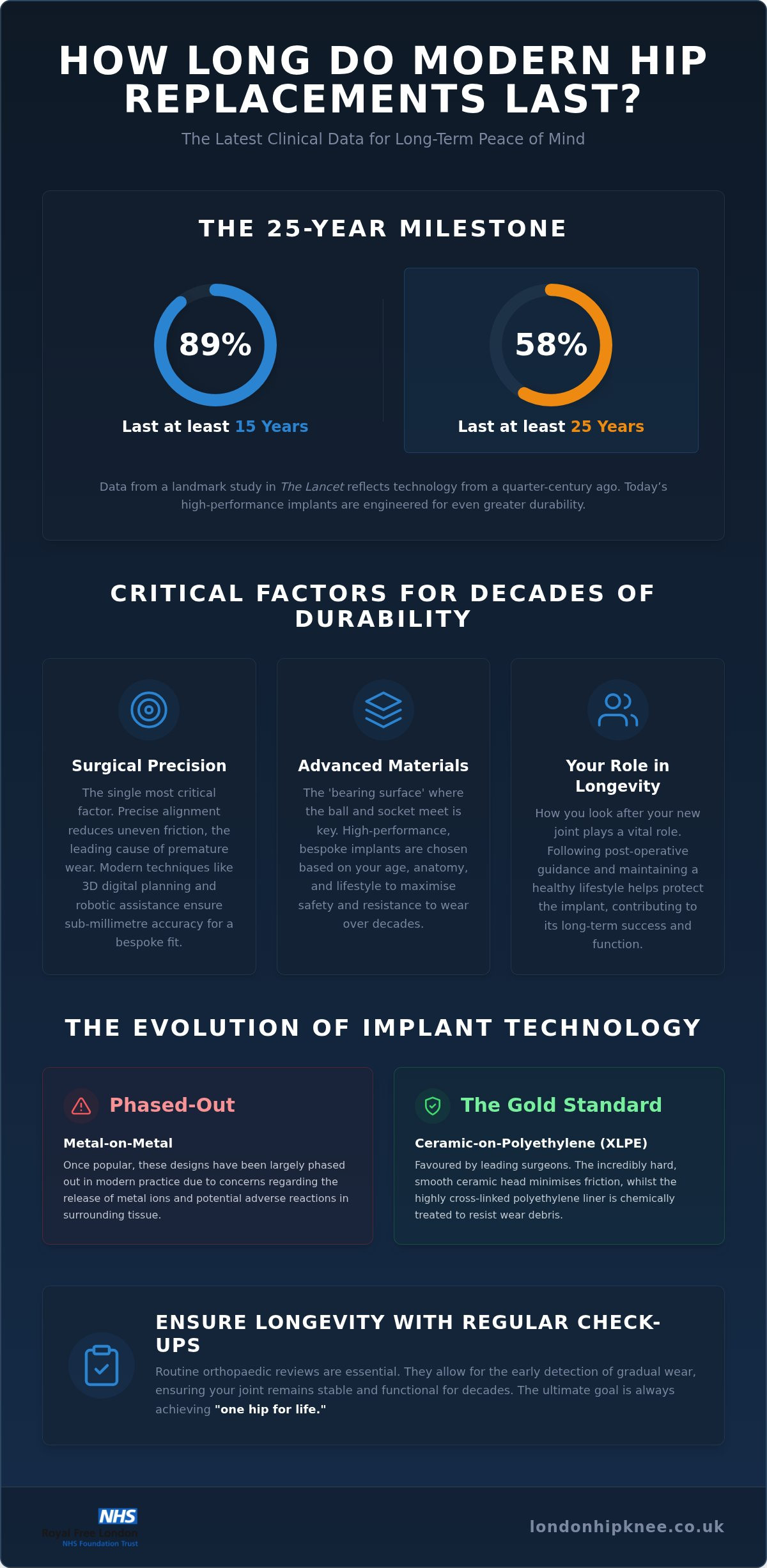
Data from a landmark 2019 study published in The Lancet provides a much more optimistic picture for patients. After analysing thousands of cases, researchers found that approximately 89% of total hip replacements lasted at least 15 years. Even more impressively, roughly 58% of these implants were still functioning perfectly after 25 years. When considering how long do artificial hips last, these long-term survival rates offer immense peace of mind. The data is clear. It’s also vital to recognise that these statistics reflect technology from a quarter-century ago. The high-performance implants we use in modern practice are engineered to be even more durable than their predecessors.
Why “Revision Surgery” is the Metric for Failure
In the orthopaedic world, we use “revision surgery” as the primary metric for an implant’s lifespan. This is essentially a secondary operation to replace or repair a worn-out or loosened prosthetic. Precision matters. Whilst modern revision techniques are highly sophisticated and successful, the gold standard is always “one hip for life.” Achieving this requires a combination of surgical excellence, precise alignment, and the selection of premium materials.
Average lifespans are helpful benchmarks, but your individual outcome depends heavily on how your specific surgery is performed. A well-aligned hip reduces uneven friction, which is the leading cause of premature wear. By prioritising surgical precision from the start, we aim for a result that serves you well into your later decades. You might feel that a 25-year estimate is just a number, but for a patient in their 60s, it often means never needing to step into an operating theatre for that hip again.
The Evolution of Implant Materials and Technology
The durability of a hip replacement depends largely on its “bearing surface.” This is the critical interface where the prosthetic ball and socket meet. Every time you walk, climb stairs, or cycle, these surfaces interact. In the past, the industry relied heavily on metal-on-metal designs. Whilst these were once popular, they’ve been largely phased out in modern practice due to concerns regarding metal ion release and potential tissue reactions. Today, we focus on high-performance materials that offer a superior safety profile and exceptional resistance to wear.
The choice of material is a primary factor in determining how long do artificial hips last. In specialist London clinics, surgeons now have access to a sophisticated range of bespoke implants. These are not “off the shelf” solutions; they’re selected based on your age, activity levels, and bone quality. By utilising premium components, we can significantly reduce the risk of the prosthetic loosening over time, which remains the leading cause of revision surgery.
Ceramic-on-Polyethylene: The Current Gold Standard
The combination of a ceramic head and a “Highly Cross-Linked Polyethylene” (XLPE) liner is currently favoured by many leading orthopaedic consultants. Ceramic is incredibly hard and smooth, which reduces friction to a minimum. Older plastic liners often suffered from “wear debris,” where tiny particles of plastic would shed into the surrounding tissue. This triggered an immune response that could weaken the bone. Modern XLPE has been chemically treated to resist this process. This advancement is a major reason why modern implants are now expected to last for 25 years or more.
The Role of Robotic-Assisted and Digital Planning
Even the most advanced materials will fail prematurely if the alignment is slightly off. Precision is the foundation of longevity. Specialist surgeons in London now use 3D digital planning to map out your unique anatomy before the first incision is made. This allows for a bespoke fit that ensures the joint is perfectly balanced. Robotic-assisted technology provides real-time feedback during the procedure, allowing for sub-millimetre accuracy. This level of precision maximises joint stability and reduces the uneven pressure that causes components to wear out. If you’re concerned about your long-term mobility, booking a consultation to discuss these advanced techniques can provide the clarity you need.
When considering how long do artificial hips last, it’s clear that technology has changed the narrative. We no longer just aim for 15 years of relief. We’re now engineering results designed to last for the rest of a patient’s life, even for those who lead highly active lifestyles.
Key Factors Influencing Your Hip Replacement’s Longevity
Whilst surgical precision and material choice provide the foundation, your lifestyle and physical health are equally influential. When considering how long do artificial hips last, we must look closely at the “Patient Factor.” This encompasses everything from your daily activity choices to your underlying bone density. A joint replacement is a partnership between the surgeon’s skill and the patient’s commitment to long-term care.
Younger patients often face a unique paradox. They are typically more active and have higher physical demands, which naturally places more mechanical stress on the joint through more frequent “cycles” of movement. Yet, these are the very patients who require the implant to function for the longest duration. Your Body Mass Index (BMI) also plays a significant role. Carrying excess weight increases the force exerted on the bearing surfaces with every step. Similarly, bone quality is a vital consideration. Conditions like osteoporosis can affect how well the implant integrates with your natural bone. Maintaining good bone health is a critical part of protecting your surgical outcome. Many patients who present with joint concerns also experience knee pain alongside their hip symptoms, and understanding the full picture of joint health is essential for long-term mobility. For those with localised joint damage who are not yet ready for surgery, exploring options such as joint preservation injections like PRP, Hyaluronic Acid, and Arthrosamid may offer a valuable intermediate step in managing symptoms and delaying the need for more invasive intervention.
Activity Levels: High-Impact vs Low-Impact
High-impact activities, such as running or jumping, involve repetitive, jarring forces that can accelerate wear on even the most advanced materials. We don’t suggest you stop being active. Instead, the goal is “sensible use.” We recommend moving towards favourite low-impact alternatives that maintain your fitness without punishing the prosthetic. Consider these options:
- Swimming: Provides excellent cardiovascular health with zero joint impact.
- Cycling: Builds leg strength whilst keeping the joint movement smooth and controlled.
- Golf or Walking: Allows for social, active lifestyles without the stress of high-velocity impact.
Staying active is essential for your general wellbeing, but choosing the right type of movement ensures your replacement can comfortably reach that 25-year milestone.
The Importance of Post-Operative Physiotherapy
Strong muscles are the best defenders of an artificial joint. Your glutes and core muscles act as natural shock absorbers, taking the pressure off the prosthetic components. Following a structured rehabilitation programme isn’t just about the first few weeks of recovery. It’s a long-term investment in your mobility. Specialist London clinics often provide integrated physiotherapy support to ensure your gait remains balanced. A balanced walking pattern prevents the uneven wear that often leads to premature revision surgery. By committing to your exercises, you’re directly extending the life of your new hip.
Maintenance and Recognising Potential Implant Wear
Whilst modern implants are engineered for extreme durability, they are not “fit and forget” devices. Understanding how long do artificial hips last requires shifting the focus from the surgery itself to the decades of proactive maintenance that follow. It’s important to remember that modern hips rarely fail in a sudden, catastrophic manner. Instead, wear is typically a gradual, microscopic process that occurs over many years. By staying vigilant, you can ensure that minor issues are identified long before they impact your mobility or quality of life.
Monitoring the bone-implant interface via regular X-rays allows us to see what you cannot feel. This is essential for detecting aseptic loosening, which is the most frequent cause for late-stage revision. This process occurs when the bond between the prosthetic and your natural bone gradually weakens, usually due to the body’s reaction to tiny wear particles. Routine imaging helps your specialist confirm that the implant remains securely fixed and that the surrounding bone stays healthy and supportive.
Warning Signs: When to Consult Your Specialist
You should remain vigilant for “start-up” pain, which is discomfort felt in the groin or thigh during your first few steps after sitting. Whilst some occasional aches are normal, a persistent feeling of instability or the hip “giving way” in the joint centre warrants an expert review. New clicking, popping, or grinding sounds are also signals that the bearing surfaces may have changed. If you notice these symptoms, Mr. Jaiswal can perform a thorough evaluation to determine if the wear is progressing faster than expected.
The “MOT” for Your Hip: Long-Term Monitoring
We recommend a structured schedule for follow-up appointments, typically at the one, five, and ten-year marks. These check-ups act as an “MOT” for your joint, allowing for early detection of wear that can sometimes be managed with minor interventions rather than a full revision. Osteolysis is defined as the silent, progressive thinning of the bone surrounding an implant, which often occurs without any outward symptoms. If you are experiencing new symptoms or are due for a routine check-up, you can book a specialised assessment with Mr. Jaiswal to ensure your joint remains in peak condition. Regular monitoring is the most effective way to maximise how long do artificial hips last for every individual patient.
Ensuring Long-Term Success with London Hip & Knee
Achieving a result that lasts requires more than just high-quality materials. At London Hip & Knee Consultant, we demand a surgeon who prioritises surgical alignment as the foundation of every procedure. Mr. Parag Jaiswal’s “Precision First” approach is built on the understanding that even a minor deviation in positioning can lead to uneven wear over time. When you ask how long do artificial hips last, the answer is often found in the accuracy of that initial placement. By using advanced digital mapping and robotic-assisted tools, we ensure your new joint is balanced perfectly within your own unique skeletal structure.
Private care in London offers a distinct advantage when it comes to implant selection. We aren’t restricted to a limited inventory. Instead, we can choose from the world’s most advanced, high-performance implants, including the latest ceramic-on-polyethylene combinations discussed earlier. This bespoke approach means your prosthetic is chosen specifically to match your age, bone density, and your personal desire to return to an active lifestyle. Having access to these premium materials is a significant factor in pushing the expected lifespan of your joint beyond the 25-year mark.
The benefit of a single, dedicated consultant cannot be overstated. From your initial assessment through to your ten-year check-up, you’ll be under the care of Mr. Jaiswal. This continuity of care ensures that your progress is monitored by someone who understands every nuance of your case. It provides a level of reassurance that is essential when embarking on such a life-changing journey. You aren’t just another patient on a list; you’re an individual with specific goals for your recovery and long-term mobility.
A Personalised Approach to Hip Replacement
Every patient receives a tailored plan that considers their specific goals. Whether you’re a younger patient aiming to return to the golf course or an older individual prioritising pain-free walking, your surgical plan is evidence-based and bespoke. We use modern techniques to ensure the best fit, reducing the risk of complications and maximising the joint’s stability. Our London-based private clinics are designed for your comfort, providing a calm and professional environment for your treatment and recovery.
Booking Your Consultation with Mr. Parag Jaiswal
If you’re experiencing persistent hip pain, it’s better to act whilst your symptoms are still manageable. Early intervention often leads to more straightforward procedures and better long-term outcomes. The referral and booking process for London residents is designed to be seamless and efficient, allowing you to focus entirely on your health. Take the first step toward a more active, pain-free future by securing an expert evaluation. Book a consultation with Mr. Parag Jaiswal today.
Securing Your Future Mobility
Deciding on a hip replacement is an investment in your quality of life for the next quarter-century. The clinical reality has shifted significantly; with modern data showing the majority of implants now last 25 years or more, the fear of a ticking clock is being replaced by the confidence of long-term restoration. Success relies on a sophisticated combination of high-performance materials, such as ceramic and XLPE, and the surgical precision that only comes with deep experience. Understanding exactly how long do artificial hips last provides the clarity you need to move forward without hesitation.
Mr. Parag Jaiswal brings over 18 years of specialist orthopaedic expertise to every procedure. By focusing on bespoke alignment and modern techniques across multiple prestigious London locations, he ensures your new joint is built to withstand the demands of your favourite activities. Don’t let the anxiety of future revisions hold you back from the active life you deserve. If you’re ready to receive a personalised longevity estimate and a clear path toward resolution, Book a Specialist Consultation with Mr. Jaiswal. You have a steady, reliable guide ready to support you through every stage of this journey.
Frequently Asked Questions
Can a hip replacement last 30 years?
Yes, it’s increasingly possible for a modern hip replacement to last 30 years. Whilst historical data often focused on a 15-year limit, advancements in material science mean we’re now seeing prosthetics remain functional for several decades. For many patients, especially those who prioritise low-impact activity and maintain a healthy weight, a single operation can provide a lifetime of mobility. Your individual result depends heavily on surgical precision and the quality of the initial implant choice.
Does my weight affect how long my artificial hip will last?
Your weight is a significant factor because it directly impacts the mechanical stress placed on the joint’s bearing surfaces. A higher Body Mass Index (BMI) increases the force exerted during every step, which can accelerate the rate of material wear. When considering how long do artificial hips last, maintaining a healthy weight is one of the most effective ways to protect your new joint. Reducing this load helps preserve the vital bond between the implant and your bone.
Is ceramic better than metal for hip replacements?
Ceramic-on-polyethylene is currently regarded as the gold standard for modern hip replacements. Ceramic heads are exceptionally hard and smooth, which significantly reduces friction compared to traditional metal components. This lower friction results in less wear debris, which is the primary cause of joint loosening over time. Whilst metal-on-metal designs were once popular, they’ve been largely replaced by these safer, more durable ceramic and highly cross-linked polyethylene combinations in specialist London clinics to ensure long-term stability.
What are the first signs of a hip replacement wearing out?
The first signs of wear are often subtle and develop gradually over several months. You might notice start-up pain, which is discomfort in the groin or thigh when you first stand up after sitting. Other indicators include a new sensation of instability, a feeling that the hip is giving way, or audible clicking and grinding sounds during movement. If you experience these symptoms, it’s vital to seek a specialist review to monitor the implant’s interface through clinical imaging.
Can I still play sports like tennis or golf with an artificial hip?
Most patients successfully return to sports like golf and tennis after their full recovery. Golf is an excellent low-impact choice that maintains cardiovascular fitness without jarring the prosthetic joint. Whilst tennis is possible, playing doubles is often recommended to reduce the amount of sudden, high-impact sprinting and pivoting. The key to ensuring your hip lasts for decades is sensible use, which means balancing your favourite activities with the long-term preservation of the modern prosthetic materials.
Why do some hip replacements fail earlier than others?
Early failure is typically caused by a combination of factors such as surgical misalignment, infection, or high-impact lifestyle choices. If an implant isn’t positioned with sub-millimetre precision, it creates uneven pressure that accelerates material wear. Other reasons include poor underlying bone quality, which can prevent the prosthetic from integrating securely. This is why choosing a specialist surgeon who uses digital planning and premium materials is essential for maximising how long do artificial hips last in active patients.
Is revision hip surgery more dangerous than the first operation?
Revision surgery is more complex than a primary hip replacement due to the presence of scar tissue and potential bone loss. Whilst it carries slightly higher surgical risks, it remains a safe and highly successful procedure when performed by a specialist in complex reconstructions. Modern techniques allow us to restore stability and function even when the original implant has worn out. Our goal is always to achieve surgical excellence during the first operation to avoid revision entirely.
Does the age at which I have surgery impact the implant’s lifespan?
Your age at the time of surgery influences the implant’s lifespan primarily through your physical demands. Younger patients are typically more active and will put the prosthetic through more cycles of movement over their lifetime, which can increase wear. Conversely, older patients may have concerns regarding bone density, such as osteoporosis, which affects how well the implant stays fixed. Every patient receives a tailored plan in our London clinics to ensure the materials match their specific age and goals.