

What if that persistent, sharp catch in your groin does not mean an artificial hip replacement is inevitable? If you are living with deep mechanical discomfort aggravated by sitting, twisting, or running, it is entirely natural to worry that irreversible arthritis has already begun. Opting for private hip joint preservation surgery offers a proactive, targeted solution, repairing delicate joint structures to halt cartilage wear and delay or completely prevent the need for prosthetic implants.
You shouldn’t have to face prolonged waiting lists while your joint deteriorates, nor should you have to decipher confusing terminology around impingement and labral tears alone. The true goal of preservation is precise anatomical restoration, safeguarding your natural bone so you can stay active for decades to come. In this 2026 guide, you will discover how specialist London care provides total diagnostic clarity, eradicates mechanical hip pain, and supports your safe return to high-impact sport and daily life.
Key Takeaways
- Understand how private hip joint preservation surgery repairs labral tears and corrects impingement, protecting your natural bone and halting early arthritic wear.
- Discover the critical diagnostic criteria used by London specialists to determine whether your joint is suited to keyhole preservation or a total hip replacement.
- Learn how advanced hip arthroscopy allows for precise joint reshaping and structural repair through minimally invasive techniques, reducing tissue trauma.
- Explore the streamlined private pathway in central London, from your dynamic clinical examination and specialised imaging to direct consultant continuity.
- Gain clarity on your post-operative rehabilitation milestones, including protected weight-bearing protocols designed to safely return you to running, sport, and daily activity.
What Is Private Hip Joint Preservation Surgery?
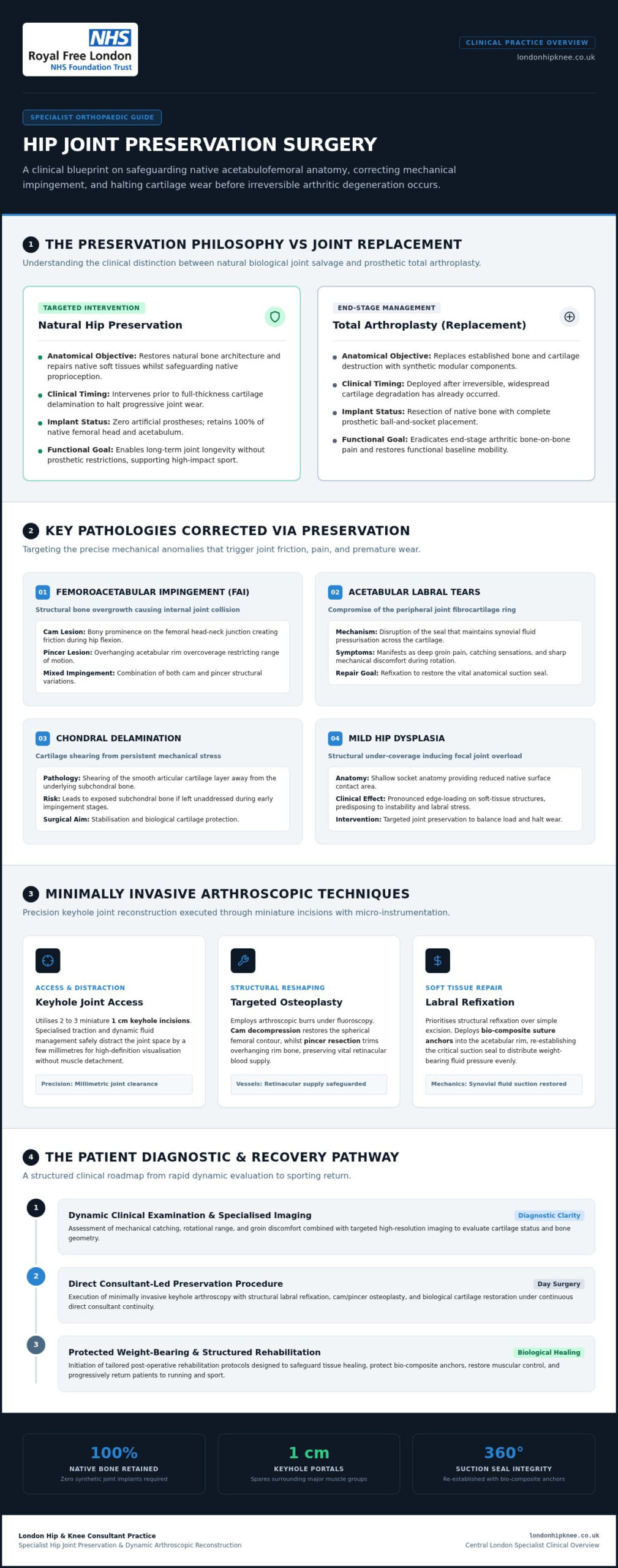
Hip joint preservation represents a specialised subdiscipline focused on safeguarding your native acetabulofemoral (ball-and-socket) anatomy rather than replacing it with synthetic components. The primary surgical objective is mechanical: restoring normal bony clearance, repairing damaged soft tissue, and halting progressive articular wear. While total hip arthroplasty remains a successful solution for end-stage arthritis, choosing private hip joint preservation surgery targets the root mechanical causes of pain before irreversible cartilage loss sets in. Rapid access to an experienced London consultant ensures that dynamic joint damage is halted long before replacement becomes a necessity.
The Core Philosophy of Natural Joint Salvage
Preservation focuses entirely on biological joint salvage. By correcting subtle structural deformities, surgeons protect your native proprioception, natural bone architecture, and fluid biomechanics. Whereas procedures such as hip resurfacing or replacement manage established joint destruction, preservation prevents that degradation from happening in the first place. Timing is decisive here. Intervening before full-thickness cartilage delamination occurs protects the smooth articular surface, allowing active adults to maintain their natural joint longevity without the functional restrictions of an artificial implant.
Key Conditions Treated Through Preservation Surgery
Modern preservation techniques correct complex mechanical issues that compromise the acetabulofemoral seal and create focal joint overload:
- Femoroacetabular Impingement (FAI): Bone overgrowths creating friction, including cam lesions (prominences on the femoral neck), pincer lesions (overcoverage by the acetabular rim), and mixed impingement.
- Acetabular Labral Tears: Ruptures to the fibrocartilaginous ring that seals the joint, compromising fluid pressurisation and triggering mechanical catching.
- Chondral Delamination: Shearing of the articular cartilage layer away from underlying subchondral bone due to persistent impingement forces.
- Mild Hip Dysplasia: Under-coverage of the femoral head leading to edge-loading, soft-tissue strain, and early joint instability.
Undergoing timely private hip joint preservation surgery addresses these specific anomalies through targeted correction, keeping your natural bone intact and preserving joint function for the decades ahead.
Surgical Techniques in Hip Preservation: Arthroscopy to Structural Realignment
Modern private hip joint preservation surgery blends high-definition visualisation with micro-instrumentation to correct internal joint mechanics without disrupting healthy surrounding tissue. Within premier London hospitals, specialised surgical traction and dynamic fluid management systems safely distract the acetabulofemoral space by a few millimetres. This clearance allows your surgeon to inspect, reshape, and stabilise native structures with millimetric accuracy, establishing a lasting biological environment for joint longevity.
Minimally Invasive Hip Arthroscopy and Labral Repair
Performed through two or three miniature 1 cm keyhole incisions, hip arthroscopy spares major muscle groups. Modern practice prioritises structural refixation over simple debridement. Surgeons don’t simply excise torn tissue; they deploy tiny bio-composite anchors into the acetabular rim, using high-tensile sutures to secure the labrum flush against the bone. Restoring this anatomical suction seal maintains synovial fluid pressurisation, preventing joint friction during everyday weight-bearing.
Bony Reshaping: Cam and Pincer Deformity Correction
Restoring dynamic joint clearance requires precise bony recontouring. Using specialised arthroscopic burrs under real-time fluoroscopic guidance, surgeons perform targeted osteoplasty:
- Cam decompression: Shaving down the aspherical bone bump at the femoral head-neck junction to recreate a smooth, spherical contour.
- Pincer resection: Trimming back overhanging acetabular margins that restrict flexion and internal rotation.
Throughout bone sculpting, surgeons meticulously safeguard the vital retinacular vessels supplying blood to the femoral head, verifying impingement-free clearance dynamically before completing the procedure.
Cartilage Restoration and Biological Adjuncts
When localized cartilage delamination accompanies mechanical impingement, biological restoration protects underlying subchondral bone. Techniques such as microfracture or matrix-induced chondrogenesis stimulate a healing response to resurface focal articular defects. Clinical data highlighting advanced hip preservation surgery shows that managing localized lesions alongside mechanical decompression significantly extends native joint lifespan. If persistent mechanical groin pain is holding you back, arranging a consultation at London Hip Knee provides direct access to dedicated keyhole preservation assessment.
Are You a Candidate for Preservation or Hip Replacement?
Determining whether to salvage or replace a symptomatic joint comes down to biological joint age rather than your date of birth. While artificial arthroplasty provides transformative relief for widespread wear, private hip joint preservation surgery is designed specifically for individuals with structurally compromised hips that still retain viable articular cartilage. A comprehensive consultant evaluation establishes precisely where your joint sits along this continuum, ensuring surgical intervention delivers lasting durability rather than short-lived temporary relief.
Ideal Indications for Joint Preservation Surgery
Preservation delivers the highest success rates when underlying structural impingement is addressed before secondary degeneration spreads. Clinical literature exploring what is hip preservation surgery demonstrates that the best outcomes occur in patients aged 16 to 50 who present with:
- Sharp groin discomfort during deep flexion, internal rotation, or prolonged sitting (positive FADIR test).
- Adequate radiographic joint space, typically exceeding 2 millimetres across weight-bearing zones.
- Minimal underlying wear, classified as Tönnis grade 0 or 1.
- Specific structural triggers confirmed on magnetic resonance arthrography, such as focal labral tears or cam lesions.
When Total Hip Replacement Becomes the Superior Option
Joint preservation has strict boundaries. When the cartilage layer has completely eroded down to subchondral bone, performing keyhole preservation can accelerate deterioration and fail to eliminate pain. If your weight-bearing radiographs show bone sclerosis, subchondral cysts, and joint space narrowing below 2 millimetres (Tönnis grade 2 or 3), total hip replacement offers the most predictable route to pain-free mobility. Operating across London clinics, a fellowship-trained consultant provides complete diagnostic integrity, recommending arthroplasty when native cartilage can no longer support long-term function.
Comparative Evaluation Matrix: Preservation vs. Replacement
Understanding these distinct pathways helps you make an informed decision alongside your surgeon:
| Clinical Factor | Joint Preservation (Arthroscopy) | Total Hip Replacement |
|---|---|---|
| Primary Goal | Salvage native bone and cartilage architecture | Resurface worn joint with prosthetic components |
| Articular Cartilage | Must be largely intact (>2 mm joint space) | Severely worn or absent (bone-on-bone wear) |
| Hospital Stay | Day-case discharge in most instances | 1 to 2 nights inpatient monitoring |
| Impact Activity | Full return to running and high-impact sports | Focus on low-impact, sustainable cardiovascular exercise |
By assessing these clinical markers early, your surgical team ensures you pursue private hip joint preservation surgery only when your natural joint has genuine biological longevity to protect.
The Private Diagnostic and Patient Pathway in London
Accessing private hip joint preservation surgery through central London facilities eliminates protracted waiting times, replacing uncertainty with immediate, consultant-led clarity. The pathway begins with a comprehensive clinical consultation designed to isolate the exact anatomical source of your symptoms. By coordinating high-precision imaging and biomechanical assessments under one roof, your diagnostic journey moves efficiently from initial evaluation to a tailored treatment plan.
Consultant-Led Clinical and Biomechanical Evaluation
Your initial assessment involves a detailed examination of your gait, spinal alignment, and hip motion. With over 18 years of clinical and surgical orthopaedic practice, Mr. Parag Jaiswal conducts targeted provocative tests to reproduce your discomfort mechanically. When intra-articular pathology is suspected, an ultrasound-guided local anaesthetic injection directly into the hip joint can confirm the diagnosis: if your typical groin catch temporarily disappears while the anaesthetic is active, it verifies that the joint capsule houses the primary pain generator.
Advanced Diagnostic Imaging Modalities
Accurate surgical planning relies on high-resolution cross-sectional imaging to visualise micro-instability and subtle bone deformities:
- 3T Magnetic Resonance Arthrography (MRA): Dilute contrast injected into the capsule outlines the labrum, highlighting delamination and detachment that standard scans miss.
- Dynamic Pelvic Radiographs: Specialist views assess acetabular coverage, retroversion, and crossover signs under physiological load.
- 3D CT Reconstructions: Three-dimensional mapping quantifies femoral head-neck asphericity, providing the exact spatial template required for bone recontouring.
Insurance Pre-Authorisation and Private Arrangements
Navigating private medical treatment in the UK is straightforward when supported by a dedicated practice team. For patients using private healthcare cover such as Bupa, AXA Health, Aviva, WPA, or Vitality, your specialist provides the precise clinical billing codes, such as OPCS-4 codes for hip arthroscopy, to secure pre-authorisation swiftly. Self-pay patients benefit from transparent hospital care packages that bring together theatre fees, specialist nursing, anaesthetic care, and follow-up reviews into a single coordinated pathway.
To take the first step toward safeguarding your native hip, you can book a private consultation with Mr. Parag Jaiswal at one of our central London clinics.
Recovery, Rehabilitation, and Long-Term Outcomes
Surgical precision marks only the beginning of your recovery. Restoring joint durability after private hip joint preservation surgery depends upon dedicated, staged rehabilitation that protects delicate repairs while progressively rebuilding muscle control. Working alongside specialist London orthopaedic physiotherapists, patients follow structured, criteria-based milestones designed to respect natural tissue healing times while preventing post-operative joint stiffness.
Phase 1: Early Protection and Joint Mobilisation (Weeks 0 to 6)
The initial phase prioritises soft tissue healing. Patients typically use crutches for two to four weeks to limit compressive shear forces across newly anchored labral tissue and recontoured bone. Gentle, passive range of motion begins immediately, avoiding aggressive hip flexion past 90 degrees. Low-resistance stationary cycling is introduced within days, circulating synovial fluid to nourish articular cartilage and prevent intra-articular adhesions without stressing the repairing joint capsule.
Phase 2: Strength, Neuromuscular Control, and Stability (Weeks 6 to 12)
Once full weight-bearing is restored, therapy shifts toward regaining symmetrical gait mechanics and eliminating compensatory limping. Rehabilitation focuses on activating deep gluteal stabilisers, hip abductors, and pelvic core muscles. London physiotherapy practices utilise hydrotherapy and closed-kinetic-chain exercises, such as controlled leg presses and step-downs, to rebuild neuromuscular control and dynamic joint stability without inflaming sensitive peri-articular tendons.
Phase 3: Return to Running, Sport, and Impact Activity (Months 3 to 6+)
Transitioning back to sport requires objective movement clearance rather than simply watching the calendar. Patients initiate interval running programmes around three to four months post-surgery, progressing toward multi-directional agility drills, plyometrics, and rotational sports by month six. Long-term clinical studies, including the landmark UK FASHIoN trial, confirm that specialist hip arthroscopy provides superior functional outcomes compared to non-operative management for impingement. To explore your personal treatment timeline, you can consult with Mr. Parag Jaiswal to discuss joint preservation and safeguard your active future.
Safeguarding Your Natural Mobility for the Years Ahead
Living with chronic groin pain or mechanical catching doesn’t mean you must accept progressive joint decline. As explored throughout this guide, timely intervention addresses the root structural drivers of impingement, refixing damaged labral tissue and shielding articular surfaces from early arthritic wear. Choosing private hip joint preservation surgery ensures you receive an accurate, unhurried diagnosis when your native cartilage still has decades of potential to protect.
Every hip joint has an individual biological threshold. Navigating your care with a fellowship-trained specialist provides complete continuity from physical biomechanical testing through to phased sports rehabilitation. With over 18 years of clinical and surgical orthopaedic experience across premier central London hospitals, Mr. Parag Jaiswal offers honest, objective assessments that prioritise joint longevity above all else.
Take control of your joint health before irreversible wear develops. Book a private hip consultation with Mr. Parag Jaiswal today to protect your natural bone and confidently return to the sports and daily activities you love.
Frequently Asked Questions
How do I know if I need hip preservation surgery rather than a hip replacement?
You need hip preservation if you have structural impingement or labral tears but still retain healthy articular cartilage. Candidacy depends on biological joint condition rather than chronological age. If weight-bearing radiographs show more than 2 millimetres of joint space and minimal wear, private hip joint preservation surgery repairs the joint mechanics. When cartilage is entirely worn away with bone-on-bone contact, total hip replacement offers the more predictable outcome.
What is the typical recovery time after private hip arthroscopy?
Most patients achieve full functional recovery within six months following keyhole surgery. You will typically mobilise using crutches for the first two to four weeks to protect the repaired labrum. Light, low-impact exercise like stationary cycling begins within days, while desk-based work resumes around week two or three. Progressive strengthening continues across three months, allowing patients to safely return to running and competitive athletics between months four and six.
Is hip joint preservation surgery covered by private medical insurance in the UK?
Yes, major UK health insurers routinely fund hip arthroscopy and joint preservation procedures when deemed clinically necessary. Providers like Bupa, AXA Health, Aviva, Vitality, and WPA cover specialist consultations, diagnostic imaging, hospital fees, and post-operative physiotherapy. Your surgeon will provide the specific clinical procedure codes following your assessment, enabling our London administrative team to assist you in securing pre-authorisation before surgical treatment begins.
How successful is hip preservation surgery at preventing future arthritis?
Hip preservation is highly effective at halting the repetitive mechanical friction that causes secondary osteoarthritis. By eliminating bony cam or pincer impingement and refixing the labrum, the surgery restores normal fluid mechanics and relieves focal contact stress on articular cartilage. Long-term studies indicate that when private hip joint preservation surgery is performed before substantial cartilage loss occurs, patients can successfully delay or avoid artificial joint replacement.
How long must I use crutches after labral repair and cam resection?
You will generally need crutches for two to four weeks following surgery. This protected weight-bearing window prevents excessive compressive forces across the newly anchored labrum and reshaped femoral neck while early bone healing takes place. Your consultant will assess your gait and muscle activation during early follow-up appointments. Once you can walk smoothly without pain or a compensatory limp, you can safely transition to unassisted walking.
What happens if a damaged labrum is left untreated without surgical intervention?
Leaving a torn labrum untreated often leads to progressive joint wear and worsening groin discomfort. Because a damaged labrum breaks the joint’s fluid suction seal, contact pressures increase across the acetabular cartilage during movement. Over time, persistent friction causes cartilage delamination, chipping away at the protective articular layer. This accelerating biomechanical wear transforms a treatable soft-tissue injury into irreversible secondary osteoarthritis, leaving joint replacement as the only remaining option.
Can hip preservation surgery be performed on both hips simultaneously?
Simultaneous bilateral hip arthroscopy is rarely recommended because both joints require protected crutch-assisted weight-bearing during early healing. Operating on one side at a time ensures you have a stable, comfortable leg to support mobility while the operated joint recovers. For patients experiencing bilateral impingement or labral tears, London surgeons typically stage the procedures roughly six to twelve weeks apart, ensuring adequate rehabilitation and strength restoration between operations.
Will I be able to run and play competitive sports after hip preservation surgery?
Yes, returning to running and high-impact sporting pursuits is a primary goal of joint preservation. Most active individuals resume straight-line jogging around three to four months post-procedure, following formal physical therapy clearance. Agility drills, cutting sports, and competitive matches typically resume between months five and six. Because native bone stock and ligamentous structures remain intact, patients regularly regain high levels of dynamic performance without the mechanical restrictions of prosthetic implants.