

Does a meniscus tear always mean meniscus surgery? Not necessarily. The next step depends on your symptoms, the type and position of the tear, and how it affects your knee. Some tears can be managed without surgery, so a scan alone does not determine whether an operation is needed.
It’s understandable to feel unsure when weighing treatment options and wondering how recovery could affect work, everyday activities or sport. If surgery is considered, the options may include repairing the meniscus with stitches or removing only the damaged portion in a partial meniscectomy. These procedures have different aims and recovery requirements, and neither is suitable for every tear.
This guide explains what each procedure involves, what a specialist considers when recommending treatment, and how recovery can vary. It also suggests questions to raise at a consultation. In London, Mr Parag Jaiswal, a Consultant Orthopaedic Surgeon with over 18 years as a medical professional, provides specialist assessment and meniscus surgery, helping patients understand which treatment may suit their knee and goals.
Key Takeaways
- A meniscus tear does not automatically require an operation. Treatment decisions take account of symptoms, knee function and the tear itself.
- Meniscus repair aims to stitch suitable torn tissue, while partial meniscectomy removes the damaged portion. Each option has different considerations to discuss with your surgeon.
- Compare non-surgical care and meniscus surgery by considering their aims alongside your symptoms, priorities and the features of the tear.
- Plan for assessment, the procedure, early recovery, rehabilitation and follow-up. Timing and aftercare depend on your individual plan.
- A consultation with London Consultant Orthopaedic Surgeon Mr Parag Jaiswal can help you understand how symptoms, examination findings and imaging inform treatment planning.
Meniscus surgery: what it treats and when it may be considered
Surgery is considered for selected meniscus problems, but a tear does not automatically mean an operation is needed. Meniscus surgery treats torn or damaged tissue, with the approach guided by the nature of the problem and your circumstances. The aim is to address the affected tissue, but no particular result can be guaranteed.
The menisci are two pieces of tough, flexible cartilage inside the knee, positioned between the thighbone and shinbone. They help cushion the joint and spread load as you walk, bend or turn. Because of this role, a specialist considers both the tear and how your knee is working, rather than relying on a scan alone.
What does a meniscus do inside the knee?
Each meniscus helps the surfaces of the knee fit together and distributes pressure through the joint. A sudden twist, particularly when your foot is planted, can tear the tissue. Meniscus damage can also develop gradually as tissue changes with age, sometimes without one clear injury.
Neither pattern determines by itself whether surgery is appropriate. An MRI may show a tear, but the finding needs to be considered alongside your symptoms and examination findings. The meniscus anatomy and surgery overview provides further background on the structure and common procedures.
An injury-related tear may cause pain or swelling after a particular movement, whilst gradual changes may be found when ongoing discomfort is investigated. In either case, the key question is how your knee feels and functions, not simply whether an image shows a change.
When might a specialist discuss surgery?
A specialist may discuss an operation after reviewing your symptoms, examining your knee and considering imaging. The conversation also takes account of your daily activities and goals, such as managing stairs comfortably or returning to a particular sport. Non-surgical management may also be considered, depending on your case. An operation is not the only possible response to a tear.
Before your appointment, note when symptoms occur, which movements are difficult and how the problem affects work, exercise or sleep. If the injury followed a twisting movement, describe how it happened and whether your knee has felt unstable or difficult to move since. These details help put the examination and scan into context.
- What might be causing your symptoms?
- How do the examination and imaging findings relate to your knee function?
- What are the aims and trade-offs of the treatment options for your situation?
- How might your personal priorities influence the plan?
Some knee injuries involve more than one structure. If a meniscus tear occurs alongside an anterior cruciate ligament injury, the specialist may consider how the combined damage affects your knee. The ACL surgery and reconstruction decisions guide explores that related treatment discussion.
Meniscus repair or partial meniscectomy: how the operations differ
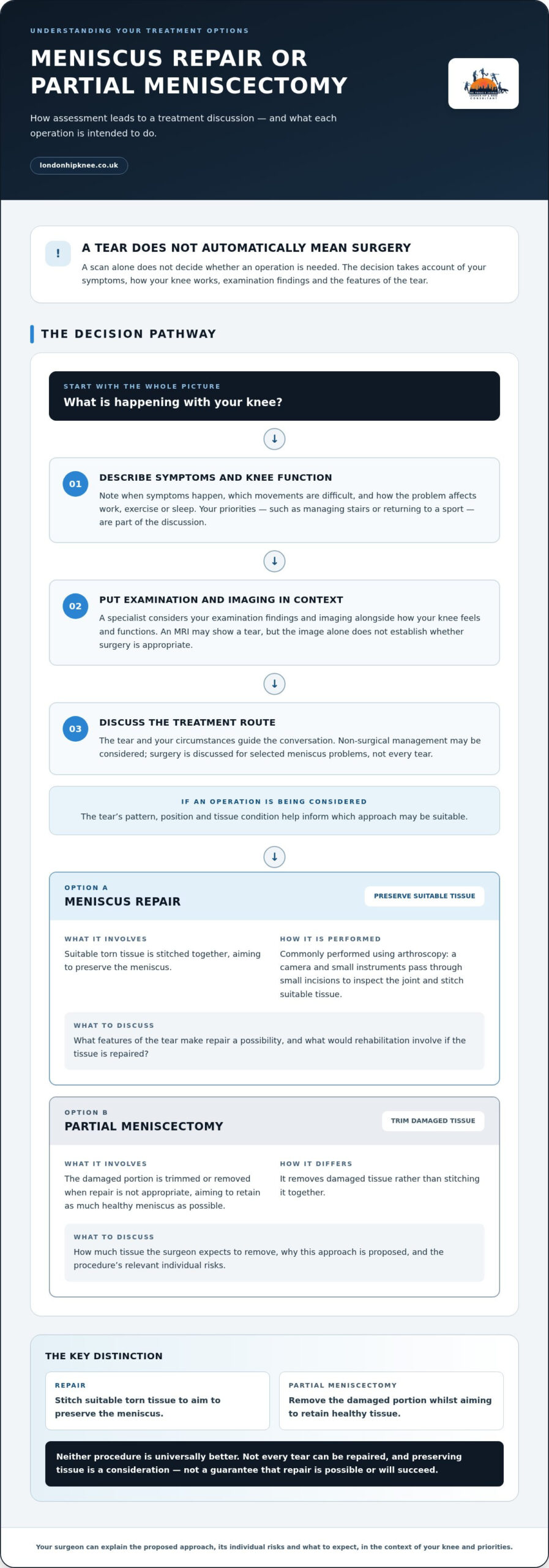
If surgery is being considered, the main distinction is whether the surgeon aims to stitch the torn tissue or remove the damaged portion. Repair aims to preserve suitable meniscal tissue. Partial meniscectomy trims away tissue that cannot appropriately be repaired, whilst aiming to retain healthy meniscus. The tear’s pattern, position and tissue condition all influence which approach may be suitable.
Preserving meniscal tissue may help maintain its role in cushioning the knee and distributing load across the joint. This is one consideration in treatment planning, not a guarantee that repair is possible or will succeed in every case.
| Consideration | Meniscus repair | Partial meniscectomy |
|---|---|---|
| What it does | Stitches suitable torn tissue together, aiming to preserve the meniscus. | Trims or removes the damaged portion whilst aiming to retain healthy tissue. |
| What may influence it | Tear pattern, location and tissue condition affect whether repair is appropriate. | May be considered when the damaged area is not suitable for repair, following assessment. |
| Useful question | What features of my tear make repair a possibility? | How much tissue would you expect to remove, and why? |
| Discussion point | What would rehabilitation involve if the tissue is repaired? | What should I understand about the proposed procedure and its risks? |
What happens during meniscus repair?
Repair is commonly performed using arthroscopy, or keyhole surgery. A camera and small instruments are passed through small incisions so the surgeon can inspect the joint and stitch suitable torn tissue. Not every tear can be repaired. Its shape, position and the condition of the meniscus help determine whether stitching is a reasonable option. Your surgeon can explain how these factors apply to your knee.
What happens during partial meniscectomy?
In a partial meniscectomy, the surgeon trims away the damaged part of the meniscus when repair is not appropriate, whilst aiming to leave as much healthy tissue as possible. The purpose differs from repair: it removes unstable or damaged tissue rather than stitching it together. Neither procedure is universally better. Before you consent, your surgeon should explain the planned approach, relevant individual risks and what to expect afterwards.
Ask how the recommended option relates to your tear, which alternatives have been considered and how the procedure may shape rehabilitation. The plan should reflect your knee and priorities, not simply the name of the operation. If you’re considering meniscus surgery in London, a specialist consultation can help clarify the reasoning behind the proposed approach.
Meniscus surgery or non-surgical care: how the decision is made
Choosing between non-surgical care and an operation is not a decision made from an MRI report alone. Non-surgical management aims to address symptoms and help you maintain or improve knee function without an operation. Meniscus surgery aims to treat selected damage directly, but also involves the considerations and recovery associated with an operation. The right balance depends on your knee and what matters to you.
A tear on a scan may not explain every symptom. Your specialist will interpret imaging alongside your account of the problem and clinical examination, then discuss how the findings fit together. You can weigh the options with the surgeon rather than assuming that a scan or a single symptom has already decided the answer.
What factors influence a treatment recommendation?
The assessment may consider the tear’s pattern, location and tissue quality, as well as pain, swelling, movement and how your knee performs in daily life. Other knee findings can matter too. For example, the discussion may differ depending on whether your main difficulty is walking comfortably, managing work tasks or returning to an activity involving turning or bending.
Your priorities help shape the conversation. A treatment plan needs to take account of what you hope to do, how symptoms affect you and which trade-offs you’re prepared to consider. After reviewing your case, the surgeon can explain which options may be relevant and why, including non-surgical care where appropriate. Use these points to organise a discussion, not to diagnose yourself or select an operation.
What should you weigh before consenting to surgery?
Before deciding, ask what the proposed procedure is intended to achieve in your situation, what limitations it may have and which risks are relevant to you. Discuss alternatives, including continuing with non-surgical management where appropriate. You can also ask what recovery may involve and how it could affect work, home responsibilities and usual activities.
Taking notes or bringing someone with you may help, particularly if you have several questions. Consider asking:
- How do my symptoms and examination findings relate to the MRI?
- What are the expected benefits and important limitations of the recommended approach?
- What alternatives are reasonable, and what might influence the choice between them?
- What should I expect during recovery, and when will progress be reviewed?
Keep the scale of the proposed treatment in perspective. Meniscus surgery addresses selected tissue within the knee, whereas knee replacement surgery is a different operation involving replacement of joint surfaces. Understanding the distinction can help you clarify what your surgeon is proposing and why.
Meniscus surgery and recovery: what to expect at each stage
Knowing the broad stages can make planning more manageable, but your care plan should reflect the proposed operation and your health. Recovery guidance varies by procedure and patient, so your surgeon’s instructions are more useful than a generic timeline.
- Assessment and planning. Your surgeon reviews your symptoms, examination findings and imaging, then explains the proposed procedure and care plan. Discuss regular medicines, health conditions, work and caring responsibilities that may affect preparation or recovery.
- The procedure. Meniscus surgery is often performed arthroscopically, using a camera and instruments through small incisions. The anaesthetic, procedure details and whether care is arranged as a day case depend on your individual plan.
- Early recovery. After the operation, your team monitors you and provides guidance for the initial period at home. Advice on movement, wound care and pain relief is tailored to your procedure and circumstances.
- Rehabilitation. Your recovery plan may include exercises and a gradual return to everyday movement. The pace and restrictions can differ, particularly between repair and partial meniscectomy.
- Follow-up. Review appointments allow your clinical team to assess progress, discuss concerns and guide the next steps, including activity progression where appropriate.
What happens on the day of arthroscopic surgery?
Before the operation, the team reviews your plan and completes the relevant pre-operative checks. During arthroscopy, a camera helps the surgeon view inside the knee while instruments are used to carry out the planned procedure. Afterwards, you move into initial recovery, where your condition is monitored and aftercare guidance is provided. The anaesthetic, timing and discharge arrangements vary, so follow the specific instructions given to you.
How is recovery planned after meniscus surgery?
Your surgeon and clinical team will explain how to manage movement, wounds and discomfort, and when follow-up is planned. A repair may need a different rehabilitation approach from trimming damaged tissue because the treatment and healing considerations differ. Your return to work, driving and sport depends on the operation, your progress and the demands of each activity. Follow your team’s advice rather than using general online timelines to set your own pace, and raise any concerns with them.
Before your procedure, consider practical arrangements at home and ask what help you might need in the early stages. Preparing practical aids or recovery supplies in advance, including exploring specialist rehabilitation platforms such as fivestep.com.hk, can make managing daily routines much simpler. Clarify activity restrictions, how to take prescribed pain relief and whom to contact if you’re unsure about your instructions. Having this information in advance can help you focus on recovery rather than making avoidable decisions at short notice.
For a plan shaped around your knee and the procedure being considered, discuss meniscus surgery options with a specialist.
Planning meniscus surgery with a London knee specialist
A specialist consultation is an opportunity to understand what may be causing your knee symptoms and which options could fit your circumstances. Mr Parag Jaiswal is a Consultant Orthopaedic Surgeon with over 18 years as a medical professional. During a consultation, symptoms, examination findings and imaging are considered together, alongside the activities and goals that matter to you. A scan is part of the assessment, not a decision on its own.
Preparing a few notes can help you explain the problem clearly and make time for questions. You may find it useful to bring:
- A concise symptom history: when the problem began, how it has changed and which movements or activities affect your knee.
- Relevant reports and details: imaging reports, a list of medicines you take and information about previous treatment.
- Your priorities and questions: daily limitations, activities you hope to return to and anything you’d like clarified about treatment.
What should you bring and discuss at a consultation?
Include practical details, such as whether pain affects stairs, work tasks or sleep, and what you’ve already tried to manage it. This helps the specialist understand the impact beyond the scan. You can ask what the assessment suggests, whether meniscus surgery is among the options and what alternatives may suit your case.
How does specialist planning support an informed decision?
A proposed care plan should reflect clinical findings and your circumstances, rather than follow a one-size-fits-all pathway. The specialist can explain the aims and limitations of relevant options, the risks to consider and what the next steps would involve. If an operation is discussed, ask how the approach relates to your knee and what recovery planning may mean for your routine.
You don’t need to make every decision during the first conversation. Take time to consider the information, note anything you’d like explained further and make sure you understand the reasoning behind the recommendation. A clear discussion should help you weigh the choices in the context of your health, commitments and personal goals.
For specialist assessment in London, explore meniscus surgery care in London and consider what you’d like to discuss about your knee.
Take your next step with greater clarity
You don’t need to arrive at a consultation with a decision already made. Start by identifying what you most want help with: understanding your scan, managing a particular daily limitation or finding out how treatment could affect an activity that matters to you. Sharing that priority can keep the discussion focused on your life as well as the image of your knee.
If meniscus surgery is being considered, take time to understand the reasoning, alternatives and practical implications before deciding. Clear answers can help you weigh the options, even if the right path is not surgery.
For a specialist discussion about your knee in London, explore specialist meniscus surgery care in London and arrange a consultation with London Hip & Knee Consultant.
Frequently Asked Questions
Can a meniscus tear heal without surgery?
Yes, some meniscus tears can be managed without an operation, but the right approach depends on your symptoms, examination findings, the tear and your circumstances. An MRI report should not be used on its own to decide whether surgery is needed. Tell your clinician which movements cause difficulty and how the problem affects your routine, then ask how the scan findings relate to those symptoms and which non-surgical options may be appropriate.
Is meniscus surgery keyhole surgery?
Meniscus surgery is commonly performed arthroscopically, using a camera and instruments passed through small incisions. The specific procedure and approach depend on the problem being treated and your knee. Ask your surgeon what they propose, why that approach is being considered, and which alternatives or risks apply to you. General information can help you prepare, but it cannot replace advice based on your own assessment.
How long does it take to recover from meniscus surgery?
Recovery varies according to the procedure, your knee and your progress, so one timeline will not fit everyone. Repair and partial meniscectomy can involve different rehabilitation needs. Before the operation, ask your surgeon or rehabilitation team how progress will be reviewed and what milestones will guide activity. If you need to plan work, driving or sport, discuss each separately rather than assuming they will all resume at the same stage.
Can I drive after meniscus surgery?
Do not assume you’ll be able to drive straight after surgery. Pain, movement, medication and the procedure itself can affect whether you’re ready to drive safely. Ask your treating team for advice that reflects your recovery, and check your motor insurer’s conditions before returning to the road. Planning a lift or other transport in advance can reduce pressure to drive before you’re ready.
Will meniscus surgery prevent arthritis in my knee?
No operation should be regarded as a guaranteed way to prevent arthritis. Surgery is intended to address a particular meniscus problem, but it cannot promise what your knee’s long-term condition will be. Ask your surgeon which symptoms or findings the proposed procedure aims to address, what its limitations are and whether other factors in your knee may affect future care.
Can meniscus surgery be combined with ACL reconstruction?
Sometimes both procedures may be considered for injuries affecting the meniscus and anterior cruciate ligament, but the plan depends on the specific findings. Your surgeon will assess the tear, ligament injury and knee stability before discussing whether procedures should be combined or sequenced. If both injuries appear on your scan, ask how each affects the treatment plan and rehabilitation, including any differences in activity guidance as you recover.