

Could the right next step for your knee be a clear assessment rather than an immediate decision about surgery? If pain, stiffness, swelling or instability is affecting your daily life, it can be difficult to know whether to wait, seek advice or explore treatment. A knee doctor can assess your symptoms, consider what may be causing them and explain which options may fit your situation.
It’s understandable to feel unsure about what a specialist appointment involves or whether an examination or scan will lead to treatment. A useful consultation starts with your symptoms, movement and medical history, then relates any suggested next steps to your individual circumstances rather than following a one-size-fits-all plan.
This guide explains when to seek a specialist assessment in London, what to expect during a consultation and how investigations may help clarify a diagnosis. It also outlines how knee care can range from non-surgical options, such as Arthrosamid injections, to procedures including knee arthroscopy, meniscus surgery, ACL reconstruction and knee replacement. At London Hip & Knee Consultant, adult knee care is led by Consultant Orthopaedic Surgeon Mr Parag Jaiswal, who has been a medical professional for over 18 years. The aim is to help you understand practical next steps for your knee problem.
Key Takeaways
- A knee doctor can assess persistent pain, reduced movement or symptoms after an injury and help clarify whether specialist care may be appropriate.
- Sharing when your symptoms began, what affects them and how they limit daily activities gives useful context for an assessment.
- Non-surgical care and procedures have different purposes. The diagnosis and your individual needs help determine which options are relevant.
- Before deciding, understand the potential benefits, limitations, alternatives and recovery considerations for each option.
- Mr Parag Jaiswal’s adult knee care includes Arthrosamid injections and procedures such as knee replacement, ACL reconstruction, arthroscopy and meniscus surgery.
What does a knee doctor do and when to see one in London?
A knee doctor assesses problems affecting the knee, works towards identifying their cause and discusses appropriate care with you. They consider symptoms such as pain, stiffness or reduced movement alongside how your knee functions. This focused assessment differs from general musculoskeletal care, which may cover a wider range of bones, joints and muscles. The right starting point depends on your symptoms and circumstances.
During a specialist consultation, the focus is your particular concern: what you can and can’t do, how the symptoms began and whether they are changing. The assessment can help establish whether further investigation or a treatment discussion is appropriate. Seeing a specialist does not mean surgery is inevitable. Similar symptoms can have different causes, so avoid assuming a diagnosis based only on how your knee feels or on information online.
Which knee problems can a specialist assess?
An adult knee specialist can assess joint pain, suspected arthritis and symptoms following sports or other injuries. Pain, swelling or a feeling that the knee may give way can have several explanations. An ACL injury or meniscus problem may be considered, but these are possibilities for clinical assessment, not conditions you can confirm from symptoms alone. Explain how the problem affects activities such as walking, using stairs or exercising to help put it in context.
Assessment can also clarify which options may be relevant to the problem identified. These may include non-surgical care, Arthrosamid injections or procedures such as knee arthroscopy, meniscus surgery, ACL reconstruction or knee replacement. Each has a different purpose, and suitability depends on the individual diagnosis. For background on one possible procedure, Knee replacement surgery involves replacing damaged joint surfaces. Whether it is relevant is a separate clinical decision.
When is a knee assessment worth considering?
Consider seeking clinical advice if knee pain persists, movement is becoming more limited or symptoms are making everyday activities difficult. Recurring instability, worsening symptoms or problems that return when you resume normal activities also merit individual attention. There is no single time threshold that applies to everyone; the effect on your mobility and daily life matters.
Before an appointment, note when the symptoms started, whether there was a particular incident, which movements make them better or worse, and what you have already tried. These details give the specialist a clearer picture, especially if your knee feels different from day to day. If an injury is involved, describe what happened and any changes in swelling, movement or confidence using the joint.
Adults seeking focused knee care in London can see a consultant orthopaedic surgeon whose practice centres on hip and knee conditions. Mr Parag Jaiswal has been a medical professional for over 18 years. An assessment can help you understand what may be contributing to your symptoms and consider next steps without assuming in advance that a particular treatment is right for you.
How does a knee doctor assess pain, injury or limited movement?
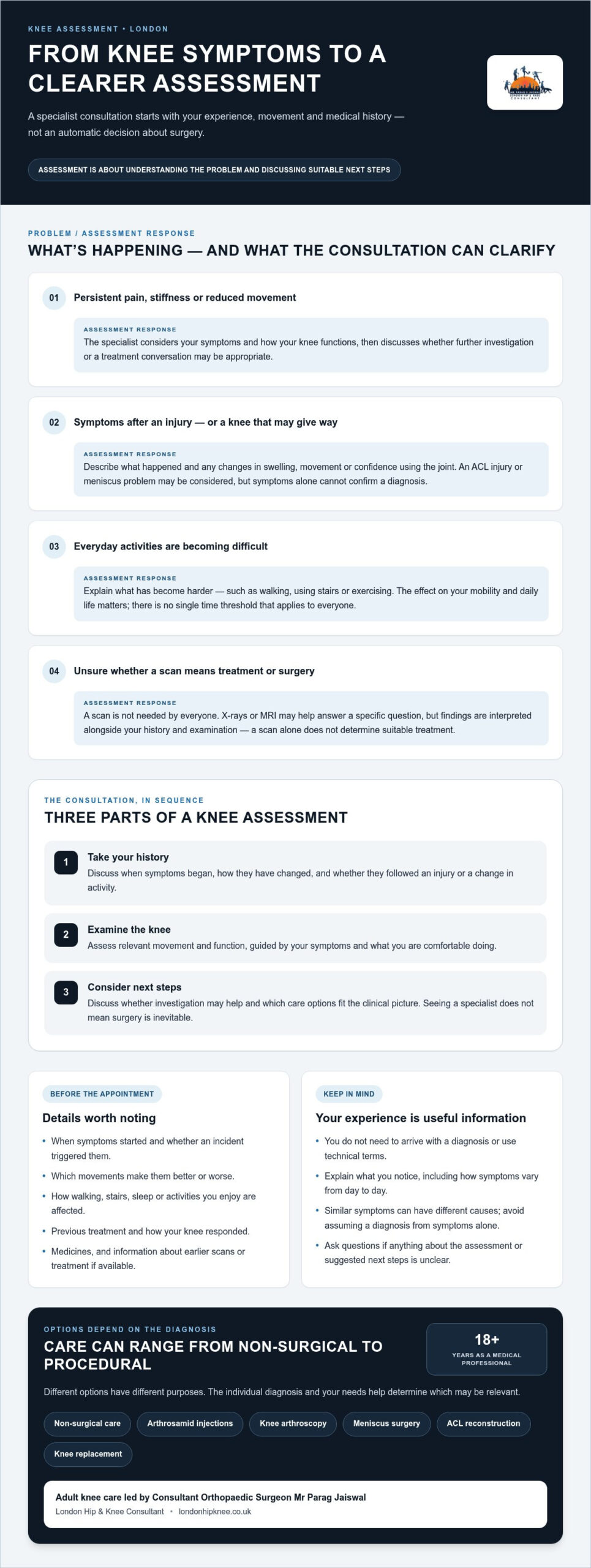
A knee assessment combines a conversation with an examination. It is not simply a decision about whether you need a scan or procedure. Your knee doctor builds a picture of the problem, considers how it affects your movement and uses the findings to discuss appropriate next steps. The assessment may include:
- Taking your history: discussing when symptoms began, how they have changed and whether they followed an injury or a change in activity.
- Examining the knee: assessing relevant movement and function, guided by your symptoms and what you are comfortable doing.
- Considering next steps: explaining whether further investigation may help and discussing care that fits the clinical picture.
Investigations such as X-rays or MRI scans can provide information about structures within the knee. Their findings need to be interpreted alongside your history and examination: a scan alone does not establish the full clinical picture or determine which treatment is suitable. Not everyone needs imaging. A clinician may suggest it if it could answer a specific question or help guide a decision.
What should you tell the knee doctor?
Before your appointment, think about when the problem started, whether anything seemed to trigger it and what makes it worse or eases it. Describe the practical effects. For example, walking, climbing stairs, sleeping comfortably or returning to an activity you enjoy may have become harder. Mention any previous treatment and how your knee responded. These details help the clinician understand your experience, not just where it hurts.
Bring a list of medicines you take and relevant information about earlier scans or treatment, if available. You do not need to arrive with a diagnosis or use technical terms. A straightforward account of what you notice is useful, and you can ask questions if anything is unclear. For general background on knee pain and self-care, the NHS guide to knee pain may help you prepare, but it cannot assess your individual symptoms.
Might I need an X-ray or MRI?
That depends on your symptoms, examination and the clinical question. Imaging is not automatically required at every consultation. The clinician will consider whether a test is likely to add useful information. If a scan is discussed, ask what it may help clarify and how the result could influence the options being considered. An image should be understood in context, not treated as a diagnosis on its own.
The consultation should leave you with a clearer understanding of what has been assessed and what may happen next, whether that means discussing care options or considering further investigation. If you are seeking an adult knee assessment in London, you can explore specialist knee care with London Hip & Knee Consultant.
How can you compare knee-care options after your assessment?
Different treatments have different aims. An injection may be discussed as a non-surgical option, while an operation may be considered for a specific joint or structural problem. Neither approach is automatically right for everyone. Your assessment, diagnosis, symptoms, day-to-day priorities and preferences all matter. A knee doctor can explain how an option relates to your circumstances, including its potential benefits, limitations and alternatives.
Use the overview below to frame questions, not to choose treatment without clinical advice. The same symptom, such as pain when walking, may arise from different knee problems, and similar diagnoses can affect people differently. Ask what a suggested treatment is intended to address and why it may or may not suit you.
Option
General purpose
Why individual advice matters
Arthrosamid injection
A non-surgical injection option for knee osteoarthritis.
Suitability depends on your clinical assessment and circumstances.
Knee replacement
Replaces the affected joint surfaces.
A specialist can discuss whether this relates to your diagnosis and needs.
Knee arthroscopy
A procedure used to assess or treat certain problems within the knee.
The reason for considering it depends on the specific problem.
ACL reconstruction or meniscus surgery
Addresses particular ligament or meniscus concerns.
Assessment is needed to understand the injury and relevant options.
When might non-surgical care be discussed?
For an adult with knee osteoarthritis, Arthrosamid may be discussed as an injection option that does not involve surgery. Whether it is appropriate depends on the clinical findings and your individual situation. Ask what the treatment is intended to address, what limitations apply and what other approaches could be considered. An injection should not be assumed to provide the same degree or duration of relief for everyone, and a discussion does not establish that you are a suitable candidate.
When might a knee procedure be discussed?
Procedures address different problems. Knee replacement concerns the joint surfaces, while arthroscopy relates to certain problems inside the knee. ACL reconstruction addresses an ACL ligament injury, and meniscus surgery concerns a meniscus problem. These descriptions are broad. Your diagnosis and priorities guide whether a procedure is relevant, not the name of a symptom alone. Recovery considerations and alternatives are also part of an informed discussion.
If replacement is raised, the article Knee Replacement London: Expert Surgical Guide and Specialist Care 2026 offers further context on that pathway. For any option, ask what it aims to achieve, what uncertainties remain and how it fits with the activities that matter to you. The goal is a considered decision based on your needs, not choosing the most or least invasive treatment by default.
What should you consider before choosing a knee doctor?
A useful consultation should leave you with a clearer understanding of what may be causing your knee symptoms and why particular options are being discussed. Look for relevant knee expertise, explanations you can follow and a treatment conversation that relates to your assessment, diagnosis and priorities. The aim is not to be offered a procedure by default; seeing a knee doctor does not mean surgery is inevitable.
For adults in London, Mr Parag Jaiswal is a Consultant Orthopaedic Surgeon whose practice focuses on hip and knee conditions. He has been a medical professional for over 18 years. Knee care includes both non-surgical injection therapy and procedures, so options can be discussed in relation to the problem being assessed rather than assuming one pathway suits everyone.
What questions can help you understand your options?
Ask what the assessment suggests, which options may be relevant and what each is intended to address. A clear conversation should also cover potential benefits, limitations, risks and recovery considerations, including how these might affect your everyday activities. If a term or recommendation is unclear, ask for it to be explained in plain language.
Shared decision-making is a conversation, not a promise that you will receive a particular treatment. Your preferences matter alongside the clinical findings. For example, explain which activities you hope to return to and any concerns you have about recovery. You can then consider whether a proposed approach fits your needs and whether alternatives should be discussed.
How can you prepare for a specialist consultation?
A few notes can help you make good use of the appointment. Write down when symptoms began, what affects them and how they change your walking, sleep or preferred activities. List your current medicines and relevant medical history, and bring previous scan reports or treatment information if available. These details connect the assessment with what you experience day to day.
If symptoms followed a sports injury, record what happened and any changes since, such as recurring instability or difficulty returning to activity. An ACL injury is one possible concern a clinician may assess, but symptoms alone do not establish the diagnosis. For more background on the surgical pathway, the guide ACL Surgery: A Guide to Reconstruction, Decisions and London Care explores reconstruction and related decisions.
Before finishing the consultation, make sure you understand the proposed next step and what it is based on. You do not have to make a treatment decision before your questions have been answered. Reviewing the practice’s knee-care information can also help you understand the options that may be discussed, from Arthrosamid injections to ACL reconstruction, arthroscopy, meniscus surgery or knee replacement.
Explore adult knee-care options in London to learn more about specialist assessment and treatment pathways.
How can Mr Parag Jaiswal help with knee care in London?
Mr Parag Jaiswal is a Consultant Orthopaedic Surgeon whose practice focuses on adult hip and knee conditions. He has been a medical professional for over 18 years. For adults looking for a knee doctor in London, this focused scope means knee symptoms can be assessed in the context of their effect on movement, daily routines and personal priorities.
The appropriate next step follows an individual assessment. Treatment options are not interchangeable, and a consultation does not mean you will be advised to have an operation. The discussion should relate the findings to the problem being considered, explain relevant choices and give you space to weigh them up.
Which knee services are relevant to the practice?
Knee care includes non-surgical injection therapy and surgical procedures. Arthrosamid is an injection option for knee osteoarthritis; whether it may be suitable depends on clinical assessment. Surgical options address different problems, so the name of a procedure alone cannot determine whether it is appropriate for you.
- Knee replacement may be discussed in relation to problems affecting the knee joint.
- Knee arthroscopy is a keyhole procedure used for selected problems within the knee.
- ACL reconstruction addresses an anterior cruciate ligament injury.
- Meniscus surgery relates to a problem involving the meniscus.
These descriptions are general, not treatment recommendations. Your symptoms, assessment findings and the nature of the knee problem help guide which options are relevant. A careful discussion should also consider your aims, such as managing discomfort or returning to activities that matter to you, without assuming a particular result.
What is a sensible next step if you are seeking a knee doctor?
Before an appointment, note what you want help with and which daily activities are affected. During the consultation, discuss your symptoms, what the assessment indicates and how each relevant option fits your priorities. Ask about potential benefits, limitations, risks and recovery considerations so you have a clearer basis for deciding what to do next.
London Hip & Knee Consultant is a London-based adult orthopaedic practice led by Mr Jaiswal. Its knee care includes Arthrosamid injections, knee replacement, ACL reconstruction, knee arthroscopy and meniscus surgery. The pathway is guided by individual assessment, rather than a presumption that one treatment suits everyone.
If you are ready to discuss your knee symptoms and possible next steps, explore knee care and arrange a consultation through the practice.
Take the next step towards clearer knee care
You do not need to have settled on a treatment before seeking advice. A thoughtful conversation can help you understand what your symptoms may mean, which options relate to your circumstances and what questions to consider before deciding how to proceed. If you are looking for a knee doctor in London, focus on getting clarity about your priorities, whether that means managing discomfort, moving more confidently or returning to an activity that matters to you.
Mr Parag Jaiswal is a Consultant Orthopaedic Surgeon who has been a medical professional for over 18 years. The practice’s adult knee care spans non-surgical options and surgical procedures, with the appropriate pathway guided by individual assessment rather than a guaranteed or assumed outcome.
Taking the next step can begin with sharing what you are experiencing and what you hope to understand. Explore knee care with Mr Parag Jaiswal and consider whether a specialist consultation could help you move forward with greater confidence.
Frequently Asked Questions
Can I see a knee doctor without having an MRI first?
Yes. An MRI is not always needed before an initial appointment. A knee doctor can first consider your symptoms and examine your knee, then decide whether imaging would help answer a specific clinical question. If you already have scan images or a report, bring them if available. You do not need to wait for a scan before seeking an assessment.
Do I need a GP referral to see a private knee doctor in London?
Not necessarily. Referral arrangements can depend on how you access private care and whether you plan to use health insurance. An insurer may require a GP referral for a claim, so review your policy requirements before booking. If you are paying privately, the route into a consultation may differ. Referral rules can also vary between services, so do not assume one process applies to every appointment.
Is a knee doctor the same as an orthopaedic surgeon?
Not always. “Knee doctor” is an informal term for a clinician who assesses knee problems, while an orthopaedic surgeon is a doctor specialising in conditions affecting the musculoskeletal system, including joints such as the knee. Some orthopaedic surgeons focus on knee care and can discuss assessment and surgical options. The title alone does not tell you the clinician’s specific area of practice, so look for relevant knee expertise.
Can a knee specialist assess a meniscus tear?
Yes. A knee specialist can assess symptoms that may relate to a meniscus problem, such as pain or difficulty moving the knee, and consider them alongside your history and examination. These symptoms can have other causes, so they do not confirm a tear by themselves. Depending on the clinical question, the specialist may consider imaging or discuss whether meniscus surgery is relevant to the findings.
Does seeing a knee doctor mean I will need surgery?
No. An appointment is an opportunity to understand your knee problem and consider suitable next steps, not a commitment to an operation. Depending on the assessment, the discussion may include non-surgical options such as Arthrosamid injections for knee osteoarthritis, as well as procedures where clinically relevant. Ask about alternatives, possible limitations and recovery, then take time to consider what fits your circumstances.
What should I bring to my first knee appointment?
Bring a list of your current medicines, relevant medical history and any previous knee scan reports or treatment information you have. It can also help to write down your main concerns, such as pain during a particular activity or difficulty using stairs, and note questions you want answered. You do not need to prepare a diagnosis; clear, everyday descriptions of what you are experiencing are useful.
Can a knee doctor help with osteoarthritis?
Yes. A knee doctor can assess symptoms that may be associated with osteoarthritis and discuss options in light of your individual situation. At London Hip & Knee Consultant, adult knee care includes Arthrosamid injections, a non-surgical option for knee osteoarthritis, and knee replacement surgery. These treatments have different roles, and an assessment helps determine which options may be appropriate to discuss.