
What if your ACL injury recovery time is better judged by what your knee can do than by a date on the calendar? It’s natural to want to know when you’ll walk comfortably, return to work or feel ready for sport. But recovery varies from person to person. Healing without surgery also differs from rehabilitation after ACL reconstruction, so one timeline won’t fit everyone.
Progress depends on the injury, any associated damage to the knee and how movement and strength return. Returning to sport too soon may put your knee at risk, while losing fitness during recovery can also be a concern. The aim is steady progress, guided by functional milestones rather than pressure to meet a fixed deadline.
This stage-by-stage guide explains what can shape recovery, how clinicians assess progress and why returning to sport takes more than feeling better. It also covers when a specialist assessment may help clarify the injury and discuss suitable treatment options, including whether ACL reconstruction may be appropriate.
Key Takeaways
- Understand recovery as a process of easing symptoms and rebuilding movement, strength and confidence for everyday activities.
- Use this acl injury recovery time guide to see how assessment and rehabilitation may differ after an injury and after ACL reconstruction.
- Consider how associated meniscus damage, your usual activity demands and consistency with rehabilitation may influence individual progress.
- Compare the demands of daily activities, work, recreational exercise and pivoting sports when planning a return.
- Seek clinical advice if instability persists, everyday function is difficult to regain or you’re unsure what to do next.
ACL injury recovery time: what does recovery involve?
After an ACL injury, it’s understandable to wonder when your knee will feel normal again. The answer varies according to the injury, symptoms, treatment plan and activities you want to return to. The phrase acl injury recovery time can sound like a single countdown, but recovery involves more than waiting for pain to settle.
Recovery means working towards comfortable movement, improved strength and confidence using your knee in daily life. Early symptom improvement is encouraging, but it doesn’t necessarily mean your knee is ready for every demand. Walking around the house, managing stairs, doing a physically demanding job and changing direction during sport each place different demands on the joint.
Your treatment pathway matters, too. Rehabilitation after an ACL injury managed without surgery differs from rehabilitation after ACL reconstruction, which involves recovery from the operation as well as restoring knee function. A calendar estimate provides context, but it can’t determine whether you’re ready to progress. Clinical assessment and functional progress help guide decisions.
What does ACL recovery time mean?
ACL recovery is an individual, staged process of improving symptoms, movement, strength and confidence for the activities that matter to you. Feeling better is not the same as being able to manage progressively more challenging tasks. Everyday movement may return before the strength, control and confidence needed for pivoting sport. Progress should reflect your goals, not a deadline alone.
After reconstruction, rehabilitation supports recovery from surgery and the gradual rebuilding of function. For general background on the procedure and its rehabilitation phases, see this overview of ACL reconstruction surgery. Your own plan should be guided by your clinical team, rather than copied from a general timeline.
Does an ACL injury always require surgery?
No. ACL reconstruction is one possible treatment, not an automatic requirement for every ACL tear. The decision depends on your symptoms, clinical findings, activity goals and knee function. Some people discuss non-surgical management with their clinical team, while others may consider reconstruction if instability or their desired activities make it appropriate.
An assessment can help clarify the injury and discuss suitable options. If you’re unsure whether surgery is relevant to you, ask how each approach relates to your daily activities and longer-term goals. The next step should reflect your knee and priorities, not an assumption about what every ACL injury requires.
ACL injury recovery timeline: how progress may unfold
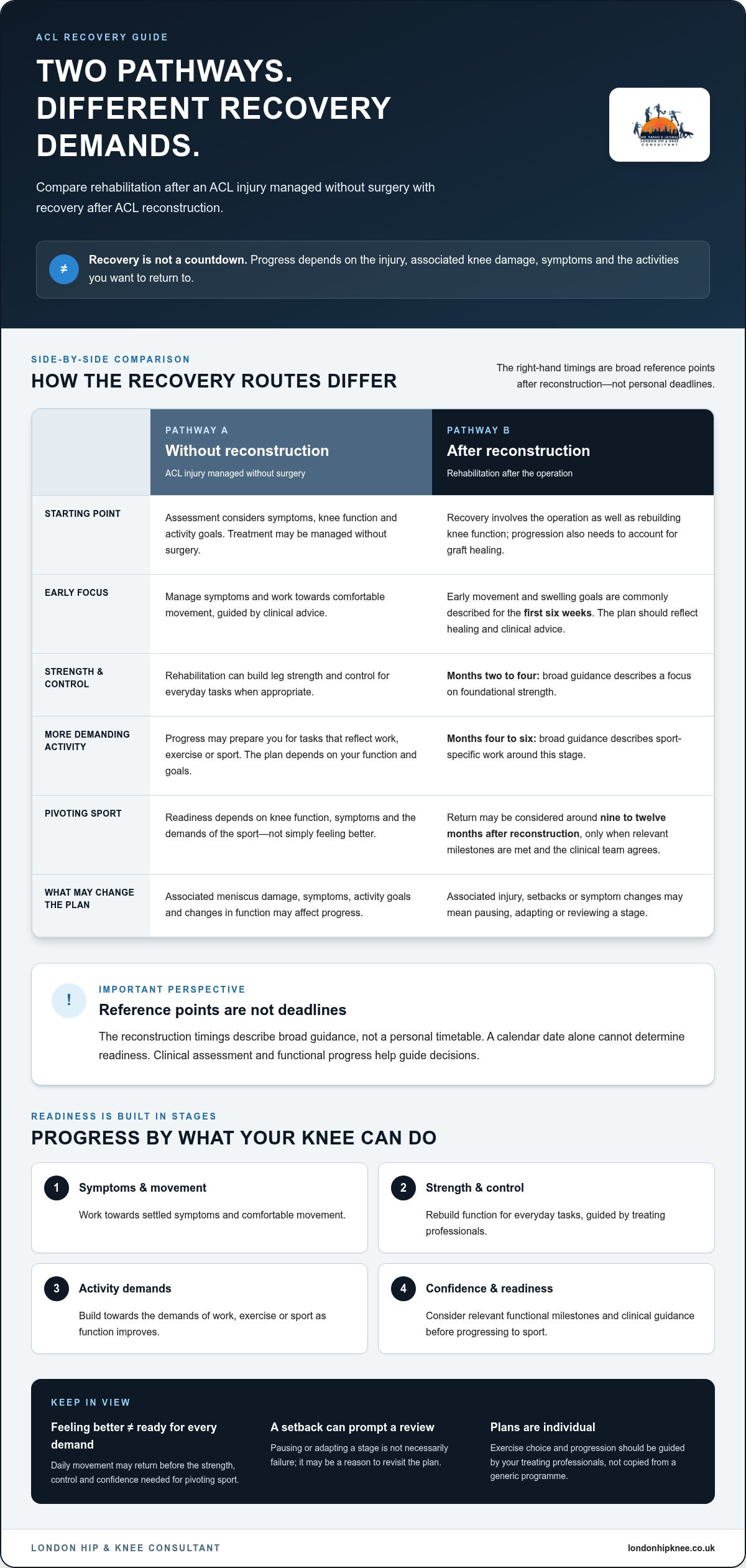
There isn’t one sequence that suits everyone. An ACL injury managed without surgery and recovery after ACL reconstruction have different starting points. A meniscus injury or other complication may also change the plan. The outline below describes common goals, not a personal timetable. Your clinical team can advise how to progress safely.
- Assessment and early care. A clinician assesses your knee, symptoms and functional difficulties to clarify the injury and discuss suitable options. Swelling, pain and reduced confidence can affect movement at first. If symptoms are severe or worsening, or you’re having significant difficulty using the leg, seek prompt medical assessment.
- Settle symptoms and restore comfortable movement. The early aim is to manage symptoms and gradually regain comfortable movement, guided by clinical advice. This stage applies whether surgery is being considered or not, but the recommended approach may differ according to your injury and treatment pathway.
- Build strength and control. When appropriate, rehabilitation can progress towards strengthening the leg and improving control for everyday tasks. After reconstruction, progression follows surgery and needs to account for healing. Exercise selection and progression should be supervised or guided by your treating professionals, rather than copied from a generic programme.
- Prepare for more demanding activity. As function improves, rehabilitation may build towards tasks that reflect work, exercise or sport. After ACL reconstruction, broad guidance commonly describes early movement and swelling goals in the first six weeks, foundational strength during months two to four, and sport-specific work around months four to six. These are reference points, not deadlines.
- Consider return to sport against criteria. For pivoting sports, a calendar date alone isn’t enough. Return may be considered around nine to twelve months after reconstruction, but only when relevant strength and functional milestones are met and the clinical team agrees. Graft healing takes time; effort alone can’t replace it.
How the pathways differ
Without reconstruction, rehabilitation focuses on restoring function and managing symptoms around the ACL injury. After reconstruction, the knee must also recover from surgery while the graft heals, so progression towards sport generally requires particular care. Associated injuries, setbacks or changes in symptoms may mean pausing, adapting or reviewing a stage. That isn’t necessarily failure; it may be a reason to revisit the plan.
Confidence matters alongside physical testing. Fear of reinjury can affect readiness to progress, and research into psychological factors in ACL recovery explores this part of rehabilitation. Discuss concerns with your clinical team rather than feeling you must push through them.
If you’re unsure which pathway fits your symptoms and goals, a specialist ACL assessment in London may help clarify the injury and treatment options.
What affects ACL recovery time and why is progress different?
Two people can have an ACL injury and follow very different recovery paths. The acl injury recovery time depends on more than the ligament: other knee structures, the treatment chosen and the activities a person hopes to resume also matter. A slower spell doesn’t automatically mean rehabilitation has failed. Symptoms and function can fluctuate, and the plan may need adjusting.
How injury severity and associated damage can matter
An assessment considers the whole knee, not just the ACL. The clinician looks at your symptoms, movement and stability, and whether other structures may also be affected. A meniscus injury, for example, can occur alongside an ACL injury, but it shouldn’t be assumed without assessment. Pain or swelling alone can’t reliably show the full injury pattern or predict how long recovery will take.
The treatment pathway matters, too. Rehabilitation without reconstruction has different considerations from recovery after surgery, and any associated injury may influence the recommended plan. Your clinician can explain what the findings mean for your options and goals, rather than estimating recovery from one symptom or scan result in isolation.
How treatment goals and rehabilitation shape progress
What you need your knee to do makes a difference. Restoring confidence for walking and daily tasks is not the same as returning to work involving repeated lifting or to a sport with rapid turns and changes of direction. Higher-demand activities call for greater strength, control and confidence, which can be considered as part of rehabilitation.
Your starting point can also shape the work involved. Existing strength, general health, usual activity level and how consistently you can follow the agreed rehabilitation plan may all influence progress, though none can predict an individual outcome on its own. A clinician can help adapt goals and progression to your circumstances.
Pain settling is welcome, but it doesn’t prove your knee is ready for demanding activity. Progress is judged in context, including how your knee responds to increasing tasks and whether relevant functional goals are being met. If discomfort, swelling or instability changes, tell your treating team. They can advise whether to modify activity or reassess the plan.
“There is no single average that can predict your ACL recovery; individual assessment matters because the injury, treatment pathway and goals are different for each person.”
Returning to work, daily activities and sport after an ACL injury
Getting back to one activity doesn’t automatically mean your knee is ready for another. Walking around the home, sitting at a desk and changing direction at speed place very different demands on your knee. A practical return plan considers what you need to do, how your knee responds and your clinical team’s advice.
| Activity | What may affect the decision |
|---|---|
| Daily activities | Comfort with routine movement, such as walking and using stairs, and how the knee responds as activity increases. |
| Work | Whether your role is mainly desk-based or involves prolonged standing, lifting, kneeling or moving quickly. |
| Recreational exercise | The type and intensity of exercise, and whether you can manage it with appropriate control and confidence. |
| Pivoting sport | Strength, movement control, confidence and readiness for turning, acceleration and deceleration. |
When can I return to everyday activities or work?
There’s no single date that applies to everyone. Desk-based work may place different demands on your knee from a role involving repeated lifting, prolonged standing or moving across uneven ground. Consider the tasks you’ll actually need to perform, not just your job title, and discuss possible adjustments and progression with your clinician.
Driving also needs individual consideration, particularly after surgery or if knee movement is limited. Follow your clinician’s guidance on driving and work rather than relying on a general recovery estimate. The right advice depends on your circumstances and knee function.
How is readiness to return to sport assessed?
Decisions about returning to sport call for more than reduced pain. A clinical assessment may consider strength, movement control, confidence and how well your knee manages tasks relevant to your sport. Returning to gentle recreational exercise is not the same as resuming a sport involving sudden stops, jumps or changes of direction.
Elapsed time alone can’t confirm readiness. Don’t use a self-test or a good day as clearance to return. Discuss your progress with your treating team, who can advise whether further rehabilitation or assessment is needed. If you’re exploring reconstruction and treatment choices, the ACL surgery guide may help you prepare questions for that discussion.
If you’d like to discuss whether ACL reconstruction may suit your goals, seek a specialist ACL assessment.
When to seek ACL advice and plan your next recovery step
If your knee continues to feel unstable, you’re struggling to regain everyday function or you’re unsure how to progress, clinical advice can help clarify what to do next. Consider seeking advice if symptoms affect work, normal activities or plans to return to sport. The acl injury recovery time can’t be judged reliably from a calendar estimate alone; an assessment can put your symptoms and goals in context.
A routine specialist assessment is different from urgent care. If symptoms are severe, rapidly worsening or causing major difficulty using your leg, seek prompt medical advice through appropriate NHS or emergency services. London Hip & Knee Consultant provides specialist adult knee care, including ACL reconstruction, but does not provide emergency trauma care.
What should I discuss at an ACL assessment?
Describe how the injury happened, what you feel now and which activities have become difficult. Mention any episodes of the knee giving way, swelling or changes in your ability to walk, work or exercise. Be clear about your goals, whether that means managing daily tasks comfortably or returning to a particular sport.
You can ask what the assessment suggests about the ACL and whether other structures, such as the meniscus, may also be involved. Ask which treatment options may suit your circumstances and what each could mean for your goals. Imaging decisions depend on clinical assessment. A scan may be considered if it could help clarify the diagnosis or guide a treatment discussion.
When might ACL reconstruction be considered?
ACL reconstruction may be discussed for some people, but it isn’t required for every ACL injury. The decision depends on the injury, symptoms, knee function and the activities you hope to resume. Your clinician can explain whether reconstruction or a non-surgical approach is worth considering, and how the benefits and limitations relate to your situation. You can read more about the decision in this ACL surgery guide.
For a useful next step, bring your questions and activity goals to a specialist assessment. Mr Parag Jaiswal and the London Hip & Knee Consultant practice provide adult orthopaedic care in London, including assessment and discussion of ACL treatment options. The aim is to help you understand your choices and plan progression with appropriate clinical guidance, without assuming one treatment or timeline is right for everyone.
Take your next step towards confident movement
The acl injury recovery time isn’t a fixed deadline. Progress depends on the injury, whether treatment includes reconstruction and the activities you’re working towards. Focus on functional milestones: feeling better is encouraging, but returning to demanding work or pivoting sport also calls for strength, control and clinical guidance.
If instability persists, everyday function remains difficult or you’re unsure which treatment pathway fits your goals, an assessment can help clarify your options. ACL reconstruction may be appropriate for some people, but it isn’t necessary for every ACL injury. London Hip & Knee Consultant provides specialist adult hip and knee care in London, including ACL reconstruction and knee arthroscopy.
Discuss your ACL injury and treatment options with London Hip & Knee Consultant. With a clear plan and support suited to your circumstances, you can take recovery one considered step at a time.
Frequently Asked Questions
How long does it take to recover from an ACL injury?
ACL injury recovery time varies according to the injury, treatment pathway and activities you want to resume. With non-surgical management, returning to daily activities may take around three to six months, but this isn’t a guarantee or a guide to returning to sport. Pivoting sports place greater demands on the knee. Your clinician can assess progress against functional goals rather than relying on a date alone.
How long does ACL reconstruction recovery take?
Returning to pivoting sport after ACL reconstruction may take around nine to twelve months, provided relevant strength and functional milestones have been met and your clinical team agrees. Everyday activities may become manageable earlier, but recovery from surgery and graft healing take time. The sequence can vary, particularly if there are associated injuries or setbacks. Treat these timeframes as broad guidance, not a personal prediction or automatic clearance to play.
Can an ACL injury heal without surgery?
Yes, some people manage an ACL injury without reconstruction. A clinician can discuss this approach in light of your symptoms, knee function and activity goals. Rehabilitation may help restore strength and everyday function, but the best option depends on individual assessment. If you want to return to a sport involving cutting or pivoting, discuss its demands and risks with your clinical team. ACL reconstruction is a possible treatment, not a requirement for every tear.
What happens if I return to sport too soon after an ACL injury?
Returning before your knee is ready may increase the risk of another injury, particularly in sports involving pivoting, sudden stops or changes of direction. After reconstruction, the graft is still healing, and less pain doesn’t prove that strength and control have recovered. Don’t use a date or self-test as clearance. Ask your clinical team to assess your functional progress and advise when a gradual return is appropriate.
How do I know if my ACL injury is getting better?
Improvement may include symptoms settling and greater ease with everyday movement, but progress isn’t measured by pain alone. Your clinician may consider movement, strength, knee control and how you manage relevant tasks. Symptoms can fluctuate, and a good day doesn’t necessarily mean you’re ready for demanding activity. Track changes in symptoms and function, and discuss persistent instability or difficulty progressing with your treating team.
Do I need an MRI to diagnose an ACL injury?
Not everyone with a suspected ACL injury will need an MRI. A clinician first assesses your history, symptoms and knee function, then decides whether imaging could help clarify the diagnosis or identify associated damage. An MRI may be considered when it would inform treatment planning, but it isn’t a substitute for clinical assessment. If you’re unsure whether imaging is appropriate, ask what information it could provide and how the result might affect your care.
When should I see a specialist about an ACL injury?
Consider specialist advice if your knee repeatedly feels unstable, you’re struggling to regain function or you’re uncertain about treatment and returning to activity. An assessment can help clarify the injury, whether other structures may be involved and which options fit your goals. In London, London Hip & Knee Consultant provides specialist adult hip and knee care, including ACL reconstruction and knee arthroscopy. For severe or worsening symptoms, seek prompt medical care through appropriate services.