

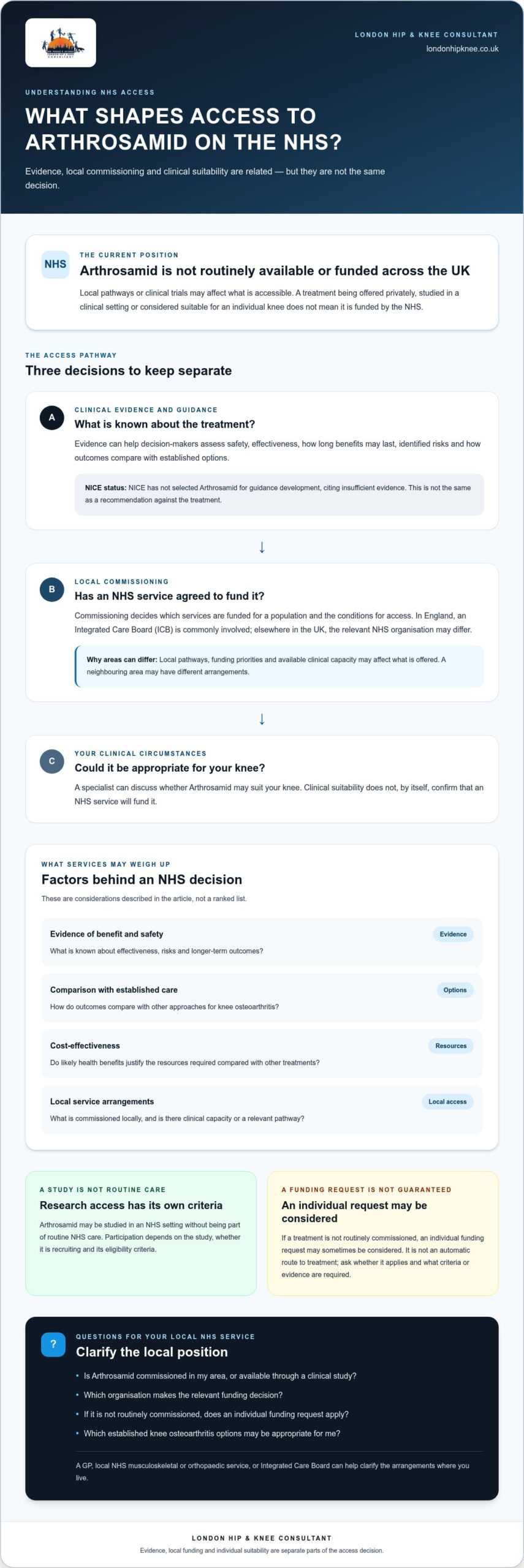
A promising treatment isn’t automatically an NHS option. As of October 2026, an arthrosamid injection nhs pathway isn’t routinely available or funded across the UK, although local pathways and clinical trials may affect what you can access. NICE hasn’t selected Arthrosamid for guidance development, citing insufficient evidence, so it isn’t currently recommended for routine NHS use.
It’s understandable to find this confusing. Access to treatments can depend on local NHS arrangements, and claims about a treatment’s benefits don’t necessarily mean it’s commissioned in your area. Your GP, local NHS musculoskeletal or orthopaedic service, or Integrated Care Board can help clarify the position where you live.
This article explains what NHS access looks like in 2026, what to ask your GP or orthopaedic specialist, and how to check whether a local pathway or trial is relevant. It also outlines established NHS options for knee osteoarthritis and practical next steps if Arthrosamid isn’t available to you. The aim is to help you have a clear, balanced conversation about care that suits your knee and circumstances.
Key Takeaways
- For the arthrosamid injection nhs question, check with your local NHS provider or Integrated Care Board, as local funding and service pathways matter.
- Separate evidence about potential benefit and longer-term outcomes from decisions about whether a treatment is commissioned.
- Compare Arthrosamid with established knee osteoarthritis options, and ask which approaches may suit your symptoms and diagnosis.
- Before speaking with a clinician, note your symptoms, previous treatments, daily limitations and relevant diagnoses.
- Private care in London is separate from NHS funding. A specialist assessment can help establish whether Arthrosamid may be appropriate for your knee.
Arthrosamid injection on the NHS: what does access mean for patients?
If you’re checking whether an arthrosamid injection nhs pathway is available, the answer is not always straightforward. As of October 2026, Arthrosamid is not routinely available or funded by the NHS across the UK. That doesn’t rule out every local arrangement or research study. However, you shouldn’t assume that a treatment offered privately, studied clinically or considered suitable for your knee will be funded by the NHS.
Osteoarthritis can cause pain and stiffness that affect everyday movement. For a general overview of the condition, see Osteoarthritis. Whether Arthrosamid might be clinically appropriate for you is a separate question from whether an NHS service commissions it.
Is Arthrosamid routinely available through the NHS?
At present, it isn’t a routine NHS treatment for knee osteoarthritis in the UK. NICE has not selected Arthrosamid for guidance development, citing insufficient evidence, and it is not currently recommended for routine NHS use. Research may still take place within NHS settings, but a clinical trial is not the same as a standard service. Participation depends on the study, its recruitment status and its eligibility criteria.
For a current answer about your area, ask your GP or local NHS musculoskeletal or orthopaedic service whether Arthrosamid is commissioned or available through a study. If they’re unsure, ask which organisation makes the relevant funding decision. Arrangements can differ across the UK, so confirm the local position rather than relying on what someone has been offered elsewhere.
What does “NHS access” mean in practice?
“Available on the NHS” usually means an NHS service provides a treatment as part of its commissioned care. In plain English, commissioning is the process of deciding which services are funded for a population and under what conditions. In England, an Integrated Care Board (ICB) is commonly involved in commissioning local NHS services. Elsewhere in the UK, the relevant NHS organisation may be different.
An individual funding request may sometimes be considered when a treatment isn’t routinely commissioned, but it isn’t an automatic route to treatment. Ask your clinician or local NHS service whether this process applies to Arthrosamid in your circumstances and what evidence or criteria are required.
In short: evidence that Arthrosamid is being studied or may help some patients does not establish that the NHS has commissioned it. If it isn’t funded locally, private treatment is a separate option and still requires a clinical suitability assessment. Confirm the NHS pathway first, then discuss appropriate next steps with your clinician.
Why might an NHS service not offer Arthrosamid injections?
There isn’t necessarily one reason. A service may consider the available evidence, how Arthrosamid compares with established care, whether benefits and risks are understood over time, and whether funding and clinical capacity allow it to be provided. The balance can differ between NHS areas, so a decision in one locality doesn’t automatically explain the position elsewhere.
How do evidence and guidance affect access?
Evidence helps clinicians and decision-makers judge whether a treatment is safe and effective for the people it may be offered to. For knee osteoarthritis, they may look beyond whether patients report improvement. They may also consider how long benefits last, what risks have been identified and how outcomes compare with established options. Longer-term follow-up can help answer questions about durability and safety. Uncertainty in the evidence doesn’t prove a treatment is ineffective; it means there may be questions decision-makers want answered.
As of October 2026, NICE has not selected Arthrosamid for guidance development, citing insufficient evidence. That is not the same as NICE issuing a recommendation against the treatment. The NHS Health Research Authority’s page on NHS research into Arthrosamid illustrates another distinction: a treatment can be studied within an NHS setting without being part of routine NHS care. Promising evidence alone does not guarantee routine NHS funding.
Decision-makers may also assess cost-effectiveness: whether the likely health benefits justify the resources required compared with other ways of treating knee osteoarthritis. This is separate from whether an injection can be delivered safely or may help an individual patient.
Why can access differ between NHS areas?
Local commissioning is the process of deciding which services are funded for a population and how patients can access them. Even where national guidance is unchanged, local service pathways, funding priorities and available clinical capacity may affect what is offered. Check the specific arrangements in your area rather than assuming that a neighbouring area has the same criteria or referral route.
If you’re asking about the arthrosamid injection nhs pathway, ask your GP or treating service who makes the relevant local decision, whether Arthrosamid is commissioned, and whether a clinical study is available. You can also ask which established options are appropriate while you clarify access. A specialist discussion may help you understand whether Arthrosamid could suit your knee, but clinical suitability doesn’t itself confirm NHS funding. If you’re considering a private assessment, you can read about specialist hip and knee care as a separate route, not a substitute for checking local NHS arrangements.
What does the evidence say about Arthrosamid compared with NHS options?
Arthrosamid is an injection of polyacrylamide hydrogel, a water-based gel intended to remain within the knee joint. It’s different from a corticosteroid injection, which aims to reduce inflammation and pain. The hydrogel isn’t a cure for osteoarthritis and shouldn’t be described as repairing damaged cartilage. Whether it may be suitable depends on your knee, symptoms and medical history.
Evidence needs to be considered in context. NICE’s decision on Arthrosamid was “Not selected” for guidance development in August 2023 because of insufficient evidence. This doesn’t establish that Arthrosamid is ineffective, but it does mean NICE has not developed guidance recommending its routine use. Comparisons between treatments should take account of the evidence available for each, its limitations and the person being treated. Responses to injections can vary.
How does it compare with other options?
There isn’t one injection that is best for everyone. NICE advises against offering hyaluronan injections for osteoarthritis. It says corticosteroid injections may be considered when other pharmacological treatments are ineffective or unsuitable, or to support therapeutic exercise, with the possibility of short-term relief. Arthrosamid has a different composition and proposed role, but evidence about one injection shouldn’t be treated as proof that it is superior to another.
What care may be available through the NHS?
NICE guidance for osteoarthritis includes tailored therapeutic exercise and, where relevant, support with weight management. Pain medicines may be considered alongside these measures, taking account of possible risks and individual circumstances. A clinician can discuss whether an injection or, for severe symptoms, knee replacement should be considered. The table summarises broad options, but actual provision and suitability need to be checked with your NHS service.
| Treatment | Purpose | Access route | Question to discuss |
|---|---|---|---|
| Exercise and rehabilitation | Support strength, movement and function | NHS care may include tailored advice or referral, depending on local services | What exercises are appropriate for my knee? |
| Pain-management options | Help manage symptoms alongside other care | Discuss with a clinician, who can consider benefits and risks | Which option is safe for me? |
| Corticosteroid injection | May offer short-term symptom relief | Considered after individual clinical assessment | What benefits and risks should I expect? |
| Hyaluronan injection | Injection proposed for osteoarthritis symptoms | NICE advises not to offer it for osteoarthritis | What alternatives does NICE recommend? |
| Arthrosamid | Polyacrylamide hydrogel injection for knee osteoarthritis | Not routinely NHS-funded; check local arrangements or private provision | What evidence applies to my situation? |
If you’re weighing up the arthrosamid injection nhs question, ask your clinician to explain how its evidence and access compare with established care in your area. The aim is an informed choice, not an assumption that one treatment will suit every knee.
How can you check NHS eligibility and prepare for a discussion?
There may not be a standard NHS eligibility route for Arthrosamid, so check what applies in your area rather than assuming you qualify or that no pathway exists. A focused conversation with your GP or treating team can establish whether the injection is commissioned locally, whether a research study is relevant, and what care is available in the meantime.
Use this checklist to prepare:
- Describe your knee symptoms. Note when they began, where you feel pain or stiffness, how often symptoms occur and whether they are changing. Mention what makes them better or worse.
- Record the effect on daily life. Be specific about activities such as walking, using stairs, sleeping, working or taking part in exercise. This helps your clinician understand what you most want treatment to improve.
- List treatments you’ve tried. Include exercise or rehabilitation, pain medicines and any injections, with approximate dates and whether they helped or caused problems. Bring details of relevant diagnoses, medicines and other health conditions.
- Ask about the local pathway. Is Arthrosamid commissioned or offered by the relevant NHS service? If not, is there a study you could ask about? Which team or commissioner can confirm the current position?
- Clarify the next steps. If it is available locally, ask what clinical criteria and referral route apply. If it isn’t, ask which established options may be suitable while you continue managing symptoms.
Keep the questions practical. You could ask: “What are the likely benefits and risks for my knee?”, “What alternatives should I consider?” and “How would we review whether treatment is helping?” If Arthrosamid is being discussed, ask how suitability would be assessed, what uncertainties remain, and what follow-up is planned. Clinical suitability doesn’t itself establish NHS funding, so ask who can confirm both decisions.
It may help to take notes or bring someone you trust to the appointment. If you leave without a clear answer about the arthrosamid injection nhs route, ask which local service to contact and whether the information can be confirmed in writing. You can revisit the discussion as your symptoms or local arrangements change.
If you’re considering a separate private assessment in London, you can discuss specialist knee care with London Hip & Knee Consultant. This is distinct from NHS access and doesn’t guarantee that Arthrosamid will be appropriate for you.
If NHS Arthrosamid is not available, what are your next steps in London?
If your local NHS service doesn’t offer Arthrosamid, you can still discuss how to manage your knee osteoarthritis. Private treatment is separate from NHS care: it isn’t NHS-funded simply because you’ve been assessed or referred, and it still depends on whether a clinician considers it appropriate for you. You can continue discussing NHS options with your GP or treating team too.
How should you weigh a private consultation against NHS care?
Compare the clinical advice, not just the treatment being discussed. Ask what the assessment involves, what alternatives may suit your knee, what risks and uncertainties apply, and how your progress would be reviewed. Before deciding, make sure you understand what is included in any proposed care and what costs may apply. No consultation or injection can guarantee a particular result.
If your symptoms are severe or other approaches haven’t helped, ask your clinician whether knee replacement is relevant to your circumstances. A discussion about surgery should consider your symptoms, examination and overall health, alongside non-surgical options. If you’re exploring that pathway in London, the practice’s specialist hip and knee care information can help you identify questions to raise. It isn’t a substitute for checking NHS referral and funding arrangements.
When might a specialist consultation help?
A consultant specialising in adult hip and knee conditions can assess your knee and discuss whether Arthrosamid or another option may be appropriate. At London Hip & Knee Consultant, Mr Parag Jaiswal is a Consultant Orthopaedic Surgeon with over 18 years as a medical professional. A specialist assessment can help clarify your options, but it doesn’t guarantee Arthrosamid suitability, treatment availability or NHS funding.
Before an appointment, gather any relevant diagnosis or scan information and note treatments you’ve tried, what helped, and how pain affects everyday activities. Consider asking:
- What might be causing my symptoms, and what further assessment do I need?
- Which treatments are appropriate for me, and what are their potential benefits and risks?
- If I consider private Arthrosamid, what follow-up would be planned?
- How can I confirm the NHS pathway and funding position in my area?
These questions can help you compare options without feeling rushed. For the arthrosamid injection nhs question, keep local NHS enquiries separate from any private assessment. If you’d like to explore a specialist opinion about adult knee care in London, you can explore specialist hip and knee care.
Take a clear next step for your knee
As of October 2026, Arthrosamid isn’t routinely available or funded by the NHS across the UK. Local pathways may vary, so confirm the position with your GP, treating service or relevant commissioner. Evidence that a treatment is being studied or may be suitable for an individual doesn’t by itself mean it’s NHS-funded.
When discussing the arthrosamid injection nhs question, ask what options are available locally, what established treatments may help, and how their benefits, risks and follow-up compare for your circumstances. If you’re considering private care, remember that it is separate from NHS funding and still requires an assessment of suitability.
In London, Mr Parag Jaiswal is a Consultant Orthopaedic Surgeon with over 18 years as a medical professional. The practice offers specialist Arthrosamid injections for knee osteoarthritis, but an assessment can’t guarantee that treatment is appropriate or predict your outcome. To explore your options, explore specialist hip and knee care with Mr Parag Jaiswal. Contact the practice to discuss a specialist assessment of your knee and possible treatment options.
Frequently Asked Questions
Is Arthrosamid injection available on the NHS?
An Arthrosamid injection isn’t routinely available or funded by the NHS across the UK as of October 2026. Local services and commissioning arrangements may differ, so check with your GP or relevant NHS team whether a pathway or clinical study is available in your area. Confirm the arthrosamid injection nhs position locally. Private treatment or research activity doesn’t, by itself, mean the NHS funds the injection.
Why is Arthrosamid not routinely offered by the NHS?
Possible considerations include the strength and duration of clinical evidence, comparisons with established treatments, cost-effectiveness and local commissioning priorities. These factors may not be the same in every NHS area. Limited availability doesn’t prove Arthrosamid is ineffective or unsuitable for every patient. Ask your local NHS service which factors apply to its pathway, and check current NICE information before relying on general claims about why treatment is or isn’t funded.
Can my GP refer me for an Arthrosamid injection on the NHS?
Your GP can discuss your knee symptoms and advise on an appropriate referral route, but a referral doesn’t guarantee access to Arthrosamid. The NHS service responsible for your care may not offer or commission it. Ask whether a local pathway exists, what clinical criteria apply and who can confirm the funding position. Referral arrangements can vary, so check the process with your GP or treating NHS team.
Does NICE recommend Arthrosamid for knee osteoarthritis?
NICE has not issued guidance recommending Arthrosamid for routine treatment of knee osteoarthritis. Its project was not selected for guidance development in August 2023, with insufficient evidence cited as the reason. This is not the same as NICE recommending against the treatment. Guidance and local NHS commissioning are related but distinct, so check the current NICE position and ask your NHS team how local arrangements affect your care.
Can I have an Arthrosamid injection privately in London?
London Hip & Knee Consultant lists Arthrosamid injections among its specialist services for knee osteoarthritis. Whether the treatment is appropriate depends on an individual clinical assessment, including your diagnosis, symptoms and previous care. Private treatment is separate from NHS funding, and a consultation doesn’t guarantee suitability or a particular result. Discuss potential benefits, limitations, risks and follow-up with a qualified clinician before deciding.
What NHS treatments can I consider if Arthrosamid is unavailable?
Depending on your circumstances, NHS care may include tailored exercise or physiotherapy, weight-management support where relevant, pain-management options and other treatments chosen with a clinician. Injections or knee replacement may also be discussed after individual assessment. NICE guidance can help inform the conversation, but it isn’t a personal treatment plan. Ask your NHS team which options are suitable for your diagnosis, health, symptoms and everyday goals.