

Could a scan showing hip cartilage damage mean you need major surgery? Not necessarily. If you’re researching hip cartilage repair london, it helps to know that an MRI or X-ray finding is a starting point for assessment, not a treatment decision.
Pain, stiffness or difficulty with everyday movement can be worrying, especially when a report uses unfamiliar terms. The joint’s smooth covering cartilage and the labrum, a ring of cartilage around the hip socket, are different structures. Damage to either does not automatically point to the same treatment.
This guide explains how clinicians assess symptoms, examine the hip and interpret imaging together before discussing suitable options. You’ll learn where non-surgical care may fit, when hip arthroscopy might be considered for selected problems, and why the extent and location of damage matter. For persistent symptoms or questions about scan findings, a specialist hip assessment in London can help clarify the next steps without assuming cartilage repair or major surgery is necessary.
Key Takeaways
- Learn what articular cartilage does inside the hip and how it differs from the labrum.
- Understand why pain, stiffness or restricted movement can have different causes and aren’t diagnostic on their own.
- See how clinicians weigh your symptoms, examination, imaging and overall joint condition when discussing treatment options.
- Find out what X-rays and MRI can each contribute to an assessment, and why scan findings need clinical context.
- Explore what a specialist assessment for hip cartilage repair london may involve, including when hip arthroscopy could be considered for selected problems.
Hip cartilage repair in London: what cartilage damage means
If an imaging report mentions cartilage damage, it can be difficult to know what that means for your hip or what should happen next. The finding needs to be considered alongside your symptoms and clinical assessment. On its own, it doesn’t confirm the source of pain or dictate treatment.
Hip cartilage damage is a change or injury to the smooth tissue covering the bones inside the hip joint, which may affect how the joint moves and needs to be interpreted in its clinical context. Not all hip pain comes from cartilage, and an image alone cannot tell the whole story.
Where cartilage sits in the hip joint
The hip is a ball-and-socket joint. The rounded top of the thigh bone, called the femoral head, fits into the socket in the pelvis, called the acetabulum. Articular cartilage covers the surfaces where these bones meet. Its smooth, resilient surface helps them glide against one another with less friction during activities such as walking, sitting and turning.
The acetabular labrum is different. It is a rim of connective tissue around the socket, helping deepen the socket and support the joint’s stability. A report describing a labral change is not describing damage to the articular cartilage covering the joint surfaces. Both may be considered during a hip assessment, but neither finding should be assumed to explain symptoms without clinical evaluation.
What people mean by cartilage repair
People use “cartilage repair” in different ways. It may refer broadly to assessing a cartilage problem and considering ways to protect the joint, address a specific finding or manage symptoms. These aims overlap, but they aren’t interchangeable. Treatment intended to preserve a joint is not automatically the same as restoring damaged cartilage, and symptom management does not necessarily change the cartilage itself.
Descriptions of articular cartilage repair include a range of approaches, but a technique’s existence doesn’t mean it suits every hip or every type of damage. The phrase “hip cartilage repair london” therefore describes a question to investigate, not a single guaranteed procedure or outcome.
A clinician considers what you’re experiencing, examines the hip and reviews relevant imaging before discussing possible next steps. Depending on the problem, a plan may focus on monitoring, symptom management or further specialist assessment. Hip arthroscopy can be considered for selected hip-joint problems, but it isn’t a universal solution for cartilage damage. The aim is to understand the specific finding and its relevance to your movement and goals before deciding what, if anything, should be done.
What causes hip cartilage damage, and what symptoms can it cause?
Cartilage changes can develop for different reasons, and sometimes there isn’t one clear cause. A previous injury may damage the joint surface, while the shape of the hip can affect how the bones meet and move. Femoroacetabular impingement, for example, involves contact between the ball and socket during certain movements and may occur alongside changes to cartilage or the labrum. Age-related changes and other joint conditions can also be relevant.
Your symptom history offers useful clues, but it doesn’t settle the diagnosis. Symptoms that begin after a particular incident may need to be considered differently from discomfort that builds gradually. Neither pattern proves cartilage damage, and a particular activity isn’t necessarily the sole explanation for what appears on a scan.
Common symptoms and their limits
Some people notice pain, stiffness or reduced movement. Discomfort may make walking, sitting for a long time, turning the hip or taking part in sport more difficult. Its location and intensity vary: pain can be felt around the groin or elsewhere near the hip, and symptoms may change with activity.
These experiences aren’t specific to cartilage. The labrum, tendons, muscles and other structures around the hip can also contribute to pain or restricted movement. Symptoms and imaging need clinical context because neither can identify the cause of hip pain on its own. A scan finding may be relevant, but it needs to be considered alongside your account of symptoms and a clinical examination.
Injury, joint shape and gradual wear
After an injury, such as a forceful twist or impact, symptoms may be easier to link to a particular event. In other cases, discomfort develops over time, with no single moment when it began. Changes in joint shape, repeated loading and age-related processes may all form part of the picture, but their significance differs from person to person.
That’s why the words on an imaging report shouldn’t be treated as a treatment plan. If symptoms persist, worsen or limit everyday activities, a specialist assessment can help relate the history, examination and imaging to one another. For information about specialist assessment of persistent hip symptoms in London, read about hip care.
Hip cartilage treatment options: how clinicians compare the choices
A cartilage finding doesn’t automatically mean you need surgery. Clinicians consider how your symptoms affect daily life, what the examination shows, how imaging relates to those findings and the condition of the hip as a whole. The aim is to discuss an appropriate option, rather than treating a scan in isolation.
Depending on the assessment, the discussion may include monitoring, non-surgical management or a surgical opinion. These aren’t fixed steps that everyone must follow in sequence. The table outlines how the options differ.
| Option | Purpose | When it may be discussed | Key limitation |
|---|---|---|---|
| Observation and review | Keep track of symptoms and changes over time. | When symptoms and clinical findings support watchful monitoring. | It doesn’t actively treat the cartilage finding. |
| Tailored non-surgical management | Address symptoms and support movement or function. | When an individual assessment suggests this approach may be appropriate. | It may help manage symptoms without repairing cartilage. |
| Surgical assessment | Consider whether an operation could address a specific hip-joint problem. | When symptoms, examination and imaging together indicate that further surgical discussion may be useful. | An assessment doesn’t mean surgery is necessary or suitable. |
When non-surgical management may be discussed
A clinician may discuss adjusting activities that aggravate symptoms and a rehabilitation plan tailored to your needs. Medication may also be part of a conversation with an appropriate clinician, who can consider your health and circumstances. The purpose and suitability of these measures vary. They may focus on easing symptoms and supporting movement, rather than restoring the cartilage itself.
When hip arthroscopy may enter the discussion
Hip arthroscopy is keyhole surgery that allows a surgeon to assess and treat selected problems inside the joint. The important question is whether your symptoms and findings point to a problem it could address. For example, treatment directed at the labrum is not the same as treatment of articular cartilage. Arthroscopy should not be presented as a universal solution for cartilage damage or as a promise that cartilage will regrow.
For more detail on the procedure and considerations around recovery, read the hip arthroscopy treatment and recovery guide. If you’re researching hip cartilage repair london, a specialist discussion can help explain how the scan, symptoms and overall joint condition inform the options, without assuming that an operation is the next step.
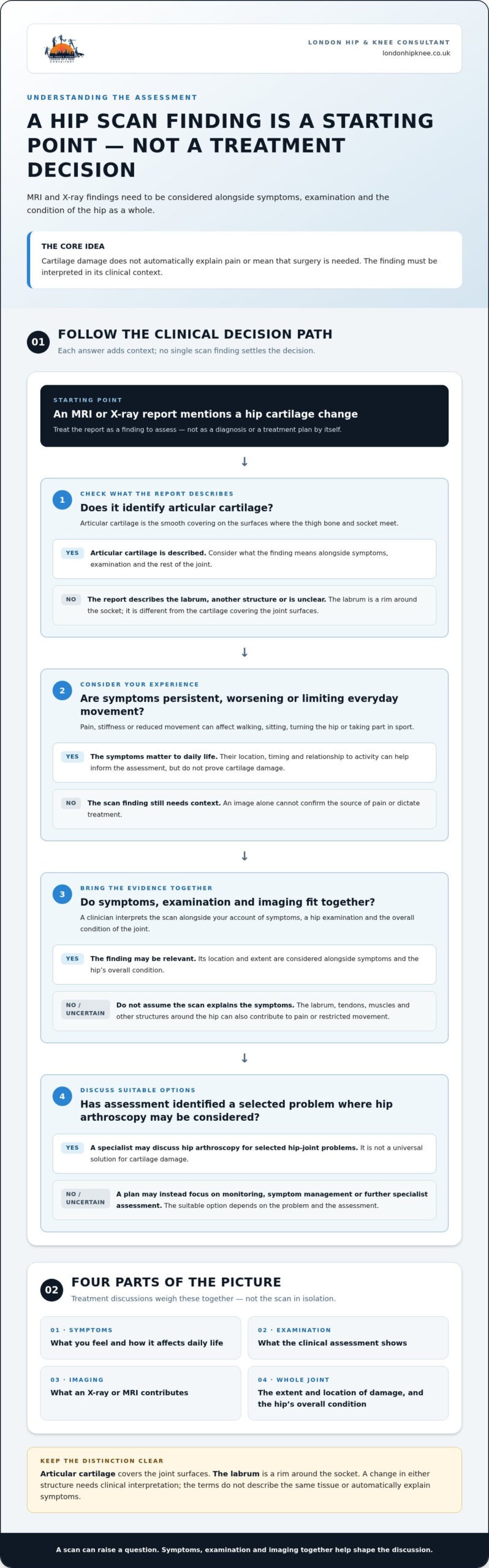
How hip cartilage damage is assessed at a London consultation
A consultation is a step-by-step process, not a decision made from a scan report alone. The clinician builds a picture of how your hip feels and functions, examines its movement, then considers any imaging alongside that information. This helps make the discussion relevant to you, rather than assuming a particular finding explains every symptom.
What to expect during symptom and movement assessment
You’ll be asked when your symptoms began, whether they followed an injury or developed gradually, and how they affect activities such as walking, sitting or exercise. Before the consultation, it can help to note what makes discomfort better or worse, any previous care, and the activities you’d like to return to. There’s no need to have all the answers. The conversation helps identify what matters clinically.
The examination may assess hip movement, comfort and function. Your clinician may ask you to move your leg or adopt certain positions, observing how the hip responds. This information is considered with your history and imaging, not used in isolation. An assessment informs a discussion about options; it doesn’t commit you to surgery.
How imaging findings inform the treatment discussion
X-rays and MRI provide different kinds of information. An X-ray can help show the bones, joint shape and signs of changes such as arthritis. MRI provides images of soft tissues and can help clinicians assess structures within and around the joint, including cartilage. Neither test answers every question, and an image may not explain the source or severity of a person’s symptoms by itself.
Imaging findings are interpreted alongside your symptoms and examination, because a scan is one part of the clinical picture, not a diagnosis in isolation. The clinician can review the images and report in context, explain what appears relevant and discuss any uncertainty. Further tests or another opinion may be considered if they would help clarify the situation, depending on the individual findings and clinical questions.
If you’re considering hip cartilage repair london, this joined-up assessment helps distinguish a finding that may need monitoring from one that could warrant further discussion. The next step may be to explore non-surgical management or, for selected hip-joint problems, whether a surgical assessment is appropriate. The aim is to understand the choices before making a decision.
For persistent hip symptoms or questions about imaging, find out about specialist hip assessment in London.
Hip cartilage repair in London: specialist options and next steps
The right next step depends on how your hip feels, what the assessment and imaging show, and what you want to be able to do. A cartilage finding doesn’t automatically mean an operation is needed. If hip arthroscopy is considered, it should be because a specialist believes it may address a selected problem, not simply because a scan mentions cartilage damage.
Mr Parag Jaiswal provides adult hip and knee orthopaedic care in London, including hip arthroscopy. He has been a medical professional for over 18 years. A specialist discussion can help put your symptoms and scan findings into context and explain which options may be relevant to your situation, without assuming a particular procedure or outcome.
Questions to bring to a hip specialist
It can help to note your symptoms, what activities they affect and what you hope to return to. You may also find it useful to ask:
- What does the imaging show, and how does it relate to my symptoms and examination?
- Could non-surgical management be appropriate, and what might it involve?
- If a procedure is discussed, what is its intended purpose, and what are the potential benefits, risks and alternatives?
- What could recovery and follow-up involve in my circumstances?
These questions can help you understand the reasoning behind a recommendation. They also give you space to discuss any concerns before deciding how to proceed.
A measured next step for persistent hip symptoms
If pain, stiffness or restricted movement continues to affect daily life, or you’re unsure what an imaging finding means, a specialist consultation may help clarify the available options. Depending on the assessment, the discussion could include monitoring, non-surgical care or whether hip arthroscopy is worth considering for a specific joint problem. An appointment is an opportunity to understand the choices, not a guarantee that surgery will be advised.
For anyone researching hip cartilage repair london, the most useful starting point is an individual assessment that connects symptoms, examination and imaging with personal goals. If persistent symptoms or scan findings are causing uncertainty, a specialist hip consultation can help you understand the possible next steps.
Take a clear next step for your hip
A cartilage finding on a scan isn’t a treatment decision. The right approach depends on how your hip feels, what examination and imaging show, and how symptoms affect the activities that matter to you. Options may include monitoring or non-surgical care. Hip arthroscopy may be considered for selected problems, but it isn’t a universal solution for cartilage damage.
If you’re exploring hip cartilage repair london, a specialist assessment can help put the findings into context and explain the options without assuming major surgery is needed. Mr Parag Jaiswal provides specialist adult hip and knee care in London, including hip arthroscopy, and has more than 18 years of experience as a medical professional.
Arrange a specialist hip consultation in London to discuss your symptoms, examination and scan findings, and understand the options available to you.
Frequently Asked Questions
Can damaged hip cartilage repair itself?
Hip cartilage has limited capacity for self-repair, but what happens depends on the type, extent and location of the damage. A scan finding doesn’t necessarily cause symptoms, and it can’t predict healing on its own. If pain or restricted movement persists, a clinical assessment can help clarify what may be contributing. A clinician interprets imaging alongside your symptoms and examination before discussing whether monitoring or treatment may be appropriate.
What does cartilage damage in the hip feel like?
Possible symptoms include pain, stiffness or difficulty moving the hip, but they vary from person to person and aren’t specific to cartilage damage. Similar discomfort can come from the labrum, tendons or other structures around the hip. Symptoms alone can’t confirm the cause. If they persist, worsen or affect activities such as walking or sitting, a clinician can assess the problem rather than relying on self-diagnosis.
Can an MRI show hip cartilage damage?
An MRI can help clinicians assess soft tissues and structures within the hip joint, including cartilage. However, no scan provides the whole clinical picture, and not every abnormality will necessarily explain symptoms. A clinician reviews the images alongside your symptom history and physical examination. A finding on MRI doesn’t automatically mean treatment is needed; its relevance depends on how it fits with your symptoms and other assessment findings.
Is hip arthroscopy used to treat cartilage damage?
Hip arthroscopy is a keyhole procedure used to assess and treat selected problems inside the hip joint. Whether it may be appropriate depends on the specific findings, your symptoms and the overall clinical assessment. The labrum and articular cartilage are different structures, so a procedure addressing one shouldn’t be assumed to treat the other. Arthroscopy isn’t a universal solution for cartilage damage and shouldn’t be taken to mean cartilage will be restored.
What is the difference between hip cartilage and the labrum?
Articular cartilage covers the surfaces of the bones where they meet inside the hip joint, helping them move smoothly. The acetabular labrum is a separate rim of connective tissue around the socket. Both structures may be relevant when investigating hip symptoms, but they aren’t the same and may require different assessment. This is why a scan report needs to be interpreted in context, rather than treated as a diagnosis by itself.
When should I see a hip specialist in London about cartilage damage?
Consider a specialist assessment if hip symptoms persist, restrict everyday activities or remain unclear after initial care. A London hip specialist can discuss your symptom history, examine the hip and review relevant imaging before explaining possible next steps. The purpose is to clarify what the findings may mean and which options could be considered. An assessment doesn’t guarantee that a particular treatment, including surgery, will be recommended.
Does hip cartilage damage always mean I need surgery?
No. A cartilage finding doesn’t automatically mean an operation is needed. Clinicians consider your symptoms, examination, imaging and the overall condition of the joint when discussing options. These may include non-surgical management or, in selected cases, a surgical assessment. The potential benefits and suitability of any approach differ between individuals, so treatment decisions need to be based on your specific clinical picture rather than the scan finding alone.