

A hip replacement is no longer a ‘last resort’ reserved for the elderly; it is a proactive clinical decision to reclaim your independence before your joint dictates your entire daily behaviour. If you find yourself waking in the early hours with a persistent, dull throb or struggling with the simple mechanics of putting on socks, you are likely searching for the definitive signs you need a hip replacement. It’s exhausting to live with the physical restriction of a stiff joint and the underlying anxiety that comes with long-term reliance on painkillers. We understand that you want to move freely again without the constant calculation of whether your hip will allow a simple trip to the shops or getting out of a car.
This guide provides the clinical and lifestyle indicators you need to determine if it’s time to stop conservative treatments and pursue a permanent solution. You’ll gain a clear framework to evaluate your symptoms against modern 2026 medical standards, helping you choose a specialist surgeon with total confidence. We will explore how recent advancements in implant longevity and surgical precision can restore your mobility and return your focus to living life, rather than simply managing pain.
Key Takeaways
- Identify why persistent pain located in the groin or thigh is a more accurate indicator of hip arthritis than discomfort on the outer hip.
- Recognise how the ‘London Commute Test’ and declining social invitations signal that your joint is beginning to dictate your daily behaviour.
- Learn to identify the clinical signs you need a hip replacement, especially when physiotherapy and anti-inflammatories fail to manage your symptoms.
- Understand the diagnostic process, including why weight-bearing X-rays are essential for assessing the true extent of joint wear.
- Discover how modern surgical techniques and enhanced recovery protocols can get you back on your feet just hours after your procedure.
Recognising the Physical Red Flags of Advanced Hip Osteoarthritis
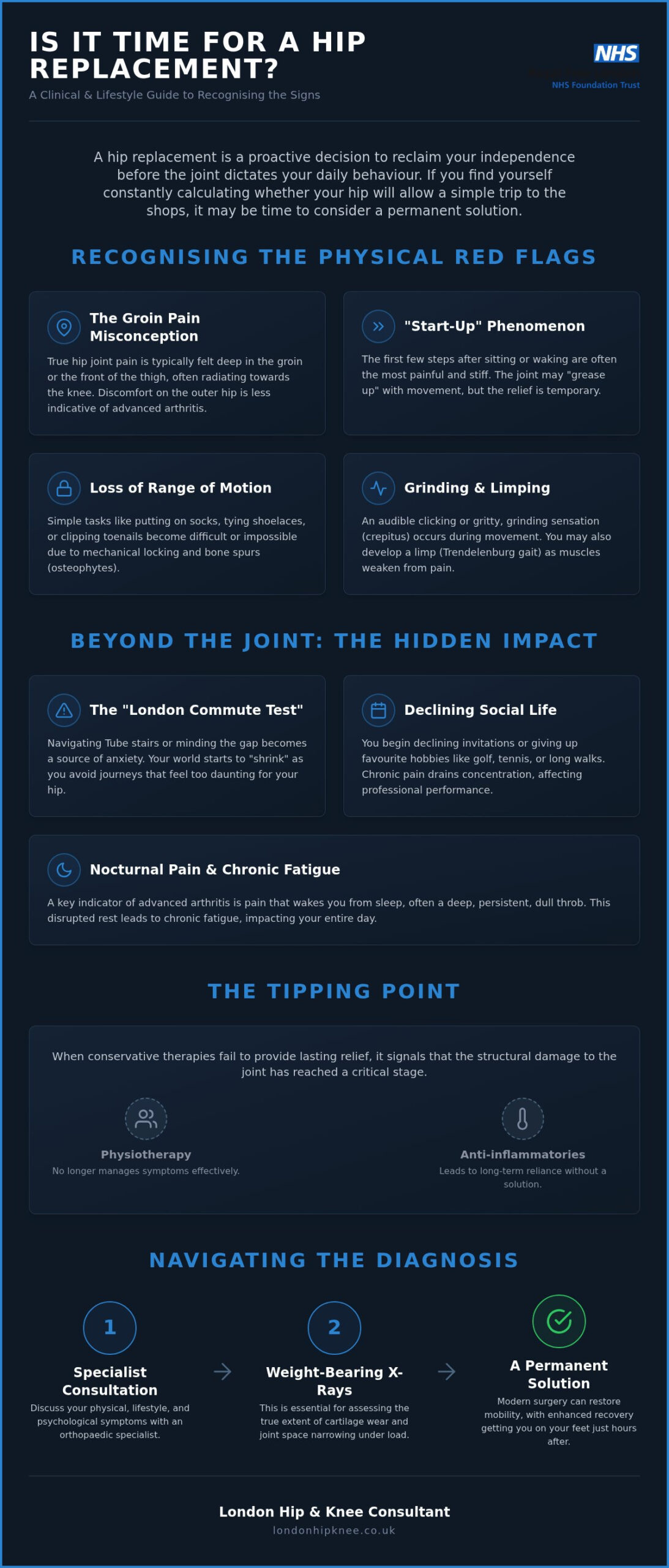
Chronic hip pain is frequently misunderstood by those living with it. Many patients arrive at our London clinics convinced they’ve simply pulled a muscle in their groin, unaware that this deep-seated, persistent discomfort is one of the primary signs you need a hip replacement. When the protective cartilage within the joint wears thin, the resulting bone-on-bone friction creates a specific set of physical ‘red flags’ that distinguish clinical osteoarthritis from simple muscular fatigue.
The Groin Pain Misconception
A common error is looking for hip pain on the outside of the upper leg or buttock. In reality, true intra-articular hip pain is almost always localised in the groin or the front of the thigh. You might feel a sharp catch when getting out of a car or a dull ache that radiates down towards the knee after a short walk. This happens because of referred pain; a clinical phenomenon where the brain misinterprets signals from the damaged hip joint and perceives the discomfort in adjacent areas like the thigh or lower back.
The "Start-Up" Phenomenon and Crepitus
Do you find the first ten steps after rising from a chair to be the most painful? This is known as the ‘start-up’ phenomenon. As the joint becomes inflamed, it stiffens during periods of rest. Once you begin moving, the joint ‘greases up’ slightly, but this relief is temporary. You may also notice mechanical symptoms such as audible clicking or a gritty, grinding sensation known as crepitus. These aren’t just annoying noises; they’re the sound of irregular joint surfaces and loose fragments of bone or cartilage interfering with smooth movement.
Loss of Range of Motion and Mechanical Locking
Advanced osteoarthritis often leads to the development of osteophytes, or bone spurs. These tiny bony growths act like physical doorstops within the ball-and-socket joint, mechanically limiting your ability to bend or rotate the leg. This is why basic self-care tasks, such as clipping toenails or tying shoelaces, become nearly impossible. Whilst some patients manage early symptoms with joint preservation techniques, advanced cases often require Hip Replacement Surgery to restore a functional range of motion and stop the joint from ‘locking’ unexpectedly.
You might also notice a change in your walking pattern, specifically a Trendelenburg gait. This is a subtle limp where your pelvis drops on one side because the hip muscles can no longer support your weight effectively due to joint pain. If you’re subconsciously shortening your stride or leaning to one side to protect the joint, your body is signalling that the structural damage has reached a tipping point.
Beyond the Joint: The Hidden Psychological and Lifestyle Signs
Your hip joint doesn’t exist in a vacuum; its health dictates the boundaries of your world. Whilst physical symptoms are often the first to be discussed in a clinical setting, the psychological and lifestyle signs you may need a hip replacement are often more profound. We frequently see patients whose lives have begun to ‘shrink’. This isn’t just about a dull ache; it’s about the immense mental energy required to navigate a city that suddenly feels hostile to your mobility.
For many of our patients, the ‘London Commute Test’ is the turning point. Navigating the steep stairs at older Underground stations or minding the gap on a busy platform becomes a source of genuine anxiety. When you start declining dinner invitations because the walk from the station feels too daunting, or you find yourself obsessively checking for lift access before leaving the house, the joint is no longer just stiff; it is controlling your behaviour. If your world is becoming smaller to accommodate your hip, it’s time to consider a consultation with a specialist to reclaim your freedom.
The Impact on Professional and Social Life
In a high-pressure professional environment, chronic pain is a silent drain on concentration. It’s difficult to focus on a complex strategy or lead a team when your hip is throbbing. Beyond the office, the loss of identity that comes with giving up a favourite hobby like golf, tennis, or even long walks in Richmond Park can be devastating. This emotional fatigue is a valid clinical consideration; surgery is as much about restoring your quality of life as it is about repairing a joint.
Nocturnal Pain and Chronic Fatigue
Rest should provide a sanctuary from daily discomfort. If you’re struggling to find a comfortable position at night, or if you’re waking frequently due to joint throbbing, the damage is likely advanced. Healthy joints should settle when you’re horizontal; if they don’t, the inflammation has likely reached a stage where rest is no longer a viable remedy. This lack of restorative sleep creates a vicious cycle where exhaustion lowers your pain threshold, making the next day’s mobility even more challenging. Chronic night pain is one of the most reliable clinical signs you need a hip replacement, as it indicates that the structural damage has bypassed the help of conservative therapies.
The Tipping Point: When Conservative Therapies are No Longer Enough
Most patients we see in our London clinics have spent months, or even years, exploring non-surgical routes. Whilst these are excellent first steps, they eventually hit a clinical "ceiling". If you’re finding that anti-inflammatories like ibuprofen or naproxen are becoming a daily requirement just to get through a morning at the office, it’s a significant warning. Long-term reliance on these medications carries documented risks of gastrointestinal irritation and renal strain. When the relief from these pills lasts only a few hours, your body is signalling that the structural wear has surpassed what medicine can manage.
The Role of Specialist Injections
Mr Jaiswal often utilises modern therapies such as Arthrosamid, Hyaluronic acid or PRP (Platelet-Rich Plasma) for joint preservation. These biological treatments are effective for mild to moderate wear, helping to lubricate the joint and reduce inflammation. However, they cannot overcome a total mechanical failure. If a steroid or lubricating injection that once lasted six months now only provides three weeks of relief, you’ve reached a diagnostic milestone. This rapid "wearing off" is one of the clear signs you need a hip replacement; it suggests the joint environment has become too hostile for injections to function.
Recognising "The Ceiling" of Physiotherapy
Physiotherapy is vital for maintaining joint health, but it cannot regrow lost cartilage. You must distinguish between "good" muscular ache from strengthening and "detrimental" joint irritation. If exercises that once felt beneficial now trigger multi-day flare-ups, you’ve reached the ceiling of conservative care. At this stage, the "bone-on-bone" friction creates an inflammatory response that exercise only exacerbates. Common indicators that you’ve hit this ceiling include:
- Increased Night Pain: Exercise during the day leads to throbbing that prevents sleep.
- Muscle Atrophy: You notice the muscles in your thigh or buttock are visibly smaller because the joint pain prevents you from using them.
- Reduced Walking Distance: Your "pain-free" walking limit is consistently decreasing despite regular strengthening.
It’s a mistake to "wait as long as possible" once you’ve reached this point. Allowing significant muscle atrophy to set in before surgery can actually make your eventual recovery more complex. A timely intervention ensures you enter the operating theatre with the best possible muscular support, which is essential for a rapid return to your favourite activities.
Navigating the Diagnosis: Your Private Orthopaedic Consultation
Determining the right time for surgery requires moving beyond self-assessment into a formal clinical environment. Your private consultation is a structured, logical process designed to validate your daily experiences with objective data. During your appointment, Mr Parag Jaiswal will perform a comprehensive physical examination, focusing on your gait, leg length, and the range of internal rotation in the joint. A significant restriction in rotation, often accompanied by a sharp ‘catch’ during certain movements, is one of the most definitive clinical signs you need a hip replacement.
This physical assessment is paired with a deep dive into your personal medical history. We discuss your specific lifestyle goals, whether that’s returning to a high-pressure work environment or simply being able to walk through London’s parks without distress. This shared decision-making model ensures that the surgical plan is tailored to your specific functional needs rather than just being a reaction to an X-ray image. It’s about restoring the person, not just the joint.
Imaging and Diagnostic Precision
Whilst many patients expect an MRI to be the primary diagnostic tool, weight-bearing X-rays remain the gold standard for assessing advanced osteoarthritis. These images allow us to see ‘joint space narrowing’ where cartilage has worn away. It is a nuanced process; radiographs often look better or worse than the patient actually feels. In cases where the diagnosis is unclear, an MRI may be used to identify labral tears or early-stage avascular necrosis that an X-ray might miss.
The Consultation Experience in London
Choosing a specialist centre for adult orthopaedic excellence provides access to refined surgical pathways. With over 18 years of medical experience, Mr Jaiswal uses the consultation to explain the precision of modern implant types and surgical approaches. You should prepare questions regarding the longevity of components and the recovery timeline specific to your health profile. Many patients also find it valuable to understand the full financial picture at this stage; a clear breakdown of the hip replacement Bupa cost in London, including what’s included and what affects price, can help you plan with complete confidence. This transparent dialogue builds the confidence necessary to move from pain management toward active restoration.
The goal of this meeting is to provide a clear roadmap. By the end of your session, you will have a definitive answer on whether your symptoms are the clinical signs you need a hip replacement or if joint preservation remains a viable path. If you are ready to move beyond managing symptoms, you can book a private consultation at one of our London clinics to discuss your options.
Advanced Surgical Techniques
In 2026, surgical precision has reached new heights. We utilise minimally invasive approaches that prioritise the preservation of surrounding soft tissue and muscle. This technique significantly reduces the risk of leg length discrepancy and speeds up the initial healing phase. The choice of materials is equally critical for long-term success. We typically use a combination of ceramic and highly cross-linked polyethylene for their exceptional wear resistance. According to a 2026 study published in The Lancet, modern hip implants are estimated to last over 30 years in approximately 92% of patients. This remarkable durability means the old concern of being ‘too young’ for surgery is rapidly declining, as these components are designed to withstand decades of active use.
Life After Hip Replacement
The hallmark of a successful procedure is the speed of your return to independence. Under our enhanced recovery protocols, many patients are mobile and walking with assistance within hours of their surgery. This early mobilisation is essential for preventing complications and kickstarting the rehabilitation process. Whilst you’ll need a structured programme of specialised physiotherapy and follow-up care, the timeline for returning to daily life is often shorter than patients anticipate. Most individuals return to driving within six weeks and can resume low-impact sports, such as golf, gardening, or swimming, shortly thereafter.
Reclaiming your life from chronic joint pain is a journey we navigate together. Whether it’s returning to a demanding career in the City or enjoying weekend walks in Richmond Park, the goal is a joint that you no longer have to think about. If you’ve reached the tipping point where your mobility is compromised, it’s time to seek expert guidance from a specialist who understands both the clinical and lifestyle impact of your condition.
Ready to discuss your options? Book a consultation with Mr Parag Jaiswal today to begin your path toward restoration.
Reclaiming Your Active London Lifestyle
Living with chronic hip pain often leads to a gradual narrowing of your daily world, but it doesn’t have to be your permanent reality. By identifying the clinical signs you need a hip replacement, such as persistent nocturnal pain and the diminishing returns of physiotherapy, you can make a proactive decision to intervene before mobility further declines. Modern surgical techniques in 2026 offer exceptional implant longevity and rapid recovery protocols, ensuring that your return to activity is both safe and sustainable.
Led by Mr Parag Jaiswal, a Consultant Orthopaedic Surgeon with over 18 years of experience, our practice provides a comprehensive pathway from non-surgical joint preservation to advanced reconstruction. With specialised clinics located across London, we offer the expert authority and empathetic care required to navigate this journey with confidence. It’s time to move beyond the limitations of joint wear and rediscover the freedom of movement you deserve.
Consult Mr Parag Jaiswal for an expert hip assessment in London
Frequently Asked Questions
Am I too young for a hip replacement surgery?
You are never strictly ‘too young’ if your quality of life is severely compromised and conservative treatments have failed. Modern 2026 implant technology, featuring ceramic-on-polyethylene surfaces, is designed for high-demand use and can last over 30 years in 92% of cases. Waiting until you are older often leads to significant muscle loss and secondary joint issues. If you recognise the clinical signs you need a hip replacement, a timely intervention is usually the best path to restoration. Mr Jaiswal uses ceramic on ceramic hip replacements in very young patients, which can theoretically last even longer!
How long is the typical recovery time for a private hip replacement in London?
Most patients in our London clinics are mobile within hours of surgery thanks to enhanced recovery protocols. You can typically return to light office work within four to six weeks, whilst driving is generally permitted once you have regained full control of your leg, usually around the six-week mark. Full recovery and a return to more strenuous activities takes approximately three to six months, supported by a structured programme of specialised physiotherapy to ensure joint stability.
Can I avoid surgery with specialist injections?
Specialist injections like PRP or steroids can effectively manage inflammation and delay surgery for several years in the early stages of arthritis. However, they cannot regrow lost cartilage or fix a mechanical ‘bone-on-bone’ failure. Whilst Arthrosamid is a revolutionary treatment we offer for knee osteoarthritis, it is not currently used for hip replacements. Once the joint has reached a certain level of structural collapse, surgery becomes the only predictable way to restore function and mobility.
What happens if I delay my hip replacement for too long?
Delaying surgery for too long can lead to irreversible muscle atrophy and compensatory pain in your lower back or opposite knee. As your body shifts its weight to protect the damaged hip, you risk developing secondary orthopaedic issues. Furthermore, the longer you wait, the more your social and professional life ‘shrinks’. Entering surgery with stronger muscles and better overall health significantly improves your post-operative recovery and leads to a far superior long-term surgical outcome.
Will I be able to return to sports like golf or tennis after the operation?
Yes, the majority of patients return to low-impact sports such as golf, doubles tennis, and swimming within three to six months. Modern prostheses are designed to handle the rotational forces involved in a golf swing or a brisk walk in Richmond Park. Whilst high-impact activities like long-distance running are generally discouraged to prevent premature wear of the implant, your new joint will allow you to maintain an active, high-performance lifestyle without the previous throb of arthritis.
What are the most common risks associated with modern hip surgery?
Modern hip surgery is highly successful, but like any major procedure, it carries specific clinical risks. These include deep vein thrombosis (DVT), joint infection, and the rare possibility of dislocation or leg length discrepancy. Mr Jaiswal utilises precise surgical planning and minimally invasive techniques to keep these risks to a minimum. We also implement rigorous post-operative protocols, such as blood-thinning medication and early mobilisation, to ensure patient safety and the best possible functional result.
How do I know if my hip pain is actually coming from my lower back?
True hip pain is almost always felt in the groin or the front of the thigh, whereas lower back pain often radiates into the buttock or down the back of the leg. If your pain increases when you rotate your leg inward, it is likely coming from the hip joint itself. During your consultation in London, we use weight-bearing X-rays and clinical tests to differentiate between referred spinal pain and the clear signs you need a hip replacement.
What is the difference between a total and a partial hip replacement?
A total hip replacement involves replacing both the damaged ‘ball’ (femoral head) and the ‘socket’ (acetabulum) with prosthetic components. This is the standard procedure for advanced osteoarthritis. A partial hip replacement, or hemiarthroplasty, only replaces the ball and is typically reserved for specific types of hip fractures in older patients rather than wear-and-tear arthritis. For most adults seeking to restore an active lifestyle, a total replacement offers the most reliable and long-lasting relief.