
True surgical precision requires bespoke, consultant-delivered care tailored to your unique anatomy, not rigid hospital bureaucracy. If you are exploring a private knee replacement London offers exceptional clinical expertise, yet finding the right specialist can feel daunting when persistent stiffness and joint pain already restrict your daily independence.
You already recognise that debilitating arthritis shouldn’t dictate your routine, but natural anxieties about surgical discomfort, extended recovery timelines, and navigating self-pay versus private insurance can easily stall your decision. This guide provides expert guidance on private knee replacement surgery in London, from advanced surgical techniques to tailored recovery pathways designed to restore your active lifestyle. We examine what to expect from dedicated consultant care, outline the differences between partial and total arthroplasty, and explain how to smoothly access treatment so you can return to a mobile, pain-free life.
Key Takeaways
- Understand how a modern knee replacement London specialist uses targeted resurfacing techniques to relieve chronic arthritic pain while preserving healthy bone structure.
- Compare the clinical advantages of total and partial knee arthroplasty, alongside innovative non-surgical joint preservation options such as Arthrosamid injections.
- Navigate the private treatment pathway with complete clarity, from weight-bearing diagnostic imaging to seamless self-pay and private medical insurance coordination.
- Demystify your post-operative recovery timeline through modern enhanced recovery pathways designed to help you mobilise safely within hours of surgery.
- Experience the clinical reassurance of end-to-end continuity under Mr Parag Jaiswal, backed by over 18 years of focused orthopaedic expertise.
Understanding Knee Replacement Surgery in London
Knee arthroplasty is not a total amputation of the joint, but a precision resurfacing procedure. During modern knee replacement surgery, an orthopaedic surgeon removes only the worn, diseased articular cartilage alongside a minimal sliver of underlying subchondral bone. These damaged surfaces are then capped with biocompatible metallic alloys and medical-grade polyethylene bearings. This restores smooth joint articulation, realigns mechanical weight-bearing axes, and eliminates the agonizing friction that characterizes late-stage arthritis.
While trauma or inflammatory conditions can degrade joint surfaces, primary osteoarthritis remains the predominant clinical indication for surgery. For patients seeking a premier knee replacement london provides access to highly refined surgical practices designed to reverse progressive physical decline. When conservative measures such as targeted physiotherapy, weight optimisation, offloader bracing, and therapeutic joint injections no longer yield functional relief, surgical intervention becomes the definitive solution to restore mobility and quality of life.
The Anatomy of Joint Wear and Severe Osteoarthritis
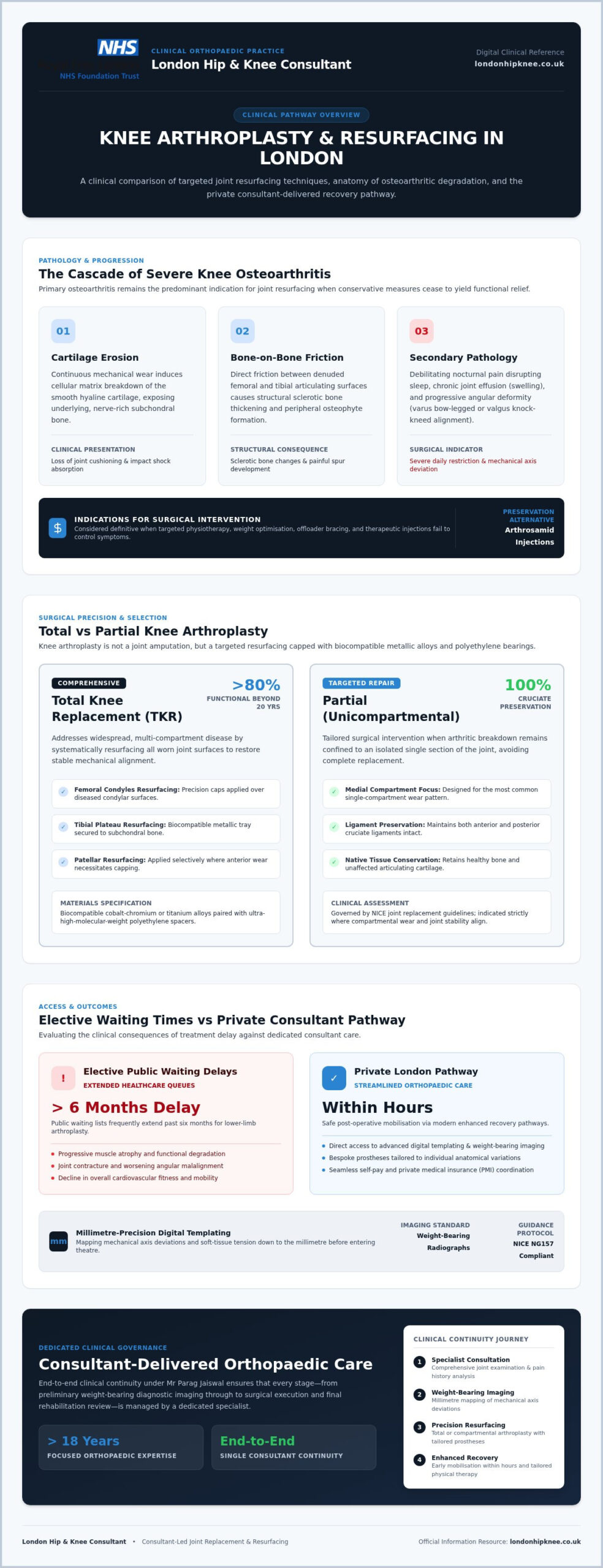
Healthy knees rely on a smooth, lubricated layer of hyaline cartilage to absorb impact and facilitate frictionless gliding. Severe osteoarthritis disrupts this delicate mechanism through progressive structural wear:
- Cartilage erosion: Continuous mechanical wear causes cellular matrix breakdown, exposing underlying nerve-rich bone.
- Bone-on-bone friction: Direct contact between denuded femoral and tibial surfaces leads to sclerotic bone changes and painful osteophyte formation.
- Secondary pathology: Sufferers experience persistent nocturnal pain that disrupts sleep, chronic joint effusion (swelling), and progressive angular deformity, commonly presenting as varus (bow-legged) or valgus (knock-kneed) malalignment.
Surgery is indicated when joint stiffness prevents basic daily movements and non-operative interventions cease to offer sustainable symptom control.
Why Seek Private Orthopaedic Surgery in London?
Opting for a private knee replacement london pathway allows individuals to bypass extensive public waiting lists, which frequently stretch beyond six months for elective lower-limb procedures. Prolonged delays risk further muscle atrophy, joint contracture, and declining cardiovascular fitness.
Private orthopaedic care across Central London clinics grants direct access to state-of-the-art diagnostic imaging, advanced surgical theatres, and bespoke prostheses. Most importantly, it ensures consultant-delivered continuity. From your initial clinical consultation and surgical execution through to post-operative review, your treatment is directed by a dedicated specialist, ensuring complete clinical consistency and clear communication at every milestone.
Types of Knee Arthroplasty: Total vs Partial Replacement
Every joint degenerates differently, which means surgical intervention must adapt to your unique anatomy rather than relying on a standard template. Advanced digital templating and weight-bearing imaging allow your consultant to map mechanical axis deviations and soft-tissue tension down to the millimetre. In line with the NICE guidelines for joint replacement, identifying the appropriate intervention hinges on clinical joint stability, compartmental wear patterns, and your functional goals. When considering a private knee replacement london specialists offer targeted procedures that preserve as much healthy native tissue as possible.
Total Knee Replacement (TKR): Complete Joint Resurfacing
Total knee arthroplasty addresses widespread, multi-compartment disease by systematically resurfacing the femoral condyles, the tibial plateau, and, where appropriate, the patella. The damaged cartilage and bone ends are replaced with precision components made from biocompatible cobalt-chromium or titanium alloys, separated by an ultra-high-molecular-weight polyethylene spacer. Registry data confirms that over 80% of modern knee prostheses remain functional beyond twenty years. This makes total joint resurfacing an exceptionally reliable option for extensive arthritis, delivering dependable pain relief and restoring stable alignment.
Partial (Unicompartmental) Knee Surgery: Targeted Repair
When arthritic damage remains confined to a single section of the joint, most commonly the medial compartment, partial knee resurfacing offers distinct advantages. By preserving the healthy compartments alongside both the anterior and posterior cruciate ligaments, this technique retains normal joint kinematics and proprioception. Patients benefit from smaller incisions, reduced post-operative discomfort, and a more natural-feeling knee during movement. Suitability relies on strict clinical criteria: your cruciate ligaments must be intact, any angular deformity must be passively correctable, and inflammatory conditions must be absent.
Evaluating Non-Surgical Therapies Before Operative Decisions
Surgical reconstruction isn’t always the mandatory first step. For patients managing moderate cartilage loss or those seeking to postpone major surgery, novel joint preservation options provide meaningful relief. Arthrosamid, an advanced non-biodegradable polyacrylamide hydrogel injection, integrates directly into the synovial membrane to cushion the joint, damp down inflammation, and improve functional mobility for sustained periods.
A comprehensive clinical evaluation at London Hip & Knee Consultant helps clarify your diagnostic scans, ensuring you understand whether non-surgical hydrogel therapy or precision arthroplasty represents the safest, most effective pathway forward.
Navigating Your Private Knee Replacement Journey in London
Embarking on private joint surgery should feel structured, predictable, and fully coordinated around your schedule. From your first diagnostic assessment to final post-operative sign-off, every stage is designed to eliminate uncertainty and streamline clinical decision-making. When planning a private knee replacement london patients benefit from rapid-access diagnostics and bespoke surgical scheduling that bypasses months of institutional delays.
Initial Specialist Consultation and Clinical Assessment
Your journey starts with a dedicated, hands-on clinical evaluation. Rather than relying solely on static reports, your consultant carries out a focused biomechanical assessment, analysing your natural gait pattern, passive and active range of motion, and ligamentous stability. Weight-bearing digital radiography and high-resolution MRI scans are evaluated alongside your day-to-day symptoms to determine the true extent of articular wear. This thorough process ensures your surgical plan matches your functional lifestyle demands, establishing clear, realistic targets for post-operative mobility.
Funding Your Procedure: Insurance and Self-Pay Options
Financing private joint surgery typically proceeds through private medical insurance (PMI) or self-funded care pathways:
- Private Medical Insurance: Most major UK insurers, including Bupa, AXA Health, Aviva, and Vitality, require an open GP referral before pre-authorising care under specific clinical coding (such as W4200 for a total replacement or W4210 for a partial resurfacing).
- Self-Pay Pathways: Patients funding their own treatment receive all-inclusive hospital quotes covering theatre fees, prosthetic components, consultant and anaesthetist fees, and essential inpatient physical therapy.
To understand the breakdown of theatre fees, diagnostic imaging, and implant considerations, review our dedicated guide on private knee replacement costs in London.
Hospital Admission and Surgical Day Protocol
On the day of surgery, you are admitted to an accredited private surgical centre in Central London. Pre-operative checks confirm your clinical readiness, followed by a detailed discussion with your consultant anaesthetist. Modern surgical protocols for total knee arthroplasty prioritise regional spinal anaesthesia combined with targeted adductor canal nerve blocks rather than general anaesthetic alone. This targeted approach dramatically reduces post-operative nausea, minimises early wound pain, and enables faster systemic recovery. Once inside the laminar flow operating theatre, your consultant delivers precision bone cuts and implant alignment, laying the foundation for your rapid physical rehabilitation.
Recovery, Rehabilitation, and Return to Active Mobility
A successful surgical outcome depends as much on structured rehabilitation as it does on operative precision. Gone are the days of prolonged hospital bed rest. Modern Enhanced Recovery After Surgery (ERAS) protocols transform recovery into an active, predictable progression. When undergoing a private knee replacement london surgical centres ensure you begin safely moving the joint on the very day of your procedure.
Immediate Post-Operative Milestones: Days 1 to 14
Within two to four hours of surgery, a specialist orthopaedic physiotherapist helps you stand and take your initial steps. This early weight-bearing is made comfortable through targeted motor-sparing nerve blocks, which suppress pain pathways without paralysing the quadriceps muscles. Prior to discharge, typically after one or two nights, you will practice navigating stairs and transferring safely.
At home, early efforts focus on wound integrity and swelling reduction:
- Cryotherapy and elevation: Dedicated cold-compression devices soothe local inflammation and minimise tissue oedema.
- Wound management: Modern waterproof dressings protect the healing incision, with skin clips or dissolvable sutures inspected between days 10 and 14.
- Prescribed daily home drills: Regular ankle pumps, straight leg raises, and gentle heel slides re-establish neuromuscular control.
Intermediate Rehabilitation: Weeks 3 to 12
Between weeks three and six, swelling settles and most patients transition away from walking aids to unassisted gait mechanics. A crucial clinical benchmark during this window is achieving 90 to 120 degrees of knee flexion alongside full terminal extension, which is essential for walking without a limp. Driving is generally safe to resume around six weeks post-surgery, provided you can execute an emergency stop cleanly and have ceased sedative medications. Desk-based professionals usually return to work within four to six weeks, whilst physically demanding occupations require closer to three months.
Long-Term Joint Health and High-Level Function
By twelve weeks, rehabilitation shifts from restoring basic mobility to building lasting muscular endurance. Low-impact activities such as stationary cycling, swimming, and golf are highly encouraged, as strong quadriceps and hamstrings shield your prosthetic joint from unnecessary wear. High-impact contact sports should be avoided to protect implant longevity. Regular post-operative consultant reviews ensure mechanical alignment and joint stability remain flawless for decades. To discuss your mobility goals and design a personalised treatment plan, book an orthopaedic consultation with Mr Parag Jaiswal.
Consultant Orthopaedic Care: The London Hip and Knee Clinic
Choosing where to undergo major joint surgery is an intensely personal decision. Large multi-specialty hospitals often delegate pre-assessment clinics and follow-up reviews across rotating clinical teams, leaving patients without a single, familiar point of contact. In contrast, seeking a knee replacement london through a specialised private practice ensures unbroken clinical accountability. At London Hip & Knee Consultant, your care is personally planned, executed, and reviewed by your consultant orthopaedic surgeon from start to finish.
Expertise of Mr Parag Jaiswal
The practice is led by Mr Parag Jaiswal, an expert Consultant Orthopaedic Surgeon with over 18 years of medical expertise in complex lower-limb reconstruction and arthroplasty. Rather than taking a one-size-fits-all approach, Mr Jaiswal evaluates each joint through a patient-centred lens. Every surgical intervention, whether an unicompartmental resurfacing or a complex total joint reconstruction, is backed by rigorous, evidence-based surgical protocols.
This specialist focus delivers several clear clinical benefits:
- Sub-specialist dedication: Deep, daily immersion in hip and knee biomechanics, ensuring refined surgical execution and soft-tissue balance.
- Direct consultant continuity: You discuss your diagnostic scans, surgical risks, and post-operative recovery with the exact surgeon operating on your knee.
- Empathetic clinical style: Consultations are unhurried, providing clear explanations of all non-operative therapies, hydrogel injections, and surgical options.
Scheduling Your London Consultation
Accessing premier orthopaedic care shouldn’t be stalled by administrative delays. Consultations take place across established, modern private hospital facilities throughout Central London, offering rapid access to high-resolution imaging suites and laminar-flow surgical theatres. Both self-pay individuals and insured patients receive responsive administrative support, ensuring seamless pre-authorisation handling alongside major UK private health insurers.
Living with chronic joint stiffness gradually diminishes your independence and restricts the activities you love. Proactive specialist assessment clarifies your clinical choices and puts you back in control of your physical health. Take the first definitive step toward lasting joint restoration and arrange your private appointment today with London Hip & Knee Consultant.
Reclaim an Active Life Without Joint Pain
Debilitating arthritic stiffness doesn’t have to define your daily routine. Modern joint restoration has moved far beyond standard approximations; today’s targeted partial resurfacing and total arthroplasty techniques protect healthy native tissue while re-establishing natural joint biomechanics. Paired with modern enhanced recovery pathways, regaining comfortable, independent movement is faster and more predictable than ever before.
When you choose to undergo a private knee replacement london offers exceptional surgical care under Consultant Orthopaedic Surgeon Mr Parag Jaiswal. Backed by over 18 years of medical experience, Mr Jaiswal leads a specialised practice focusing exclusively on advanced hip and knee disorders. Consultations and procedures take place across prestigious Central London private hospital locations, ensuring dedicated continuity of care from your initial diagnostic assessment through to your final review. You don’t have to let persistent joint pain restrict your quality of life. Take the definitive step toward lasting relief and book an expert knee consultation with Mr Parag Jaiswal to begin your journey back to active mobility.
Frequently Asked Questions
How much does a private knee replacement cost in London?
Private treatment fees depend on whether you require a partial resurfacing or a total joint replacement, the complexity of joint deformity, and the hospital facility chosen. Self-pay quotes typically cover surgeon fees, anaesthetist care, prostheses, operating theatre expenses, and inpatient physiotherapy. Following your clinical consultation and diagnostic imaging, you receive an itemised package quotation tailored to your specific care pathway with no hidden administrative fees.
How long is the recovery period following knee replacement surgery?
Most patients begin standing with physical therapy assistance within hours of surgery and return home within one to two nights. Independent daily activities usually resume around six weeks, which is also when driving and desk-based work are typically safe to restart. Full soft-tissue remodelling and strength building continue across nine to twelve months, guided by a structured outpatient exercise programme designed to restore your functional range of motion.
Can I undergo knee replacement privately if I have medical insurance?
Yes, private medical insurance policies generally cover knee arthroplasty when clinical criteria for surgical intervention are met. You typically need an initial referral from your GP to begin. Once evaluated, your consultant provides the relevant clinical procedure code, such as W4200 for a total replacement, allowing your insurer to issue pre-authorisation. The clinic coordinates administrative details directly with your insurer prior to hospital admission.
What is the difference between a partial and total knee replacement?
A partial knee replacement resurfaces solely the damaged compartment of your joint, preserving healthy cartilage, bone, and your natural anterior and posterior cruciate ligaments. A total replacement addresses widespread arthritis by resurfacing the femoral, tibial, and patellar surfaces. When evaluating a knee replacement london orthopaedic specialists recommend partial resurfacing whenever disease is isolated, which supports a faster recovery and more natural joint motion.
How long do modern artificial knee joints typically last?
Modern knee prostheses are remarkably durable, with registry data indicating that over 80% remain functional beyond twenty-five years. Longevity depends on sub-millimetre surgical alignment, advanced implant material quality, and post-operative lifestyle habits. Maintaining lower-limb muscular conditioning and prioritising low-impact activities like swimming or cycling shields the prosthetic components from excessive wear, ensuring decades of stable, pain-free joint function.
What happens during my initial orthopaedic consultation in London?
Your initial consultation involves an unhurried, comprehensive evaluation of your symptoms, gait mechanics, and joint flexibility. Mr Parag Jaiswal assesses your weight-bearing radiographs or MRI scans alongside your day-to-day physical limitations. Together, you will explore conservative measures, injection therapies, or surgical reconstruction, formulating a personalised management plan tailored around your personal mobility goals and lifestyle requirements.
Are there non-surgical alternatives available for severe knee arthritis?
Non-surgical alternatives offer meaningful symptomatic relief for moderate degenerative changes or for patients seeking to postpone surgical intervention. Aside from specialised physiotherapy, biological options include Arthrosamid, an innovative non-biodegradable polyacrylamide hydrogel injection that integrates within the synovial membrane to cushion joint movement. Prior to planning a knee replacement london specialists thoroughly assess whether these non-invasive approaches can successfully defer the need for operative joint resurfacing.