

Imagine standing at the base of the stairs at a busy London station, watching the crowds flow past whilst you hesitate, calculating the exact physical cost of each step. For many people living or working in the centre of the city, persistent knee pain isn’t just a minor ache; it’s a gradual narrowing of your world that makes even a simple walk to the office feel like a challenge. You might feel trapped between conflicting advice about whether to rest or exercise, all whilst the quiet anxiety of potential surgery weighs on your mind.
It’s natural to feel overwhelmed by the complexity of modern orthopaedics, but you deserve a clear path back to the activities you love. This guide will help you discover the underlying causes of your knee pain and the modern pathways available to restore your mobility and comfort. We will explore what a comprehensive treatment plan looks like in 2026, covering everything from innovative non-surgical cushioning therapies to the latest precision surgical techniques. By understanding the factors that influence care in London, you can move forward with the confidence that you’re making the right choice for your long-term health.
Key Takeaways
- Understand the mechanical and inflammatory factors that drive knee pain, helping you distinguish between minor strains and chronic conditions like osteoarthritis.
- Recognise the critical red flags and symptoms that indicate a specialist assessment is necessary to protect your long-term joint health.
- Discover the role of modern “bridge” therapies, such as Arthrosamid injections, which provide non-surgical options for restoring comfort and mobility.
- Compare the benefits of total versus partial knee replacement to understand how precision surgery can be tailored to your specific anatomy.
- Learn what a comprehensive treatment pathway in London involves, ensuring you feel confident in the clinical excellence and outcomes of your care.
Understanding Knee Pain: Why Your Joint Hurts
The knee is a marvel of biological engineering, yet its complexity makes it uniquely vulnerable to injury and decay. As a sophisticated hinge joint, it relies on the seamless interaction between the femur (thigh bone), the tibia (shin bone), and the patella (kneecap). When this delicate system fails, the resulting knee pain can be debilitating, often acting as a signal that the internal structures are no longer coping with the demands placed upon them.
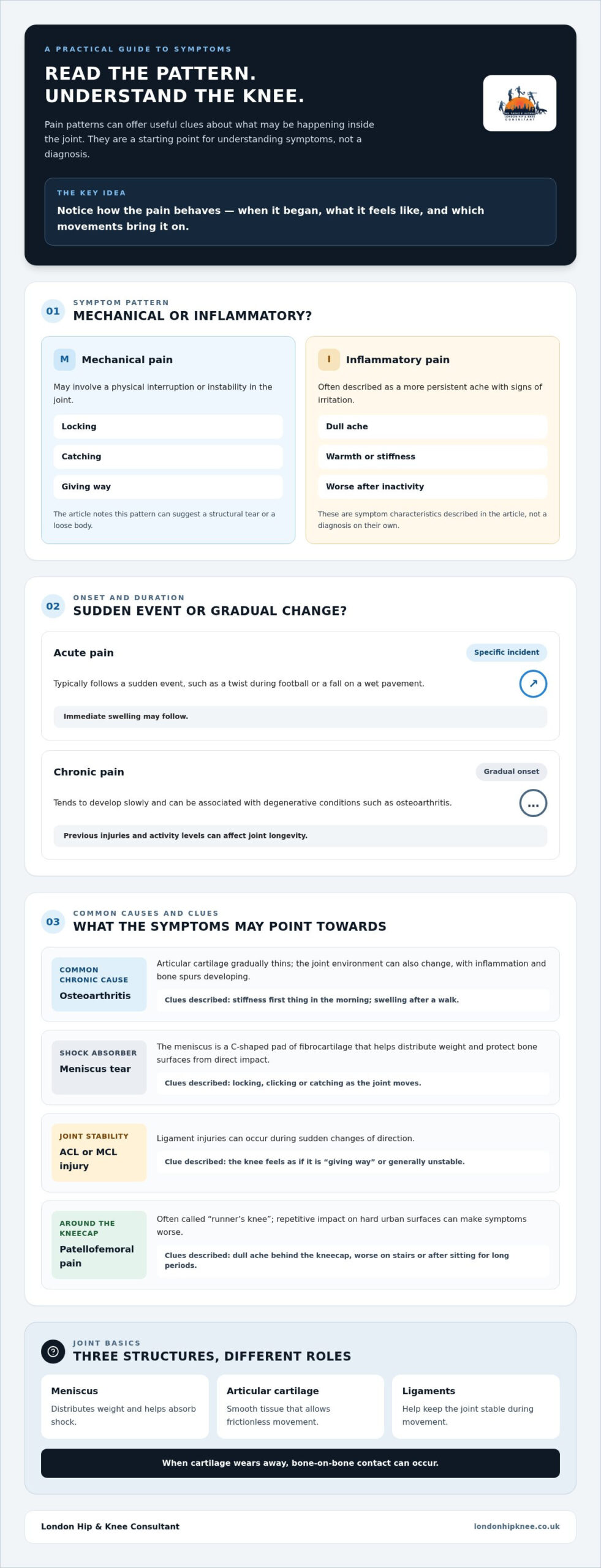
For many active Londoners, joint stress is an everyday reality. The repetitive impact of walking on hard pavements in the city centre, combined with the strain of navigating deep Underground stations, creates a specific environment for joint wear. Understanding your symptoms is vital. We often distinguish between "mechanical" pain, which involves the joint locking, catching, or giving way, and "inflammatory" pain. Whilst mechanical issues usually suggest a structural tear or loose body, inflammatory pain is often characterised by a dull ache, warmth, and stiffness that feels worse after periods of inactivity.
The Anatomy of Discomfort
Inside the joint, the meniscus serves as a vital shock absorber. These C-shaped pads of fibrocartilage distribute your weight and protect the bone surfaces from direct impact. Surrounding the bones themselves is articular cartilage, a smooth, glistening tissue that allows for frictionless movement. When this cartilage thins or wears away, bone-on-bone contact occurs, which is a primary clinical driver for seeking knee replacement surgery. Stability is further maintained by a network of ligaments, including the ACL and MCL, which act as living ropes to prevent the joint from shifting out of place during movement.
Acute vs. Chronic Knee Pain
It’s helpful to identify whether your discomfort is the result of a sudden event or a gradual process. Acute pain typically follows a specific incident, such as a twist during a weekend football match or a fall on a wet pavement, often resulting in immediate swelling. Chronic pain, however, tends to have a slow, insidious onset. This is frequently the hallmark of degenerative conditions like osteoarthritis, where the joint’s protective structures gradually degrade over time. Lifestyle factors, including previous injuries and activity levels, play a significant role in joint longevity. Recognising these patterns early allows for a more methodical approach to treatment, prioritising joint preservation whenever possible. If you are experiencing discomfort in knee joint that has persisted beyond a few weeks, understanding whether it is acute or chronic is an essential first step toward finding the right treatment pathway.
Identifying the Cause: Common Conditions and Injuries
Identifying the root cause of your discomfort is the essential first step toward reclaiming your mobility. Whilst many people assume that joint issues are an inevitable part of ageing, your symptoms are often the result of specific, treatable conditions. Whether you’re dealing with a long-term ache or a sudden injury sustained on a morning run through Hyde Park, gaining clinical clarity is vital for your long-term health.
Osteoarthritis: More Than Just "Wear and Tear"
Osteoarthritis is the most common cause of chronic knee pain, but it’s often misunderstood as a simple mechanical failure. In reality, it’s a complex biological process where the articular cartilage gradually thins. This isn’t just "wearing out"; the joint environment changes, leading to inflammation and the development of bone spurs. You might notice your knee feels particularly stiff first thing in the morning or swells significantly after a walk into the City. Early intervention is crucial. By addressing the condition sooner, we can often employ joint-preserving strategies that change the trajectory of the disease and delay the need for more invasive procedures.
Soft Tissue and Sports Injuries
Active individuals in London frequently encounter soft tissue injuries that require a different diagnostic approach. Meniscus tears are particularly common amongst both the athletic population and those with slightly older joints. If you experience a sensation of locking, clicking, or catching, it’s often a sign that a piece of the meniscus is interfering with the joint’s smooth motion. This can make navigating the city’s many staircases particularly treacherous.
Ligament injuries, such as ACL or MCL tears, present differently. These often occur during sudden changes in direction, leading to a distressing feeling of the knee "giving way" or general instability. If you are weighing up your options following a ligament injury, our detailed guide on ACL surgery, reconstruction decisions and London care can help you understand when surgical intervention may be considered alongside non-surgical management. For those who enjoy running on hard urban surfaces, Patellofemoral Pain Syndrome, often called "runner’s knee", causes a dull ache behind the kneecap that worsens when climbing stairs or sitting for long periods. The repetitive impact of concrete pavements can exacerbate this condition, making even a short commute feel exhausting.
In many cases, keyhole surgery, known as knee arthroscopy, offers a minimally invasive way to repair these structures and restore function. If you’re unsure whether your symptoms require a specialist’s eye, consulting the NHS knee pain guide can help you identify immediate red flags. However, for a definitive diagnosis and a personalised recovery plan, a specialist consultation remains the gold standard for restoring your quality of life.
When to See a Specialist: Red Flags and Assessment
Many patients hope that their discomfort will resolve with simple rest and ice. Whilst the "wait and see" approach is often appropriate for minor muscular strains, it can be counterproductive when dealing with structural joint issues. Delaying a specialist assessment often leads to secondary problems, such as muscle wastage in the quadriceps or compensatory changes in your gait that can affect your hips and lower back. If you’ve been managing persistent knee pain for more than a few weeks without improvement, it’s time to seek a more definitive answer. A Consultant Orthopaedic Surgeon assesses the joint with a level of granularity that goes far beyond a standard physical check, focusing on the subtle mechanics of your movement.
Warning Signs You Should Not Ignore
Certain symptoms act as urgent signals that the knee’s internal environment is under significant distress. If you find yourself unable to bear weight on the leg or if you notice an obvious change in the joint’s alignment, you should seek a specialist opinion without delay. Persistent swelling that doesn’t respond to anti-inflammatory medication is another key indicator of an underlying issue. Perhaps most significantly, nocturnal pain—discomfort that wakes you from sleep or prevents you from drifting off—is a clinical red flag that often suggests advanced joint degradation or significant inflammation.
The Specialist Diagnostic Pathway
The diagnostic journey begins with a thorough clinical examination. Your consultant will physically test the stability of your ligaments and the range of motion in the joint, looking for signs of "giving way" or mechanical catching. This hands-on assessment is vital for understanding how the joint behaves under stress, which imaging alone cannot always capture. However, diagnostic technology remains a cornerstone of precision medicine. Whilst weight-bearing X-rays are excellent for identifying the bone-on-bone contact seen in advanced arthritis, MRI scans are the gold standard for assessing soft tissues, including the meniscus and articular cartilage.
By combining these diagnostic insights, your consultant can create a bespoke management plan tailored to your unique anatomy. This process adheres to the NICE joint replacement guidelines, ensuring that surgical interventions are only recommended when conservative options have been fully explored. This methodical approach gives you the clarity needed to address your knee pain effectively, moving you away from uncertainty and toward a structured recovery.
The Treatment Pathway: From Conservative Care to Arthrosamid
Once a diagnosis is confirmed, the focus shifts toward a structured recovery plan. For many patients, the journey doesn’t begin in the operating theatre. Instead, it starts with a foundation of conservative management designed to offload the joint and improve function. This often involves a combination of specialist physiotherapy, weight management, and activity modification. These steps are essential for stabilising the muscles around the joint, yet for some, they aren’t enough to fully resolve persistent knee pain or restore the quality of life they expect in a fast-paced city like London.
Historically, patients who didn’t respond to physiotherapy were left with limited options, often relying on repeated steroid injections that provided only short-term relief. Today, we recognise a vital "bridge" in the treatment pathway. These modern interventions are designed for individuals who aren’t yet ready for surgery or whose condition doesn’t yet warrant a full joint replacement. By focusing on joint preservation and biological restoration, we can often delay or even avoid the need for more invasive procedures whilst keeping you active and mobile.
Non-Surgical Innovations
The most significant advancement in non-surgical care is the introduction of Arthrosamid. Unlike traditional steroid or hyaluronic acid injections, which are eventually absorbed by the body, Arthrosamid is a non-biodegradable polyacrylamide hydrogel. It works by integrating with the synovial lining of the joint capsule, creating a permanent cushion that reduces friction and dampens the inflammatory response. This technology is particularly effective for those with mild-to-moderate osteoarthritis who find that their symptoms are beginning to interfere with daily walks or social activities. It offers a single-dose solution that provides long-lasting relief without the downtime associated with surgery.
Biological and Injection Therapies
Whilst Arthrosamid offers a structural solution, other biological therapies focus on changing the joint’s internal chemistry. Viscosupplementation remains a valuable tool for lubricating the joint, acting like "oil" for a stiff hinge. However, managing expectations is key; while these injections can significantly reduce discomfort, they are most effective when integrated with a bespoke rehabilitation programme. Strengthening the supporting structures allows the injection to work more efficiently, providing a window of comfort that helps you engage more fully with your recovery. If you’re looking for a non-surgical way to manage your symptoms, you can learn more about joint preservation injections in London, including PRP, Hyaluronic Acid, and Arthrosamid and how they might fit into your personalised care plan.
Restoring Mobility: Advanced Surgical Solutions
When conservative treatments and innovative "bridge" therapies no longer provide sufficient relief, surgery often becomes the most effective pathway to reclaiming your quality of life. For many patients, the decision to undergo a procedure is driven by a desire to return to a life unhindered by chronic knee pain, whether that means returning to the golf course or simply walking through a London park without hesitation. Modern orthopaedic surgery has moved far beyond the generic approaches of the past, now prioritising precision, joint preservation, and rapid recovery tailored to your specific physical goals.
Modern Knee Replacement Surgery
Total knee replacement remains one of the most successful operations in modern medicine, yet it is not the only option. For patients whose arthritis is confined to a single area of the joint, a unicompartmental knee surgery may be a superior choice. This specialised technique involves replacing only the damaged compartment, preserving your natural ligaments and healthy bone. This often results in a joint that feels more "natural" during movement and typically allows for a faster return to daily activities. If you are considering your surgical options, our comprehensive guide on knee replacement London specialist care outlines the differences between partial and total arthroplasty and what to expect from consultant-delivered treatment.
The success of these procedures relies heavily on the use of advanced prosthetic materials and meticulous surgical precision. Patients are often curious about the durability of these modern implants. Whilst every case is unique, you can find detailed insights in our guide on how long do artificial hips last, which discusses the factors influencing implant longevity. Today’s knee replacements are engineered to provide decades of reliable function, provided they are fitted with the expert technique that a seasoned consultant brings to the theatre.
Keyhole Surgery (Arthroscopy) and Meniscus Repair
For younger or more athletic patients, the focus is often on joint preservation rather than replacement. ACL reconstruction surgery is a vital procedure for restoring the rotational stability required for sports and active city living. By using minimally invasive keyhole surgery, or arthroscopy, we can also address meniscus tears with great precision. The primary goal is always to keep as much of your natural tissue as possible, as a healthy meniscus acts as the joint’s essential shock absorber.
Recovery from these advanced surgical solutions is a structured process. You can typically expect to be mobile shortly after the operation, with a dedicated physiotherapy programme designed to rebuild strength and confidence. Choosing a London-based centre for your surgery ensures you have access to expert post-operative care and a consultant who will guide you through every stage of the healing journey. Addressing your knee pain through these modern surgical pathways doesn’t just fix a joint; it restores your personal freedom and long-term well-being.
Reclaiming Your Active London Lifestyle
Living with persistent knee pain can make the vibrant life of the city feel out of reach, but modern orthopaedics offers more pathways to recovery than ever before. Whether you benefit from revolutionary non-surgical hydrogels like Arthrosamid or require the precision of a partial joint replacement, the focus is always on restoring your freedom of movement. By identifying the root cause of your discomfort early, you can move beyond conflicting advice and choose a treatment plan that aligns with your specific mobility goals and anatomical needs.
Led by Mr. Parag Jaiswal, a Consultant Orthopaedic Surgeon with over 18 years of experience, our practice is a specialist centre for Arthrosamid and joint preservation. From our centrally located London clinics, we provide a steady, reliable guide through every stage of your diagnostic and treatment journey, prioritising patient safety and long-term well-being.
Book a consultation with Mr. Parag Jaiswal in London to discuss your options and take the first step toward a more comfortable, active future. You don’t have to navigate this journey alone; expert care is here to help you move forward with confidence and clarity.
Frequently Asked Questions
How do I know if my knee pain is serious?
Knee pain is considered serious if you cannot bear weight on the leg, experience pain that wakes you at night, or notice an obvious deformity in the joint. Whilst minor muscular strains often improve within a few days of rest, structural issues like ligament tears or advanced wear require a specialist’s eye. If you notice persistent swelling that doesn’t respond to anti-inflammatories, it’s a sign that the joint’s internal environment is under significant distress.
Can knee osteoarthritis be treated without surgery?
Surgery is not the only option for managing knee osteoarthritis. Many patients find significant relief through conservative management, including specialist physiotherapy, weight modification, and activity changes. We also offer innovative "bridge" treatments such as Arthrosamid injections. These non-surgical hydrogels provide long-lasting cushioning within the joint, helping to delay or even avoid more invasive procedures whilst maintaining your mobility and comfort in the city.
What is Arthrosamid and how does it help with knee pain?
Arthrosamid is a revolutionary, non-biodegradable polyacrylamide hydrogel used to treat knee osteoarthritis. Unlike traditional injections that the body eventually absorbs, this hydrogel integrates with the synovial lining of the joint capsule. It creates a permanent cushion that reduces friction and dampens inflammation. This provides patients with sustained relief and improved joint function, making it an excellent choice for those seeking a non-surgical alternative to restore their personal freedom.
How long is the recovery time for ACL reconstruction?
Recovery from ACL reconstruction follows a carefully phased timeline designed to protect the new ligament. Most patients use crutches for the first week or two, transitioning to light daily activities within six weeks. A return to low-impact exercise typically occurs around three months, whilst a full return to pivoting sports usually takes between six and nine months. Success depends heavily on following a structured rehabilitation programme to rebuild strength and stability.
Is a partial knee replacement better than a total one?
A partial knee replacement isn’t necessarily "better" than a total one; it simply addresses a different clinical need. If your arthritis is confined to a single area, a partial replacement preserves your natural ligaments and healthy bone, often resulting in a joint that feels more natural. However, if the wear is widespread across multiple compartments, a total replacement is the gold standard for providing comprehensive relief and long-term durability. You can explore both options in detail in our expert guide on private knee replacement London surgery, which covers tailored recovery pathways and what to expect from specialist consultant care.
What should I expect during my first orthopaedic consultation?
During your initial consultation, Mr. Jaiswal will conduct a thorough review of your medical history and specific symptoms. You’ll undergo a physical examination to test the stability and range of motion in your joint. We will also review any existing X-rays or MRI scans, or arrange for new diagnostic imaging if required. The goal is to provide a clear diagnosis and a bespoke management plan tailored to your unique anatomy and lifestyle goals.
Do I need a GP referral to see a private knee specialist in London?
You don’t strictly need a GP referral to book a consultation as a self-funding patient at our London clinics. Many people choose to self-refer to gain faster access to specialist expertise. However, if you’re using private medical insurance, your provider will almost certainly require a GP referral letter before they authorise your initial appointment or any subsequent diagnostic tests. It’s always best to check your specific policy details before your visit.
Can meniscus tears heal on their own without surgery?
Whether a meniscus tear heals without surgery depends largely on the location of the injury. The outer third of the meniscus has a good blood supply and may heal with a structured physiotherapy programme and sufficient rest. However, tears in the inner two-thirds lack this blood supply and are unlikely to heal on their own. In these cases, meniscus surgery or a minimally invasive arthroscopy may be necessary to repair the damaged tissue. Understanding the full range of assessment and treatment options available for discomfort in knee joint conditions can help you make a more informed decision about the right path forward.