

Could the same painful, swollen knee point to a ligament, meniscus, tendon or bone injury? If you’re searching for “types knee injury”, it’s understandable to want a quick answer, especially when you’re unsure whether it’s safe to keep moving or return to sport. Symptoms can overlap, though, so they can’t confirm what’s damaged on their own.
This guide explains the main types of knee injury, how they commonly happen and how they differ. You’ll learn why a twist, impact or sudden change of direction can affect different structures, and why a pop, swelling or difficulty bending your knee needs to be considered in context rather than treated as a diagnosis.
You’ll also find practical guidance on next steps and when to seek professional assessment. Severe pain or swelling, inability to bear weight, a visible deformity or a popping sound at the time of injury warrants urgent medical attention. Understanding the possibilities can help you make a safer decision without guessing at the cause or risking further strain.
Key Takeaways
- Explore the main types knee injury by the structure affected, from ligaments and meniscus to tendons and bone.
- Learn how different injuries may occur, and why similar symptoms can have different causes.
- Understand why a clinician may use an examination and, where appropriate, imaging to establish what’s injured.
- Find out how to judge urgency and choose an appropriate next step after a knee injury.
- See why treatment is individual, depending on the injury, its severity, your health and your goals.
Types of knee injury: which structures can be affected?
Knee pain after sport, a fall or an everyday movement can be unsettling. You may wonder whether you’ve strained something, damaged a ligament or simply overdone it. A useful starting point is to understand what the knee is made of, rather than trying to identify an injury from how it feels.
A knee injury is damage or irritation affecting a structure that supports or moves the knee joint; symptoms alone can’t confirm which structure is involved. The types knee injury can affect ligaments, menisci, tendons or bones, or develop through repeated loading. Osteoarthritis is different: it’s a joint condition, not an acute injury, although it can also cause pain and stiffness. The causes of knee pain include a broad range of injuries and other conditions.
What parts of the knee can be injured?
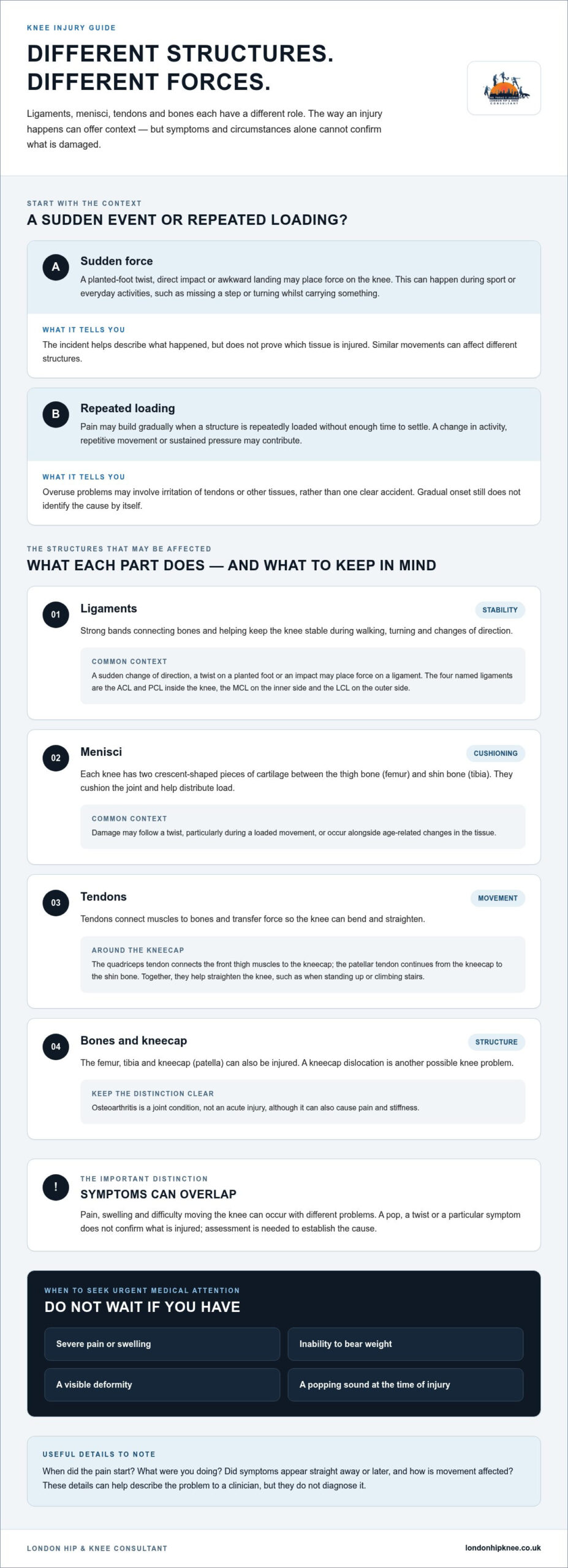
Ligaments are strong bands that connect bones and help keep the knee stable as you walk, turn or change direction. The menisci are two pieces of cushioning cartilage between the thigh bone (femur) and shin bone (tibia). They help distribute load across the joint.
Tendons have a different role: they connect muscles to bones and transfer force so the knee can bend and straighten. Bones can also be injured, including the femur, tibia and kneecap (patella). Overuse problems may involve irritation of tendons or other tissues after repeated strain, rather than one clear accident.
How can knee injuries happen?
Some injuries begin with a sudden event. A planted foot and a twist, a direct impact or an awkward landing may place force on the knee. These can happen during sport, but also during everyday activities such as missing a step or turning while carrying something.
Other problems build gradually when a structure is repeatedly loaded without enough time to settle. A change in activity, repetitive movements or sustained pressure may contribute. The circumstances can help a clinician understand what happened, but they don’t prove which tissue is injured. Similar movements can affect different structures, and an injury can occur without a dramatic incident.
Before an assessment, note when the pain started, what you were doing and how it affects your movement. Also consider whether symptoms appeared straight away or developed later. These details help describe the problem, but they don’t diagnose it.
Ligament and meniscus injuries: common causes and differences
Ligament and meniscus injuries can both cause knee pain, but they affect different structures. Ligaments help control the knee’s stability; the menisci are cushioning cartilage that help spread load between the bones. That distinction explains their different roles, but it doesn’t mean you can identify an injury from symptoms or the incident alone. A search for “types knee injury” may bring up familiar names such as ACL tears and meniscus damage, yet proper assessment is needed to establish what has happened.
What are ACL, PCL, MCL and LCL injuries?
The anterior cruciate ligament (ACL) and posterior cruciate ligament (PCL) sit inside the knee, crossing between the thigh bone and shin bone. They help control the bones’ movement relative to one another. The medial collateral ligament (MCL) runs along the inner side of the knee, whilst the lateral collateral ligament (LCL) is on the outer side. Both help resist sideways movement and support stability.
A ligament may be injured during a sudden change of direction, a twist on a planted foot or an impact. These mechanisms can place substantial force on the knee, but they don’t prove which ligament, if any, has been affected. The American Academy of Orthopaedic Surgeons outlines a range of common knee injuries, including sprains and ligament tears.
If you’d like to understand more about one specific ligament and the decisions involved in its care, read this ACL surgery guide.
What is a meniscus injury?
Each knee has two menisci, crescent-shaped pieces of cartilage between the thigh bone and shin bone. They cushion the joint and help distribute pressure as you move. Damage may follow a twist, particularly during a loaded movement, or occur alongside age-related changes in the tissue.
Pain, swelling or difficulty moving the knee can occur with meniscus damage, but these experiences are not unique to it. They can also arise with other knee problems, so they shouldn’t be used alone to diagnose a tear. The timing and nature of an injury can inform a clinical assessment, but neither a twist nor a particular symptom confirms the cause.
If knee symptoms persist or affect your everyday function, a specialist assessment may help clarify the problem and possible next steps. You can learn more about specialist knee assessment as one option for adult knee care in London.
Tendon, fracture and overuse knee injuries: what else can be affected?
Ligaments and menisci aren’t the only structures involved in knee problems. Tendons, bones and the kneecap can also be affected, whilst repeated loading may lead to pain that develops gradually rather than after one clear accident. Different knee structures can be affected by different forces, and the way pain begins cannot, by itself, identify the cause. These less familiar types knee injury are another reason not to rely on symptoms alone.
Tendon injuries, kneecap problems and fractures
The quadriceps tendon connects the muscles at the front of the thigh to the kneecap; the patellar tendon continues from the kneecap to the shin bone. Together, they help straighten the knee, for example when you stand up or climb stairs. These tendons can become irritated or injured, but pain around the front of the knee can have other explanations too.
A kneecap dislocation occurs when the patella moves out of its usual position. It’s different from other causes of pain around the kneecap, and you shouldn’t try to confirm or manage a suspected dislocation by appearance alone. Fractures, which involve a break in bone, also require professional assessment. If you suspect a fracture or dislocation, seek prompt medical attention. The American Academy of Orthopaedic Surgeons’ guide to common knee injuries covers fractures and dislocations alongside other injury types.
Overuse problems and pain that builds gradually
Not every knee problem starts with a twist or impact. Repeated activities such as running, jumping or frequent stair climbing can place recurring load on tissues around the joint. If that load exceeds what the tissues can comfortably manage, pain or irritation may build over time. This gradual pattern differs from a sudden injury, although the two can’t always be distinguished reliably without an assessment.
“Runner’s knee” is a familiar phrase for pain around the front of the knee, but it isn’t a precise diagnosis. The term doesn’t identify the structure involved or explain why the pain has developed. A change in activity, training or daily movement may be useful context to share with a clinician, but it can’t establish the cause on its own.
Persistent pain deserves attention even if you can’t recall a specific incident. If it’s affecting your movement or everyday function, an assessment by a knee specialist may help clarify what is contributing to it and what steps could be appropriate. You can find out more about specialist knee assessment as one option for adult knee care in London.
How do knee injury symptoms differ, and when should you seek help?
Pain, swelling and stiffness can occur with several different knee problems. The way symptoms feel may offer useful clues, but it can’t reliably show whether a ligament, meniscus, tendon or bone is affected. A list of symptoms is not a diagnosis or a treatment plan, and using one to decide whether it’s safe to carry on could delay appropriate care.
Can symptoms tell you which knee structure is injured?
Not on their own. A ligament injury may affect stability, whilst meniscus, tendon and bone problems can also cause pain, swelling or difficulty moving. Symptoms vary between people, and different injuries can feel similar. Even a clear account of how the knee was hurt cannot confirm the damaged structure.
To assess the problem, a clinician will consider when symptoms started, what you were doing, how the knee moves and what they find during an examination. Imaging may be appropriate in some cases to help clarify what’s injured. Understanding the types knee injury is useful, but matching symptoms to a category yourself isn’t a substitute for assessment.
Which knee injury symptoms need urgent attention?
Seek urgent NHS advice if the injury is significant or symptoms are severe. Examples include being unable to bear weight on the leg, a knee that is badly swollen or visibly out of shape, or difficulty moving it after an injury. A hot, red knee with fever or feeling unwell also needs prompt medical advice. These signs don’t establish a diagnosis, but they shouldn’t be ignored.
Contact NHS 111 for urgent advice on what to do next. If you think it’s a life-threatening emergency, call 999 or go to A&E. Don’t wait for a routine private orthopaedic appointment when urgent care may be needed.
If the problem isn’t urgent but pain persists or affects your movement, arranging a clinical assessment can help establish the next steps. Arrange a specialist knee assessment for ongoing concerns; this is not a substitute for urgent NHS care.
What happens next after a knee injury? Assessment and treatment options
After a knee injury, think in three steps: consider whether the problem needs urgent attention, arrange an appropriate assessment, then agree a care plan based on the findings. If you’re unsure about urgency, use NHS advice rather than waiting for a routine appointment. Once urgent concerns are addressed, a clinician can help clarify what may be causing the symptoms and what to do next—whether that begins with an in-person doctor or through digital healthcare platforms like askmydoc.ca that explain how to consult a physician virtually and secure specialist referrals.
How is a knee injury assessed?
A clinician will ask how and when the problem began, what movements aggravate it and how it affects your usual activities. They may examine the knee’s movement, areas of tenderness and stability, and consider your general health and relevant medical history. It can help to describe any change in symptoms over time and what activities you’re finding difficult. These details build a clearer picture, but no single part of the assessment necessarily gives the whole answer.
Imaging, such as an X-ray or MRI, may be considered if the history and examination suggest it could help. It isn’t automatically needed for every painful knee. Assessment findings guide whether further investigation or treatment is appropriate, and help ensure that decisions relate to the injury rather than symptoms alone.
When might a knee specialist be helpful?
Specialist advice may be useful if symptoms persist, the knee repeatedly feels unstable or you’re struggling to return to usual activities. Treatment depends on the structure affected, the extent of the problem, your health and your personal goals. It may involve non-surgical care, with procedures considered only where a clinician judges them appropriate. Surgery isn’t necessary for every knee injury; for non-invasive clinical rehabilitation, you can learn more about Benchmark Physio to see how structured physiotherapy aids joint recovery.
If you’ve already been diagnosed with an ACL injury, the ACL recovery stages guide explains more about the recovery process. Understanding the types knee injury is a useful starting point, but your assessment and care plan should reflect your specific situation.
For ongoing symptoms or questions about adult knee care, you can explore London Hip & Knee Consultant as one option for specialist assessment. The practice focuses on adult hip and knee orthopaedic care in London. This is not a substitute for urgent NHS care if you need immediate medical advice.
Take the next step towards understanding your knee pain
The types knee injury can involve different structures, from ligaments and menisci to tendons and bone. Pain, swelling and stiffness may overlap, so symptoms alone can’t confirm the cause. A clinical assessment helps guide whether further investigation or an individual care plan may be appropriate.
If symptoms are severe or you’re concerned about a significant injury, seek urgent NHS advice rather than waiting for a routine appointment. For ongoing pain, recurring instability or difficulty returning to everyday activities, specialist assessment may help you understand your options. Surgery isn’t needed for every injury; decisions depend on your individual findings, health and goals.
London Hip & Knee Consultant focuses on adult hip and knee orthopaedic care. Consultant Orthopaedic Surgeon Mr Parag Jaiswal has more than 18 years of medical experience. The practice offers knee care including arthroscopy, meniscus surgery and ACL reconstruction when appropriate following assessment. To discuss ongoing knee concerns with a specialist in London, explore specialist knee care in London.
With the right guidance, you can take a considered next step towards protecting your mobility and returning to the activities that matter to you.
Frequently Asked Questions
What are the most common types of knee injury?
Common knee injuries affect ligaments, menisci, tendons or bones, and some develop gradually through repeated loading. Ligaments help stabilise the joint, whilst the menisci cushion the bones inside it. Tendon problems, fractures and kneecap dislocations are other possibilities. Osteoarthritis can also cause knee pain, but it’s a joint condition rather than an acute injury. The phrase “types knee injury” covers a range of problems, and symptoms alone can’t identify which one you have.
How can I tell if I have injured a ligament or my meniscus?
You can’t reliably tell from symptoms alone. Ligament injuries may affect the knee’s stability, whilst meniscus problems involve the cartilage that cushions the joint. Both can cause pain, swelling or difficulty moving, and these symptoms overlap with other conditions. How the injury happened and when symptoms appeared can help guide an assessment, but don’t confirm the cause. A clinician may examine your knee and consider imaging if it’s appropriate.
Can you walk with a torn knee ligament?
Some people can walk after a knee ligament tear, but being able to bear weight doesn’t rule out a significant injury. Pain, swelling or a feeling that the knee is unstable may make walking difficult, and symptoms can vary. Don’t use walking ability as a test or push through activities that worsen your symptoms. If you’re concerned, particularly after a sudden injury, seek appropriate medical advice so the knee can be assessed.
What knee injury causes swelling after a twist?
Swelling after twisting your knee can occur with different injuries, including ligament or meniscus damage, but swelling alone can’t identify the cause. It may develop quickly or more gradually, and pain or restricted movement can accompany it. Note when the swelling began and what movement led to it, then share those details with a clinician. Seek urgent advice if the injury is severe, the knee looks deformed or you can’t bear weight.
When should I seek urgent help for a knee injury in the UK?
Seek urgent NHS advice if you have severe pain, major swelling, a visibly deformed knee or can’t put weight on your leg after an injury. Contact NHS 111 for guidance on the appropriate next step. If you believe it’s a life-threatening emergency, call 999 or go to A&E. Don’t wait for a routine private orthopaedic appointment when urgent assessment may be needed; private specialist care isn’t emergency trauma care.
Do all knee injuries need surgery?
No, surgery isn’t needed for every knee injury. The right approach depends on what’s injured, the severity, your health and your personal goals. A clinician may recommend non-surgical care, further investigation or, in some cases, a procedure. Surgery should follow an individual assessment, not a symptom checklist or assumption based on how the injury happened. If symptoms persist or affect daily activities, discuss your options with a suitable healthcare professional.
How is a knee injury diagnosed?
A knee injury is assessed through your account of how symptoms began, your medical history and an examination. A clinician may check movement, tenderness and stability, then decide whether imaging, such as an X-ray or MRI, could help. Not everyone needs a scan. The findings are considered together to establish what may be injured and whether treatment or further investigation is appropriate. Seek urgent NHS advice first if symptoms are severe.