

What if surgery isn’t the right answer to persistent hip pain? Ongoing discomfort or restricted movement can make everyday activities and exercise difficult, but symptoms don’t always show whether the cause is inside the hip joint or in the surrounding tissues. Hip arthroscopy is a targeted option for certain problems, not a default response to every painful hip.
If you’re weighing up treatment, it’s reasonable to want clear answers about what may be causing your symptoms, whether an operation could help and what recovery involves. Hip arthroscopy may be considered for issues such as femoroacetabular impingement or a labral tear, while arthritis may call for a different approach.
This guide explains what hip arthroscopy is designed to treat, how it compares with non-surgical care and other procedures, and what specialist assessment and rehabilitation may involve. It will help you prepare questions for a specialist, including Mr Parag Jaiswal, whose London practice provides hip arthroscopy as part of adult hip and knee care.
Key Takeaways
- Hip arthroscopy is a targeted procedure for certain hip problems. Whether it’s appropriate depends on the diagnosis and condition of the joint.
- A scan finding alone doesn’t determine treatment. Your symptoms, examination and imaging need to be considered together.
- Non-surgical care, hip arthroscopy and hip replacement have different purposes. The right option depends on your individual circumstances and goals.
- Specialist assessment can help clarify whether your symptoms are coming from the hip joint and what factors may affect your suitability for surgery.
- Learn what to expect when discussing your options and recovery with Mr Parag Jaiswal’s specialist hip and knee practice in London.
What is hip arthroscopy, and what can it help treat?
Hip arthroscopy is keyhole surgery that uses a small camera and instruments, passed through small incisions, to examine and treat certain problems inside the hip joint. The camera allows the surgeon to view the joint directly and, where appropriate, address a diagnosed problem. The procedure doesn’t guarantee pain relief and isn’t suitable for every cause of hip pain.
Persistent pain or restricted movement can have several sources, including structures inside the joint and surrounding tissues. Whether surgery is appropriate depends on the diagnosis, the condition of the joint and hip cartilage and your individual circumstances, rather than symptoms alone. A specialist assessment brings these factors together before treatment options are discussed.
What happens during a hip arthroscopy?
The surgeon guides an arthroscope, a narrow instrument with a small camera, into the joint. Images from the camera show the area being assessed. If the findings match a problem that can be treated this way, instruments may be used to address it. The procedure is therefore directed at a specific diagnosis, rather than being a general treatment for hip pain.
For a broader overview of the approach and its uses, see Hip arthroscopy. Your treatment plan, however, depends on your assessment and the condition of your hip.
Which hip problems may be considered for arthroscopy?
Labral damage and femoroacetabular impingement (FAI), where the shape of the hip bones can cause contact during movement, are examples a specialist may assess. Finding one of these changes on imaging doesn’t automatically mean surgery is the best option. The scan needs to be considered alongside your symptoms and clinical examination, because an image alone may not explain what you’re experiencing.
Other causes of pain may need different care, and the condition of the joint matters when weighing up treatment. Note which movements and activities bring on symptoms, and how these affect your daily routine. This information can help your specialist assess whether a finding on a scan fits the problem you’re experiencing.
In London, Mr Parag Jaiswal’s specialist adult hip and knee practice provides assessment and hip arthroscopy. The aim of assessment is to clarify what may be driving your symptoms and whether this procedure is a suitable option to discuss, not to presume that surgery is needed.
How diagnosis guides hip arthroscopy and treatment choices
Hip pain can affect walking, sitting, sleep or exercise, but the place you feel discomfort doesn’t always identify its cause. Before discussing hip arthroscopy, a specialist considers your account of the symptoms, examination findings and relevant imaging together. This helps distinguish a change seen on a scan from a problem that is actually contributing to your symptoms.
What may happen at a hip specialist assessment?
You may be asked when the pain began, where you feel it and which movements make it better or worse. The discussion can also cover how symptoms affect daily activities and sport, and what treatment you’ve already tried. Examination findings help the specialist understand your hip movement and decide whether further investigation may be useful. The next step depends on what the assessment reveals.
What can scans show, and what can they not decide?
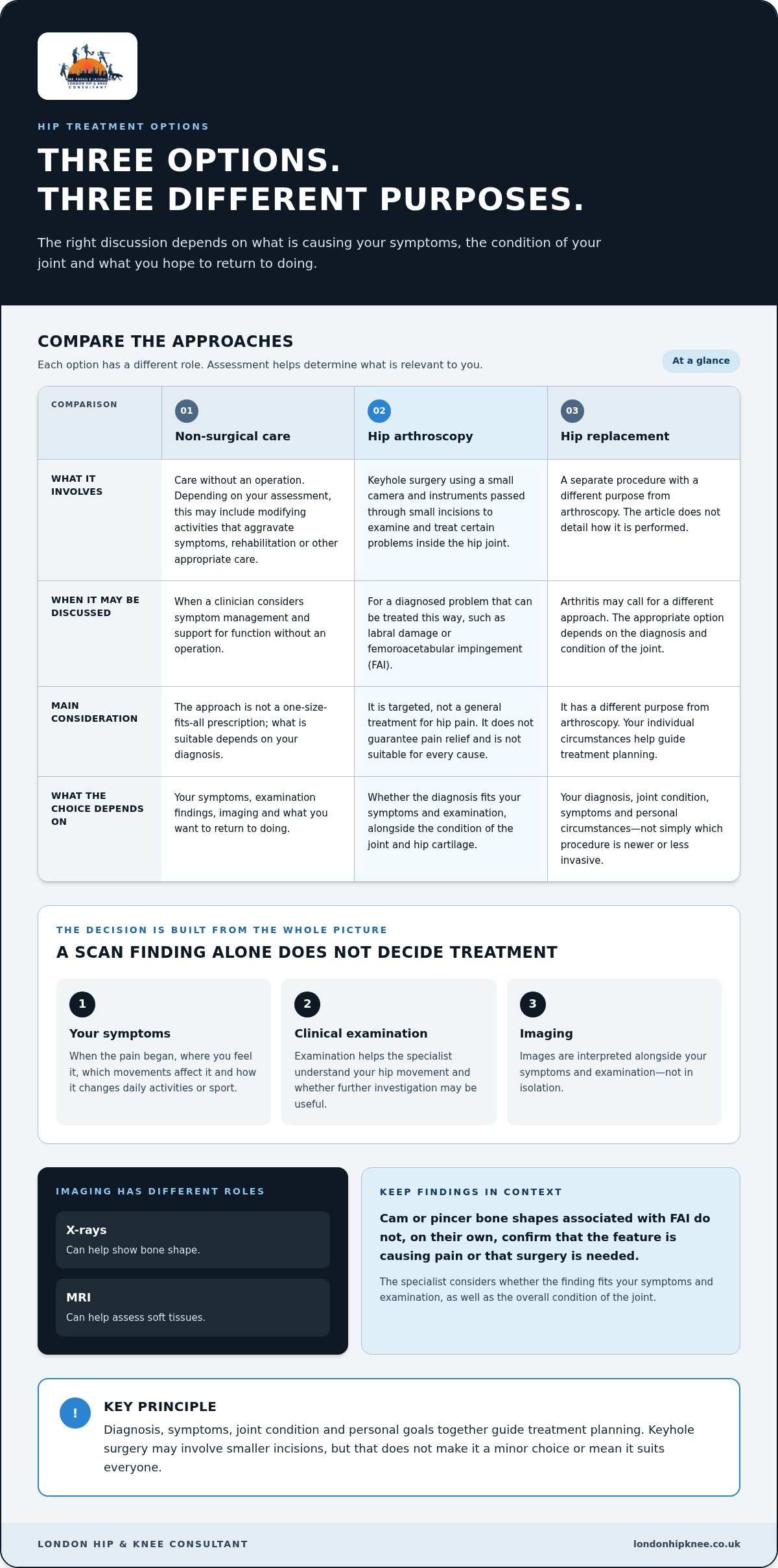
X-rays and MRI can provide different information. X-rays can help show bone shape, whilst MRI can help assess soft tissues. Neither scan, by itself, decides whether an operation is appropriate. The images need to be interpreted alongside your symptoms and examination, and further tests are considered only where they may help clarify the picture.
For example, cam and pincer morphology describe bone shapes associated with femoroacetabular impingement. Seeing one of these features does not, on its own, confirm that it is causing pain or that surgery is needed. The specialist considers whether the finding fits your symptoms and examination, as well as the overall condition of the joint. Yale Medicine also describes the importance of assessing the individual problem rather than treating a scan in isolation.
It can help to describe specific activities that bring on discomfort, such as climbing stairs, getting in and out of a car or turning during exercise. These details give context to examination and imaging findings, and help shape a discussion around what you want to return to doing. Bring any previous scan reports or treatment information you have, so they can be considered as part of the assessment.
In brief: diagnosis, symptoms, joint condition and personal goals together guide treatment planning. Read more about hip care with Mr Parag Jaiswal in London.
Hip arthroscopy versus non-surgical care and hip replacement
Choosing treatment isn’t simply a question of which procedure is newer or less invasive. Each option has a different purpose, and the right discussion depends on what is causing your symptoms, the condition of the joint and what you hope to return to doing. Keyhole surgery may involve smaller incisions, but that doesn’t make it a minor choice or mean it suits everyone. Potential benefits, risks and recovery all need careful consideration.
When might non-surgical treatment be discussed?
Depending on your assessment, a clinician may discuss modifying activities that aggravate symptoms, rehabilitation or other appropriate care. These approaches may aim to manage symptoms and support function without an operation. They aren’t a one-size-fits-all prescription. What’s suitable depends on your diagnosis and circumstances.
If pain continues despite a treatment plan, or starts to limit daily activities, a review can help reconsider what may be driving it and whether the next step should change. Reassessment doesn’t automatically lead to surgery. It gives you and your specialist an opportunity to weigh up the options in light of your symptoms and priorities.
How is hip arthroscopy different from hip replacement?
Hip arthroscopy is used to address selected problems within the joint, such as a labral injury or impingement, when the assessment supports that approach. Hip replacement serves a different purpose: it replaces damaged joint surfaces and may be considered when the joint itself is significantly affected. They aren’t interchangeable procedures, and one isn’t automatically the next step after the other.
In broad terms, the discussion may consider:
- Non-surgical care: approaches to manage symptoms and support movement without an operation.
- Arthroscopy: a targeted procedure for certain diagnosed problems inside the joint.
- Hip replacement: an operation that addresses a different situation involving the joint surfaces.
The word “keyhole” can make surgery sound straightforward, but it doesn’t remove the need to consider whether the likely benefit is worthwhile for you. Your joint condition, general health, daily demands and personal goals all matter. A specialist can explain why an option may or may not fit the clinical picture, and what its implications could be.
There’s no universal winner. A considered treatment plan matches the option to the problem, rather than choosing an operation first and trying to make the diagnosis fit.
Who can have hip arthroscopy and what is recovery like?
Persistent pain alone doesn’t determine whether surgery is suitable. A specialist considers whether a specific problem has been diagnosed, whether it fits your symptoms and examination, and what condition the joint is in. Your overall health and what you want to return to, such as comfortable walking, work or sport, also help shape the discussion.
What factors can influence suitability?
The decision is individual. A specialist may consider the type of problem, the degree of change in the joint and whether the clinical findings support treating it with an operation. Your general health and personal priorities matter too. For example, the demands of your work or preferred activities can help clarify what outcomes are important to you and what trade-offs you’re prepared to consider.
There isn’t a single symptom or scan result that can establish suitability on its own. Assessment helps determine whether the proposed procedure addresses the source of the difficulty, or whether another approach may be more appropriate. You should have the opportunity to discuss expected benefits, possible risks and alternatives before making a decision.
What should patients understand about recovery?
Recovery is a process, not simply a date on the calendar. Your treating team will provide individual instructions, including guidance on rehabilitation and how to build activity back up. Progress can differ between patients, and return to work, everyday tasks or sport depends on factors such as the procedure performed, your healing and the demands of the activity. Don’t use someone else’s timeline as a substitute for your own clinical advice.
Before deciding, consider asking your specialist:
- What diagnosis is guiding the recommendation, and how do the findings relate to my symptoms?
- What are the alternatives to surgery in my circumstances?
- What benefits, risks and limitations should I understand?
- What will rehabilitation involve, and how will progress be reviewed?
- What might influence my return to work, daily activities or sport?
Writing down your questions and describing the activities you hope to resume can make the consultation more useful. In London, Mr Parag Jaiswal’s specialist adult hip and knee practice provides assessment and hip arthroscopy, with decisions grounded in your individual situation.
Find out more about specialist hip assessment and discuss your diagnosis, treatment choices and possible recovery needs.
Discussing hip arthroscopy with a London specialist
A consultation is an opportunity to connect your symptoms with assessment findings and understand the options, not a commitment to surgery. In Mr Parag Jaiswal’s specialist adult hip and knee practice in London, the discussion can move step by step: describe what you’re experiencing, review relevant findings, compare suitable approaches and agree what happens next. Hip arthroscopy is considered where it may address the diagnosed problem and fit your individual circumstances.
Preparing for a hip arthroscopy consultation
A few notes beforehand can help you explain how your hip is affecting you. Record when symptoms began, where you feel them and which activities make them better or worse. Include practical examples, such as difficulty with walking, sitting, work or sport. Bring relevant scan reports and details of your medical history or previous treatment, if available.
It’s also useful to think about what you hope to achieve and what concerns you most. You might want to discuss alternatives to surgery, possible risks and what recovery could mean for your routine. Mr Jaiswal brings more than 18 years as a medical professional to his specialist hip and knee practice; the consultation remains focused on your symptoms, findings and priorities.
What to ask about the recommended treatment plan
Ask for a clear explanation of the diagnosis and how it relates to your symptoms. You can also ask what the assessment or imaging can establish, and what remains uncertain. Understanding the reasoning behind a recommendation can make it easier to weigh up the decision at your own pace.
- What problem is the proposed treatment intended to address?
- What alternatives are appropriate, including non-surgical care?
- What benefits and risks are relevant to my situation?
- What would rehabilitation involve, and how might it affect work and daily activities?
- What are the next steps if I decide to proceed, or if I need more time to consider?
The aim is an informed conversation, with realistic expectations and a plan that reflects your diagnosis and goals. Read about consultation options with Mr Parag Jaiswal in London.
Details of specialist hip consultations are available online.
Take the next step towards clearer answers
Hip arthroscopy is a focused option for certain diagnosed problems, not a default treatment for every painful or restricted hip. Whether it may suit you depends on the cause of your symptoms, the condition of the joint and your personal goals. A scan can inform the discussion, but it needs to be understood alongside your symptoms and clinical assessment.
Non-surgical care, arthroscopy and hip replacement each have different roles. A specialist can help you compare relevant options, understand potential risks and benefits, and discuss what rehabilitation may involve without assuming that surgery is the right choice.
At London Hip & Knee Consultant, care is led by Consultant Orthopaedic Surgeon Mr Parag Jaiswal, and hip arthroscopy is among the specialist surgical services provided. If ongoing symptoms are affecting your daily life, a considered assessment can help you understand the next steps.
Explore hip arthroscopy care with London Hip & Knee Consultant and arrange a specialist discussion about your options.
Frequently Asked Questions
What is hip arthroscopy used to treat?
Hip arthroscopy is used to assess and treat selected problems inside the hip joint, including labral damage and femoroacetabular impingement. A specialist considers whether a suspected problem matches your symptoms, examination and imaging findings. A scan alone doesn’t establish that surgery is appropriate, and hip pain can also come from other causes. The treatment plan depends on the diagnosis and condition of your joint.
Is hip arthroscopy a major operation?
Hip arthroscopy is keyhole surgery, but it’s still an operation and shouldn’t be treated as minor simply because it uses small incisions. It involves a procedure inside the hip joint, and recovery and rehabilitation need careful planning. As with any operation, potential benefits and risks should be discussed in relation to your health and diagnosis. Your specialist can explain what the procedure would involve in your individual case.
Can hip arthroscopy help a labral tear?
It may be considered for a labral tear if a specialist finds that the tear is relevant to your symptoms and suitable for arthroscopic treatment. Imaging can show changes in the labrum, but those findings need to be considered alongside your history and clinical examination. The discussion should also cover other treatment options, expected recovery demands and whether the likely benefits make surgery a reasonable choice for you.
How long does recovery from hip arthroscopy take?
Recovery varies between patients and depends on the problem treated, the procedure performed and your progress with rehabilitation. Your treating team will give you individual instructions about activity, physiotherapy and when to build towards work, daily tasks or sport. Don’t assume that a particular timeline will apply to you or use another person’s experience as a guide. Discuss your work and activity goals when planning recovery.
What happens if hip arthroscopy is not suitable for me?
If arthroscopy isn’t considered appropriate, your specialist can explain why and discuss other options based on your diagnosis and joint condition. These may include non-surgical care, such as activity adjustments or rehabilitation, or another procedure where suitable. The next step could also involve clarifying the diagnosis. Not being suited to one operation doesn’t mean there are no ways to address your symptoms or support your function.
Can I have hip arthroscopy in London?
Yes. London Hip & Knee Consultant provides hip arthroscopy as part of specialist adult hip and knee care in London. Care is led by Mr Parag Jaiswal, a Consultant Orthopaedic Surgeon. Whether the procedure is suitable depends on your assessment, including your symptoms, diagnosis and joint condition. A consultation can help you understand the findings, compare treatment choices and discuss appropriate next steps.