

What matters when choosing an Arthrosamid clinic in London is not a confident promise, but a careful assessment of whether the treatment suits your knee. If ongoing pain or stiffness is disrupting everyday activities, it’s understandable to want relief while feeling unsure about benefits, safety and recovery. Start by considering the quality of the assessment, not the promise of a guaranteed result.
Arthrosamid is an injectable hydrogel used for knee osteoarthritis. It’s designed to integrate with the joint lining, but it won’t be suitable for everyone or replace consideration of other treatments. A specialist assessment should take account of your symptoms, the condition of your knee and what you hope to achieve.
This guide explains how Arthrosamid works, who may be considered for treatment and what to understand about the injection and recovery. You’ll also learn what to look for when choosing specialist knee care in London and how Mr Parag Jaiswal can discuss the options with you. The aim is to help you make an informed decision, with realistic expectations and your individual needs at the centre.
Key Takeaways
- Learn what Arthrosamid is and why it may be considered for knee osteoarthritis, without mistaking it for a cure.
- Understand why suitability depends on your symptoms, knee assessment and treatment goals, rather than a one-size-fits-all promise.
- Compare Arthrosamid with other treatment options by considering their aims, practicalities and uncertainties.
- Prepare for a consultation by noting how your symptoms have changed and which treatments you have already tried.
- When choosing an arthrosamid clinic london, consider whether the specialist offers an individual assessment and a clear discussion of your care.
What should you expect from an Arthrosamid clinic in London?
Arthrosamid is a polyacrylamide hydrogel injection used in the treatment of knee osteoarthritis. It’s one possible part of knee care, not a cure or an automatic recommendation for anyone with knee pain. Osteoarthritis affects the joint and can cause pain, stiffness and difficulty with everyday movement. Read more about the condition in this overview of Osteoarthritis.
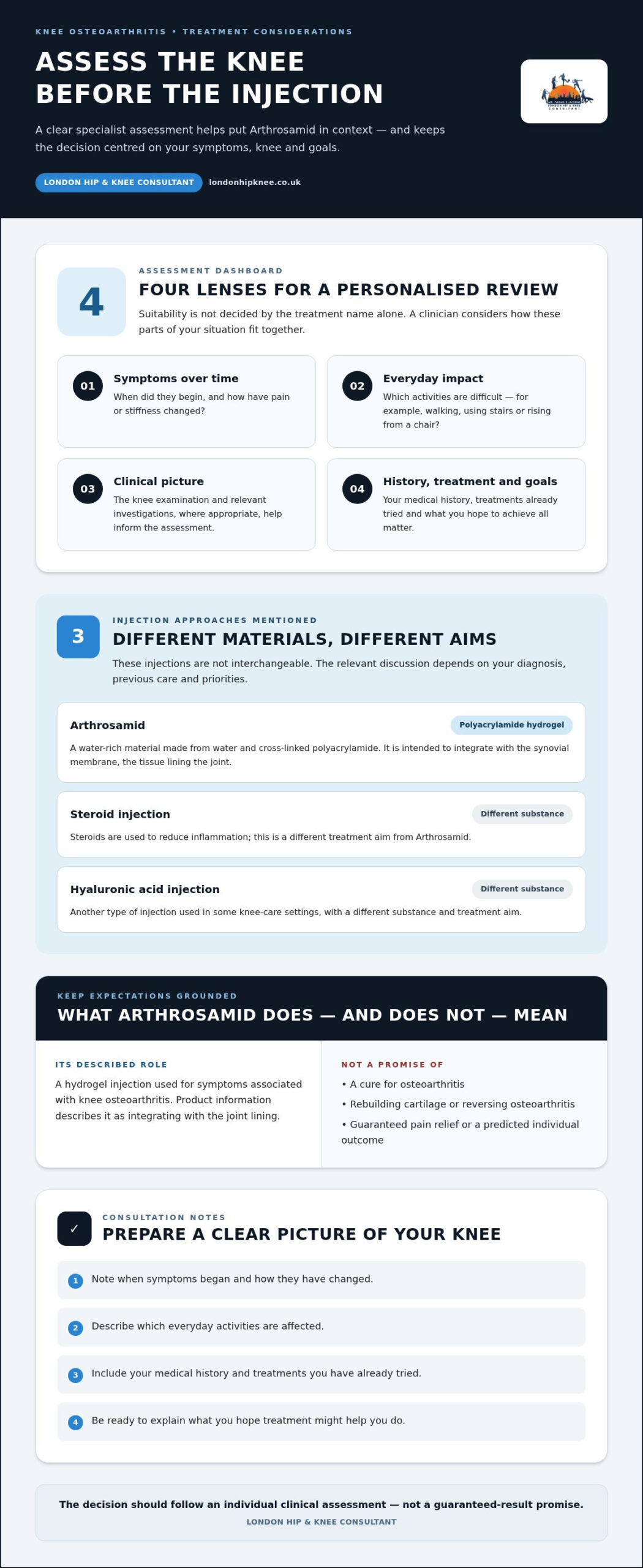
A useful assessment starts with your experience, not simply the name of a treatment. The clinician should consider what may be causing your symptoms, how they affect your daily life and what you want treatment to help you do. Information about Arthrosamid can explain its intended role, but an individual clinical assessment is needed to determine whether it may be appropriate for you.
What does an Arthrosamid clinic assess?
Expect to discuss when your knee symptoms began, how they have changed and which activities are difficult, such as walking, using stairs or getting up from a chair. Your medical history and previous treatments also matter. A clinical examination, alongside relevant investigations where appropriate, can help build a clearer picture of your knee and inform a discussion of suitable options.
Knee pain can have different causes, so symptoms alone don’t establish that osteoarthritis is responsible or that an injection is the right next step. The assessment should relate your symptoms to the clinical findings and your goals. This keeps the conversation focused on your knee rather than on a general description of the treatment.
Why consider a London-based knee specialist?
When choosing an arthrosamid clinic london, consider the local setting, but focus on how carefully the clinician assesses your condition and explains the available options. A specialist focused on adult hip and knee conditions can consider Arthrosamid in the wider context of knee care, rather than presenting the injection as a stand-alone solution.
At London Hip & Knee Consultant, care is led by Consultant Orthopaedic Surgeon Mr Parag Jaiswal, whose practice focuses on adult hip and knee conditions. A specialist review is a conversation about your diagnosis, priorities and possible approaches. It should help you understand whether Arthrosamid merits consideration while leaving room to discuss other appropriate knee treatments. An injection shouldn’t be assumed before that assessment.
How does Arthrosamid work, and who may be suitable?
Arthrosamid is a polyacrylamide hydrogel injection used to treat symptoms associated with knee osteoarthritis. A hydrogel is a soft material containing a high proportion of water; Arthrosamid is made from water and cross-linked polyacrylamide. Product information describes it as integrating with the synovial membrane, the tissue lining the joint. This differs from steroid or hyaluronic acid injections, which use different substances and have different treatment aims.
That distinction doesn’t mean Arthrosamid rebuilds cartilage, reverses osteoarthritis or guarantees pain relief. It’s an option to discuss in the context of a diagnosed knee condition. The NHS overview of osteoarthritis explains common symptoms and other approaches to managing the condition, helping put an injection into perspective.
What is the role of polyacrylamide hydrogel?
In straightforward terms, the hydrogel is a water-rich material intended to remain in the joint and interact with its lining. It isn’t a steroid, which is used to reduce inflammation, or hyaluronic acid, another type of injection used in some knee-care settings. These treatments aren’t interchangeable. The relevant discussion depends on your diagnosis, previous care and priorities. Arthrosamid shouldn’t be presented as a cure or as a way to restore damaged cartilage.
Who might discuss Arthrosamid with a specialist?
Adults with knee osteoarthritis may wish to discuss Arthrosamid if pain or stiffness is affecting activities that matter to them. That doesn’t establish suitability. A clinician considers the diagnosis and examination findings alongside symptom severity, medical history, previous treatment and what you hope to achieve. One person may prioritise making everyday walking more manageable; another may want to understand how the option fits into a broader knee-care plan.
There isn’t a self-check that can confirm whether the injection is appropriate. Knee pain has more than one possible cause, and the treatment decision needs to follow a clinical assessment. The clinician should explain the evidence, possible benefits and uncertainties relevant to your circumstances. Results or duration described in general information don’t predict your individual outcome; discuss these details using current clinical and product information.
If you’re considering an arthrosamid clinic london, look for a consultation that makes space for questions and a balanced discussion, rather than treating an injection as the default answer. Mr Parag Jaiswal leads London Hip & Knee Consultant, a practice focused on adult hip and knee conditions. Explore specialist knee care in London as you consider your next steps.
How should you compare Arthrosamid with other knee treatment options?
Different treatments have different aims, and none is automatically right for every knee. Compare options in light of your diagnosis, symptoms, previous care and priorities. NICE’s guidelines for osteoarthritis provide a framework for established management, including exercise, weight management where appropriate and medicines. An Arthrosamid discussion should sit alongside, not replace, consideration of these approaches.
| Option | Treatment aim | Assessment and practical considerations | Key uncertainty |
|---|---|---|---|
| Conservative care | Support movement and manage symptoms through approaches such as exercise, physiotherapy and medicines. | Plans can be tailored to your health, function and day-to-day needs, and may be used alongside other treatments. | Progress and symptom response vary between individuals. |
| Steroid injection | Reduce inflammation and ease symptoms for some people. | A clinician considers the diagnosis, health history and whether an injection is appropriate. | Relief may be temporary, and response varies. |
| Arthrosamid | Offer a different injectable option for knee osteoarthritis. | Suitability depends on clinical findings, symptoms, previous treatment and personal aims. | Individual benefit and its duration can’t be guaranteed; discuss current evidence with the clinician. |
| Knee replacement | Address joint damage and symptoms through surgery. | May enter the conversation if symptoms and assessment findings indicate a surgical pathway. | Whether surgery is appropriate depends on the whole clinical picture and a discussion of its benefits and risks. |
Arthrosamid, steroid injections and other non-surgical options
Arthrosamid isn’t another name for a steroid injection. The materials and intended treatment roles differ, so compare what each option is designed to do, the evidence available and how it fits your circumstances. Conservative care may remain relevant even if an injection is considered. There’s no reliable basis here for promising that one option will work better for you or quoting head-to-head success rates.
When might knee replacement enter the discussion?
If pain and limitations persist, or assessment shows more advanced joint damage, the discussion may include surgery rather than another injection. That isn’t an automatic next step: the decision should reflect your symptoms, findings and preferences. For an overview, read this knee replacement specialist guide. If you’re considering the wider treatment journey, see what can affect knee replacement costs in London.
A thoughtful arthrosamid clinic london discussion should help you weigh these choices without presenting any one treatment as a universal solution.
What happens at an Arthrosamid consultation in London?
A consultation should give you space to explain what’s happening with your knee and understand the options before making a decision. The process is individual: having knee pain or exploring treatment doesn’t mean an Arthrosamid injection is suitable.
Your consultation, step by step
- 1. Discuss your symptoms. Describe when they began, how they’ve changed and which activities are affected, such as walking, using stairs or sleeping comfortably.
- 2. Review your health and treatment history. Talk through relevant medical conditions, medicines and previous knee treatments, including how helpful or difficult you found them.
- 3. Assess the knee. The clinician examines your knee and considers relevant investigations where needed to understand the diagnosis and findings.
- 4. Consider the options. Discuss whether Arthrosamid or another approach may fit your clinical picture and personal goals.
- 5. Agree the next step. If treatment is being considered, review its potential benefits, limitations, risks, aftercare and any follow-up discussion before deciding how to proceed.
How to prepare for your specialist appointment
A few notes can help you explain the impact of your symptoms clearly. Record when the problem started, whether it comes and goes or is getting worse, and what you now find harder to do. For example, note whether standing for a while or walking a familiar route brings on discomfort.
Bring relevant details of your medical history and previous knee treatments, including medicines or injections you’ve tried and how you responded. You don’t need to arrive with a decision already made. Ask whether Arthrosamid may suit your diagnosis, what alternatives might be considered and what remains uncertain.
What should you understand before deciding?
Ask the clinician to explain the proposed treatment in terms you understand, including its intended role, possible benefits and limitations, and risks relevant to your health. You should also know what aftercare involves, whether follow-up is planned and what to do if you have concerns afterwards. No injection can promise a particular result, so it’s reasonable to ask how the available evidence applies to your circumstances.
Procedural details and recovery advice depend on the clinician’s assessment and the plan agreed with you. If you’re considering an arthrosamid clinic london, a clear consultation should leave you better informed, not pressured. To discuss your knee symptoms and possible care options, arrange a specialist knee consultation.
Why discuss Arthrosamid with London Hip & Knee Consultant?
Choosing where to discuss an injection means finding a specialist who can consider it in the context of your knee condition and wider care. London Hip & Knee Consultant is led by Mr Parag Jaiswal, a Consultant Orthopaedic Surgeon whose practice focuses on adult hip and knee conditions. He has been a medical professional for over 18 years.
For knee osteoarthritis, Arthrosamid is one option within a broader treatment discussion. A considered conversation should begin with your symptoms, clinical findings and aims, then explain how the injection might fit alongside other approaches. It should also address what is known, what remains uncertain and why an option may or may not suit your circumstances. No treatment can guarantee a specific result.
A specialist approach to knee osteoarthritis
A focus on hip and knee conditions provides a relevant setting for discussing knee symptoms and treatment choices. The aim is to understand the individual problem and explain possible next steps clearly, not to steer every patient towards an injection. Your priorities matter too: you may want to manage discomfort during daily activities, understand non-surgical options or consider how different treatments fit into your longer-term plan.
How to take the next step in London
If you’re considering an arthrosamid clinic london, bring questions that help you make an informed decision. For example:
- What do my assessment findings suggest about the cause of my knee symptoms?
- Why might Arthrosamid be considered for me, and what alternatives are relevant?
- What potential benefits, limitations and risks should I understand?
- What would the next steps involve if I decide to proceed, or if I don’t?
You can explore specialist knee care and discuss your symptoms and treatment options with Mr Jaiswal. You don’t need to arrive having already chosen a treatment. The right plan should reflect your clinical needs, personal goals and informed preferences.
Take an informed next step for your knee
Choosing an arthrosamid clinic london starts with more than learning about the injection. Suitability depends on your diagnosis, symptoms, health history and what you hope to achieve. A careful consultation should explain how Arthrosamid compares with other options, including its potential benefits, limitations and risks, without promising a particular outcome.
At London Hip & Knee Consultant, care is led by Consultant Orthopaedic Surgeon Mr Parag Jaiswal, who has over 18 years of experience as a medical professional. Arthrosamid injections are among the specialist knee treatments available and are considered as part of an individual approach to knee osteoarthritis.
If knee pain or stiffness is affecting your daily life, discussing your concerns with a specialist can help you understand the choices ahead. Explore specialist knee care with Mr Parag Jaiswal and take the next step at a pace that feels right for you. Your treatment plan should reflect your clinical needs and personal goals, giving you a clearer basis for moving forward.
Frequently Asked Questions
What is Arthrosamid and how is it used for knee osteoarthritis?
Arthrosamid is an injection of polyacrylamide hydrogel used to treat knee osteoarthritis. The hydrogel is a water-rich material that integrates with the joint lining. Unlike steroid or hyaluronic acid injections, it uses a different material and treatment approach. It isn’t designed to rebuild cartilage or reverse arthritis. A specialist considers it alongside your diagnosis, symptoms and other knee-care options, rather than as a guaranteed solution.
Who may be suitable for an Arthrosamid injection?
Adults with knee osteoarthritis, particularly those with ongoing symptoms despite other treatments, may discuss Arthrosamid with a specialist. Suitability isn’t determined by symptoms alone. A clinician considers your diagnosis, examination findings, health history, previous treatments and goals. It may not be appropriate in some circumstances, such as severe joint damage, active infection or a previous knee replacement in that joint. An individual assessment is needed before making a recommendation.
How long can Arthrosamid relief last?
Clinical studies have reported pain relief sustained for several years in some patients, but this doesn’t predict how long an individual will benefit. Response varies, and evidence about long-term benefit and cost-effectiveness remains an area of uncertainty. Ask the clinician to explain what current evidence suggests, its limitations and how outcomes are monitored. A responsible discussion won’t promise a specific level or duration of relief.
Is Arthrosamid injection painful, and what happens during treatment?
People’s experience of discomfort varies. The injection is generally described as a minimally invasive outpatient procedure using local anaesthetic, with ultrasound guidance used to help place it in the joint. Antibiotics may be given as a precaution. Your clinician should explain the procedure and what to expect before you decide. Light activity may be possible the same day, but follow the personalised aftercare advice you’re given.
What are the possible risks or side effects of Arthrosamid?
Possible risks include infection or a temporary increase in discomfort around the treated knee, as with joint injections generally. Your personal risk depends on your health and clinical circumstances, so ask the specialist to explain product-specific risks and warning signs that need medical attention. Tell the clinician about relevant health conditions, medicines, allergies or any current infection before treatment. They should also discuss appropriate aftercare and follow-up.
Can Arthrosamid cure knee osteoarthritis or replace knee surgery?
No. Arthrosamid doesn’t cure osteoarthritis or reverse joint damage, and it isn’t a guaranteed substitute for surgery. It may be considered as one non-surgical option for some people with knee osteoarthritis. If symptoms remain limiting or assessment indicates substantial joint damage, knee replacement may also be discussed. The appropriate path depends on your condition, treatment goals and preferences, following a balanced conversation with a specialist.
How do I choose an Arthrosamid clinic in London?
Choose an arthrosamid clinic london by looking for a careful, individual assessment rather than a promise of results. The consultation should establish the cause of your symptoms, review your health and previous treatments, and explain suitability, alternatives, uncertainties and risks. At London Hip & Knee Consultant, care is led by Mr Parag Jaiswal, a Consultant Orthopaedic Surgeon with over 18 years of experience as a medical professional.