

What if the right knee specialist is the one who helps you avoid surgery, rather than rush you towards it? If you’ve searched “knee specialist london”, you may already be dealing with pain that makes walking, running or everyday tasks difficult. It’s understandable to want a clear diagnosis while feeling unsure whether injections, keyhole surgery or a knee replacement is the right next step.
A good specialist looks beyond the procedure. They assess what may be causing your symptoms, explain the options and recommend treatment suited to your knee, health and goals. That may mean considering non-surgical care, including Arthrosamid injections where appropriate, or discussing surgery when other approaches haven’t restored your comfort and mobility.
This guide explains what to look for when comparing specialists and what to expect, from consultation and imaging to treatment decisions. You’ll find questions to ask, ways to weigh conservative care against surgery, and practical checks for a consultant with experience across both. The aim is to help you make an informed choice and work towards returning to activities you enjoy, whether that’s golf, running or a walk in one of London’s parks.
Key Takeaways
- Look for relevant knee expertise and experience with the condition and procedure being considered.
- Understand how a specialist’s examination and appropriate imaging can help clarify the cause of your symptoms.
- Ask whether Arthrosamid injections may suit your individual knee condition, and discuss their potential benefits and limitations.
- Check practical details, including GMC registration and procedure-specific experience, when assessing a consultant.
- Find out how Mr Parag Jaiswal’s experience in adult hip and knee care informs consideration of both surgical and non-surgical options.
What to Look for in a Knee Specialist London Patients Can Consult
Look for a consultant orthopaedic surgeon whose experience is relevant to the problem affecting your knee. Depending on the diagnosis, this may mean experience in joint preservation, knee reconstruction or soft tissue procedures involving the meniscus or ligaments. Fellowship training focused on knee surgery can indicate further sub-specialist experience, but ask how the consultant’s practice relates to your diagnosis and treatment needs.
London offers a wide choice of private hospitals and specialist practices, but the setting alone doesn’t establish expertise. A GP can assess your symptoms and arrange initial care or referral. A physiotherapist can help with movement, strength and rehabilitation. A consultant orthopaedic surgeon assesses the joint from a medical and surgical perspective, investigates possible causes and discusses treatment options, including whether surgery is appropriate.
Consider a specialist consultation if pain continues despite the management you’ve tried, restricts daily activities, or comes with persistent swelling, instability or difficulty bearing weight. You don’t need to assume surgery is the next step. An assessment can help clarify the cause and whether further non-surgical care, imaging or an operation should be considered.
The Role of a Consultant Orthopaedic Surgeon
In the UK, “consultant” describes a senior hospital doctor who has completed specialist training. Within orthopaedics, experience may focus on particular joints and procedures. Knee mechanics involve bones, cartilage, ligaments and other soft tissues, so ask whether the surgeon regularly assesses and treats conditions like yours. Check their registration on the GMC’s Specialist Register, and ask about relevant training, experience with the procedure being considered and how they keep their practice current. Some specialists may contribute to research or clinical trials, so ask rather than assume.
Why Seek Private Knee Care in the Capital?
Private care may allow you to choose a named consultant and arrange an assessment outside the NHS pathway, although appointment and imaging timings vary. Ask which investigations are appropriate. An X-ray, MRI or, in selected cases, CT may be recommended depending on your symptoms and examination. A 3T MRI isn’t necessary for every knee problem, so ask whether it would add useful information and where it would take place.
London has clinics in different locations, which may make follow-up more practical if the appointments suit your travel needs. Confirm where consultations and any planned treatment will take place, and how follow-up is organised. If replacement surgery is discussed, ask about alternatives and recovery as well as the procedure itself. This overview of knee replacement surgery offers general background for that conversation.
The Specialist Diagnostic Journey: From Pain to Clarity
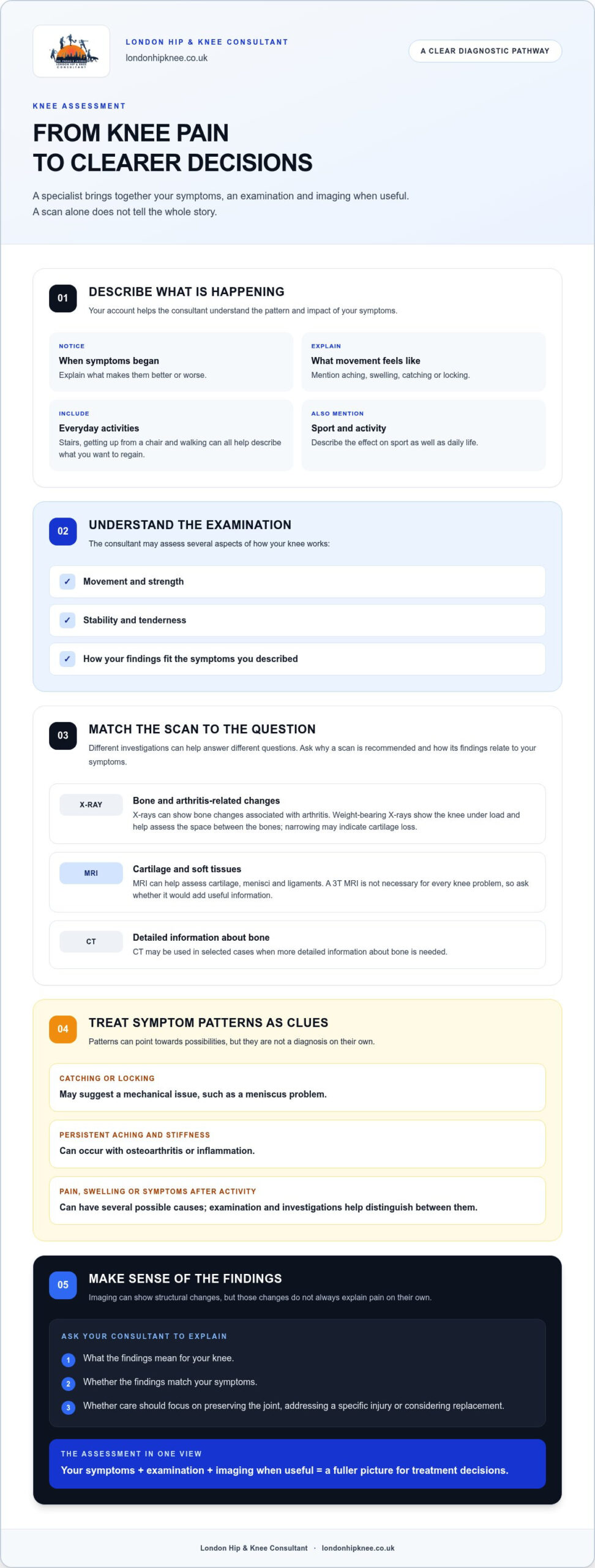
Pain is a symptom, not a diagnosis. A knee that aches after a walk, swells after activity or catches during movement may have several possible causes. The right treatment depends on identifying what may be happening in the joint. A specialist assessment brings together your account of the symptoms, a physical examination and, when useful, imaging. This helps ensure decisions are based on the whole picture, not a scan alone.
During the examination, the consultant may assess your knee’s movement, stability, tenderness and strength, and ask when symptoms began and what makes them better or worse. Describe the effect on everyday life as well as sport: using stairs, getting up from a chair or walking in a park can all help explain what you want to regain. A specialist’s approach to diagnosing knee pain also illustrates why clinical findings help guide which tests, if any, are appropriate.
Advanced Imaging and Symptom Analysis
Different scans answer different questions. X-rays can show bone and changes associated with arthritis. MRI can help assess cartilage, menisci and ligaments, while CT may be used when detailed information about bone is needed. The consultant should explain why a particular scan is recommended and how its findings relate to your symptoms. Imaging can show structural changes, but those changes don’t always explain pain on their own.
Weight-bearing X-rays show the knee under load, helping a specialist assess the space between the bones and identify narrowing that may indicate cartilage loss.
A knee that catches or locks may suggest a mechanical issue, such as a meniscus problem, while persistent aching and stiffness can occur with osteoarthritis or inflammation. These patterns are clues, not a diagnosis. Examination and investigations help distinguish between possible causes, including a meniscus tear and more advanced joint wear.
Understanding Your Diagnosis
Clear explanations matter. Chondromalacia describes softening or damage to cartilage, often beneath the kneecap. Osteophytes are small bony growths that can develop around a joint. Ask your consultant to explain unfamiliar terms, what the findings mean for your knee and whether they match your symptoms.
A diagnosis is the foundation for choosing proportionate care, not a reason to proceed straight to an operation. It can help avoid unnecessary surgery by clarifying whether treatment should focus on preserving the joint, addressing a specific injury or considering replacement. Your plan should reflect your health, pain, daily demands and goals, whether that means returning to running or walking more comfortably. Persistent pain can also affect confidence and mood, so tell your specialist what you’re finding difficult and what recovery would mean to you.
If you’re looking for a knee specialist London patients can consult about surgical and non-surgical options, you can learn more about hip and knee care with Mr Parag Jaiswal.
Advanced Treatment Options: Beyond Traditional Surgery
Persistent knee osteoarthritis doesn’t always mean moving straight from exercise-based care to joint replacement. Depending on your diagnosis and goals, a specialist may discuss treatments to manage symptoms or preserve the joint before considering major surgery. These options aren’t suitable for everyone, so ask about their likely benefits and limitations for your knee.
For general self-care and guidance on when to seek medical advice, the NHS advice on knee pain is a helpful starting point. A consultant can then discuss whether an injection or procedure is relevant to your particular condition.
Arthrosamid: A Non-Surgical Option for Osteoarthritis
Arthrosamid is an injectable, non-biodegradable hydrogel intended to remain within the knee joint. It may be considered for some adults with osteoarthritis who continue to have symptoms and want to explore an option other than major surgery. The gel is intended to provide cushioning within the joint; it doesn’t rebuild lost cartilage or reverse arthritis.
Some patients may experience longer-lasting pain relief and improved function, but response varies and no outcome can be guaranteed. Suitability depends on factors such as your diagnosis, symptoms and overall health. Ask about expected benefits, possible risks, aftercare and how success will be assessed. A knee specialist london patients consult can explain whether Arthrosamid might fit into an individual care plan.
Other Treatments and Specialist Surgery
Corticosteroid injections may be considered for short-term relief of moderate to severe osteoarthritis pain. Biological injections are a separate category, and their availability and evidence should be discussed with a clinician. Neither should be presented as a guaranteed way to avoid surgery. The right choice depends on the diagnosis and a balanced discussion of potential benefits, limitations and risks.
Keyhole knee arthroscopy uses small incisions and a camera to treat selected problems, including some meniscus injuries. It isn’t a general solution for osteoarthritis. Ask the surgeon whether a finding on your scan is likely to be causing your symptoms. Where possible, preserving meniscus tissue may be considered, although surgery can’t promise to prevent future arthritis.
For ligament injuries causing instability, ACL reconstruction aims to restore knee stability. The technique and rehabilitation plan depend on the individual. If arthritis is advanced and other treatments haven’t provided enough relief, replacement may be discussed. A partial replacement treats damage confined to one part of the knee, while a total replacement addresses more extensive joint damage. The decision should reflect the pattern of arthritis, your health and your priorities, rather than a one-size-fits-all approach. Read more about knee replacement London and questions to discuss with your consultant.
How to Evaluate Your Knee Consultant in London
Choosing a consultant involves more than a hospital name or an impressive biography. Look for someone whose experience fits your knee condition, who explains the options clearly and whose practical arrangements work for you. If you’re comparing a knee specialist london patients can access privately, use the first consultation to assess clinical expertise and communication.
Credentials and Professional Standing
Check that the surgeon is registered with the General Medical Council and listed on its Specialist Register. On the GMC website, confirm their specialist registration in Trauma and Orthopaedic Surgery, then compare it with their published profile for knee-specific practice, as sub-specialty detail may not be listed there. Membership of a professional body such as the British Orthopaedic Association can be another point to check, but it doesn’t replace questions about relevant training and experience.
Years in practice can provide useful context, particularly for complex cases, but ask what that experience involves: which knee conditions and procedures the consultant treats, and how often they perform the procedure being discussed. Experience across NHS and private practice may inform a surgeon’s perspective, but ask how their background relates to your diagnosis. Patient testimonials can offer insight into communication and care. Treat claimed success rates carefully, and ask how outcomes are measured and whether they relate to your specific procedure.
Practical Considerations for London Patients
Hospital affiliations affect where consultations or procedures may take place. Ask which hospitals the consultant currently works with, where your proposed treatment would be carried out and whether follow-up takes place at the same location. Consultants may work across more than one London site, so check the current arrangements and consider whether appointments are practical to reach from home or work.
Before booking, ask your insurer whether the consultant and hospital are recognised for your proposed treatment, whether you need authorisation and whether any part of the fee may be your responsibility. Recognition can vary by insurer and procedure, so confirm the details with both the provider and the consultant’s practice. If you’re self-funding, request a clear explanation of consultation, investigation and treatment charges; this London knee replacement cost guide outlines questions to consider.
Pay attention to how the consultant listens. Do they explain the diagnosis in language you understand, discuss non-surgical and surgical options where relevant, and make space for your concerns? Mr Parag Jaiswal has over 18 years of experience in hip and knee conditions and consults across multiple London locations. Explore Mr Jaiswal’s hip and knee care to find out more about his practice.
Specialist Care with Mr. Parag Jaiswal
Knee pain can make familiar routines feel uncertain. Mr. Parag Jaiswal is a Consultant Orthopaedic Surgeon specialising in hip and knee conditions, with over 18 years of medical experience. His practice focuses on adult orthopaedic care, with treatment options that include Arthrosamid injections, knee arthroscopy, ACL reconstruction and knee replacement. The aim is to understand what matters to you, explain the available choices and help you make an informed decision about the next step.
For people seeking a knee specialist london patients can consult about surgical and non-surgical care, this range of options can help ensure recommendations are considered in light of the diagnosis rather than assuming surgery is the only route. Where appropriate, preserving the joint and discussing non-surgical options may form part of the conversation. If surgery or an injection is recommended, ask what the process involves, what recovery may entail and who to contact with questions at each stage.
A Patient-Centred Approach to Recovery
Your goals are individual. You may want to return to golf or running, manage stairs more comfortably or walk further without pain. Share these priorities so they can inform discussions about treatment and recovery. Rehabilitation may involve physiotherapy, depending on your condition and treatment. Ask how it will be arranged and whether coordination with your own physiotherapist is possible. You can also clarify how follow-up is managed during treatment, without assuming that every stage involves direct access to the consultant.
Booking Your Consultation in London
Mr Jaiswal consults across multiple London locations. Clinic locations and arrangements can change, so check the current location when enquiring and consider which site is practical for appointments and any follow-up. If you plan to use private medical insurance, confirm directly with your insurer whether the consultant and proposed care are covered, whether authorisation is needed and whether any fees may remain your responsibility. Self-pay patients should request clear information about consultation and any investigation or treatment charges before proceeding.
To make the first appointment more useful, prepare a brief account of when the pain began, which activities affect it and what you’ve tried so far. Bring relevant scan reports or images, a list of medicines and details of previous treatment if available. Write down your questions, too. You might ask what the diagnosis means, which options are suitable and what each could mean for your everyday mobility.
If you’re ready to discuss your symptoms and possible next steps, request a consultation with Mr Jaiswal.
Take the Next Step Towards Easier Movement
Choosing a knee specialist means finding someone who can explain your diagnosis, discuss suitable options and take your goals seriously. A clear assessment can help you weigh non-surgical treatment against surgery without feeling rushed into a major decision.
Mr Parag Jaiswal brings over 18 years of experience in hip and knee conditions, with expertise in surgical care and non-surgical options such as Arthrosamid injections. If you’re considering a knee specialist london patients can consult, check that the consultant’s experience and proposed care fit your needs, and confirm any insurance cover directly with your provider.
To discuss persistent knee pain and possible treatment pathways, book a consultation with Mr Parag Jaiswal. A considered assessment can help you understand your options and plan your next steps.
Frequently Asked Questions
Do I need a GP referral to see a knee specialist in London privately?
Not always, but referral requirements depend on the consultant, clinic and how you’re paying. If you’re searching for “knee specialist london” options, contact the practice to ask whether you can book directly. If you plan to claim through private medical insurance, check with your insurer first, as it may require a GP referral or pre-authorisation. Bring any referral letter and relevant medical records to your appointment.
What is the difference between a knee surgeon and a knee specialist?
A knee surgeon is a doctor trained to perform operations on the knee. Knee specialist is a broader description of a clinician whose practice focuses on knee conditions and may include surgical and non-surgical care. A consultant orthopaedic surgeon can assess your symptoms, explain a diagnosis and discuss appropriate options, which may include injections, arthroscopy or replacement surgery. Ask about experience with your specific condition and the treatments being considered.
How long is the recovery time for a private knee replacement in London?
Recovery varies between people and depends on the type of replacement, your general health and your rehabilitation. You’ll usually need a period of recovery and physiotherapy, with progress towards everyday activities happening gradually rather than on a fixed timetable. Ask your surgeon what to expect in your circumstances, including hospital stay, mobility aids, follow-up and returning to work or activities such as walking or golf. Don’t rely on a single recovery estimate.
Is Arthrosamid injection available at your London clinics?
Arthrosamid injections are among the treatments offered by London Hip & Knee Consultant for suitable adults with knee osteoarthritis. Whether it’s appropriate depends on your symptoms, diagnosis and individual circumstances, so a consultant assessment is needed before deciding. The practice operates across multiple London locations; ask which clinic currently provides the treatment and what appointments involve. Your consultant can explain potential benefits, limitations, risks and alternatives before you make a decision.
Can I use my private health insurance (Bupa/AXA) for a knee consultation?
Possibly, but cover depends on your policy, the consultant and the care you need. Before booking, ask Bupa, AXA or your insurer to confirm whether the consultant is recognised for your consultation and any proposed treatment, whether you need a referral or authorisation, and whether fees could exceed your cover. Recognition can change, so confirm the current position with both the insurer and the practice rather than assuming all costs are covered.
What happens during the first orthopaedic consultation for knee pain?
Your consultant will ask about your symptoms, medical history and how knee pain affects daily life, then examine the joint’s movement and stability. Depending on the findings, they may review existing scans or recommend imaging such as an X-ray or MRI. You should leave with a clearer understanding of possible causes and suitable next steps, which may include further investigation, non-surgical treatment or discussion of surgery. Bring scan reports and a list of medicines if available.
How do I know if my knee pain requires surgery or just an injection?
You can’t reliably decide from pain alone. The choice depends on the cause, examination findings, imaging where appropriate and how symptoms affect your life. An injection may be considered for some conditions, while surgery may be discussed if pain and loss of function remain troublesome despite suitable non-surgical care. Ask your consultant to explain the expected benefits, risks and alternatives for each option. A recommendation should be tailored to your diagnosis, not made automatically.
Where are your London knee clinics located?
London Hip & Knee Consultant sees patients across multiple locations in the capital, but clinic arrangements can change. Contact the practice to confirm the current addresses, which location offers the appointment or treatment you need, and where follow-up will take place. Before booking, consider travel time from home or work and check whether your insurer covers care at that site. Confirming these details directly helps you plan your care.