

Can Arthrosamid reviews tell you whether the injection will ease your knee pain? Patient experiences can show what treatment was like for someone else, but they can’t predict your result. The reviewer may have different symptoms, osteoarthritis or treatment goals from yours, and online accounts can be difficult to verify. Conflicting reports may leave you with more questions than answers.
It’s understandable to look for reassurance before considering an injection. Reviews can help you identify experiences and concerns to discuss, but they’re only one part of the picture. They don’t replace clinical evidence or an assessment of your individual knee.
This article explains how to read Arthrosamid reviews critically, what to consider alongside testimonials, and what reviews can’t tell you. It also suggests questions to raise with a knee specialist, including whether Arthrosamid may suit your diagnosis and what other options could be appropriate. Reviews can inform your decision, but they shouldn’t make it for you.
Key Takeaways
- Read Arthrosamid reviews as individual experiences, not forecasts of how your knee may respond.
- When considering research, check who took part, how long they were followed and which outcomes were measured.
- Compare treatment options by their purpose, practical considerations and limitations, rather than assuming one is best for everyone.
- Prepare for a specialist discussion by noting your symptoms, priorities, previous care and questions.
- A knee assessment can help clarify your diagnosis and whether Arthrosamid is an appropriate option to discuss.
Arthrosamid reviews: what patient experiences can tell you
Before considering a knee injection, it’s natural to look for first-hand accounts from people who have had treatment. A review can help you understand how someone describes the experience, from deciding to proceed to changes in daily activities. But it remains one person’s account, not a prediction of what will happen to you.
People with osteoarthritis can have different symptoms and priorities. One reviewer may focus on walking more comfortably, whilst another may care most about sleep, work or managing stairs. Their diagnosis, starting symptoms, other health factors and follow-up arrangements may also differ from yours.
Patient experience can help you frame questions; clinical evidence helps assess outcomes across groups. Neither guarantees an individual result.
What makes an Arthrosamid review useful?
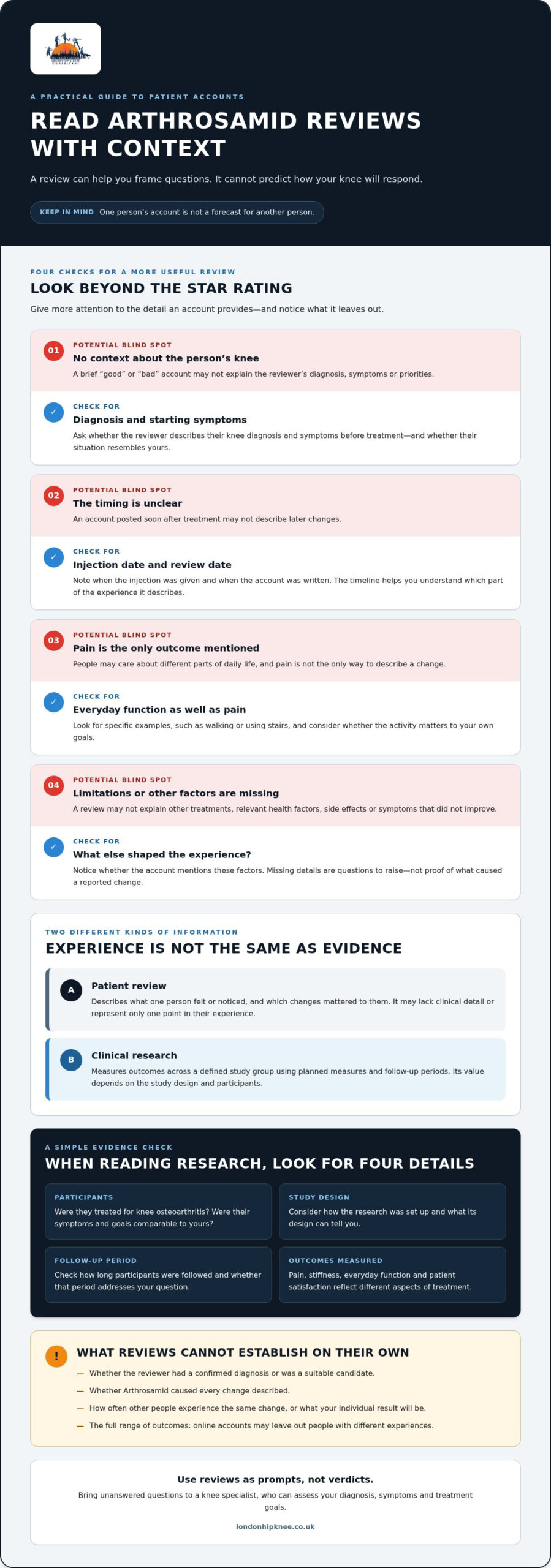
Give more weight to detail than to a star rating or a brief statement that treatment was “good” or “bad”. A useful account gives enough context to help you judge whether the reviewer’s situation resembles yours, while recognising that no two experiences are identical.
- Context: Does the reviewer describe their knee diagnosis and symptoms before treatment?
- Timeline: When was the injection given, and when was the account written? A review posted soon after treatment may not describe later changes.
- Outcome: Does it explain changes in everyday function, such as walking or using stairs, as well as pain?
- Limitations: Does it mention other treatments, relevant health factors, side effects or areas where symptoms didn’t improve?
These details can’t verify an account or establish that the injection caused every reported change. They can help you identify what is missing and what to ask a knee specialist.
Why individual experiences can differ
Osteoarthritis symptoms vary, and people may seek treatment at different stages or with different goals. Someone hoping to manage pain during a particular activity may judge their experience differently from someone focused on general mobility. Previous care and other health factors can also affect what a person notices and reports.
Personal satisfaction is not the same as a measured clinical outcome. A positive review may describe an improvement that matters greatly to that individual, but it doesn’t show how often others experience the same change. A negative account matters too, but it can’t establish that treatment is unsuitable for everyone. Don’t assume either account is typical without supporting evidence.
Use reviews as prompts, not verdicts. Note which details are missing, compare the reviewer’s circumstances with your own, and take unanswered questions to a specialist who can assess your diagnosis and treatment goals.
What Arthrosamid reviews say about benefits, limitations and evidence
Arthrosamid reviews describe what individual patients felt or noticed. Published clinical research asks a different question: what happened across a defined group of participants, measured in a planned way? Both can help you understand treatment, but they aren’t interchangeable.
Patient experience can show which changes mattered to one person, such as comfort during a daily activity, and what they found difficult. It may lack clinical detail or represent only one point in their experience.
Clinical research can assess outcomes across a study group using specified measures and follow-up periods. Its value depends on the study’s design and participants, and its findings can’t promise an individual result.
How to read research behind Arthrosamid
Start with the participants. Were they treated for knee osteoarthritis, and were their starting symptoms and treatment goals comparable to yours? A study involving people with different symptoms or priorities may not answer your particular question.
Then check the study design, follow-up period and outcomes measured. Pain scores, stiffness, everyday function and patient satisfaction reflect different aspects of treatment. A result recorded at one follow-up point doesn’t establish what every participant experienced before or after it. The ClinicalTrials.gov study record can help you check a study’s listed design, status and outcome measures. Check the current record and any published findings before relying on them.
Research can indicate patterns within the group studied, but it can’t determine whether Arthrosamid suits you or guarantee your response. Check the full publication rather than relying only on a headline or a figure repeated elsewhere. Look at how the researchers measured outcomes and whether the follow-up period answers the question you have.
What reviews cannot establish on their own
A testimonial can’t confirm a diagnosis, show whether a person was a suitable candidate or predict your outcome. Online reviews may also leave out people with different experiences, so the accounts you find may not represent the full range of patient outcomes.
Reviews tell you how someone describes their experience; research tells you what was measured in a study group. Neither replaces an individual assessment.
Use accounts to identify questions, then discuss your diagnosis, goals and suitable options with a knee specialist. If you’re considering treatment, you can discuss Arthrosamid with a knee specialist as part of an assessment of your circumstances.
Arthrosamid reviews compared with other knee osteoarthritis options
Arthrosamid reviews may describe one person’s experience, but they don’t show whether another treatment would have suited them better. Options for knee osteoarthritis have different aims and practical considerations. The right comparison depends on your diagnosis, symptoms, previous care and what you hope to do more comfortably. Use the table to prepare for a discussion, not to rank treatments for everyone.
How Arthrosamid differs from other injection approaches
Injections can use different substances and have different intended roles. That doesn’t establish that one is superior for you. Ask what each option is intended to address, what risks and limitations apply, and how it compares with other suitable approaches. For more detail about the injection itself, read this Arthrosamid knee injection patient guide.
| Option | Purpose | Practical considerations | Limitations and questions for your clinician |
|---|---|---|---|
| Arthrosamid injection | An injection option considered for knee osteoarthritis. | Discuss the procedure, expected aims and follow-up. | Ask whether it suits your diagnosis, what risks apply and what alternatives are relevant. |
| Other injections | Different injections may be considered for different treatment aims. | Ask what substance is proposed and why it may be appropriate in your case. | Benefits and limitations vary. Ask how evidence for the option relates to your symptoms and goals. |
| Non-surgical care | May form part of a broader plan for managing symptoms and maintaining function. | Discuss which approaches fit your health, daily routine and priorities. | There may not be one approach that addresses every symptom. Ask how progress will be reviewed. |
| Knee replacement | Surgery may enter the conversation when symptoms and their effect on function warrant surgical assessment. | Requires a discussion of the operation, recovery and your individual circumstances. | It isn’t the right step for everyone. Ask when a surgical opinion is appropriate; this knee replacement specialist guide offers further information. |
When a broader knee osteoarthritis plan matters
Your decision may involve more than choosing an injection. Tell your clinician which activities are difficult, how symptoms affect your day and what matters most to you. This context makes comparisons more relevant to your life than relying on someone else’s review to choose a treatment.
Questions to ask after reading Arthrosamid reviews
Use reviews to shape your questions, not to decide on treatment by themselves. A knee specialist can assess your symptoms and establish the diagnosis before discussing whether Arthrosamid may be appropriate. Preparing a few details can help make the conversation specific to what you want to do more comfortably.
What to take to a knee specialist appointment
Before your appointment, make a brief note of what your knee feels like and how it affects your daily life. You don’t need a perfect record; a clear summary is a useful starting point.
- 1. Record your symptoms: Note where and when you feel discomfort, which activities are affected and how symptoms have changed over time.
- 2. List previous care: Bring details of treatments you’ve tried and any relevant investigations or results you have available.
- 3. Identify your priorities: Describe what a satisfactory improvement would mean in practical terms, such as finding a particular activity easier.
- 4. Write down questions: Include anything prompted by Arthrosamid reviews, especially claims or experiences you’re unsure how to interpret.
Questions that clarify benefits and uncertainty
An assessment should explore your diagnosis and whether this injection is suitable, rather than assume a reviewer’s outcome applies to you. Consider asking:
- What features of my diagnosis and symptoms inform your view on whether Arthrosamid may be suitable?
- What are the treatment’s aims in my situation, and which uncertainties should I understand?
- What evidence is relevant to people with circumstances or treatment goals like mine?
- What possible risks should I consider, and what follow-up would be appropriate?
- If my symptoms persist or don’t change as hoped, what would the next step be?
- What alternatives are relevant to my diagnosis and priorities?
If you’re considering private treatment, ask for a clear explanation of what is included and any separate consultation or follow-up arrangements. The Arthrosamid injection cost guide may help you prepare practical questions about costs, but it can’t determine clinical suitability.
Bring your notes to a specialist in adult knee conditions and discuss your options. You can discuss Arthrosamid with a knee specialist as part of an individual assessment.
Considering Arthrosamid in London: make the next step a specialist discussion
After reading Arthrosamid reviews, it can be tempting to decide based on the experiences that feel most familiar. A more useful next step is to discuss your own knee symptoms and diagnosis with a clinician. Reviews can help you identify what to ask, but they can’t establish whether an injection is appropriate for you.
What a specialist discussion can help clarify
A specialist assessment can explore whether your symptoms and diagnosis fit the circumstances in which Arthrosamid might be considered. It can also help put your priorities into context. For instance, the activities you hope to manage more comfortably may shape your questions, whilst your overall knee condition and health can inform which options are relevant.
The discussion should include alternatives, possible risks and uncertainty, not just the treatment you first searched for. Ask what the available evidence can and can’t tell you, whether further assessment may be needed, and what the next steps would be if Arthrosamid isn’t considered suitable. Treatment decisions are individual; an assessment explores options without committing you to proceed.
How to take the next step in London
London Hip & Knee Consultant provides specialist care for adults with hip and knee conditions, including Arthrosamid injections for knee osteoarthritis. The practice is led by Mr Parag Jaiswal, who has more than 18 years of experience as a medical professional. This background provides context for the specialist service, but it doesn’t mean a particular treatment will be right for every patient or guarantee an outcome.
If you’re considering an assessment, you can contact the practice to ask about a consultation and discuss your knee symptoms and treatment options. You don’t need to have reached a decision before speaking with a specialist. The aim is to understand your circumstances and consider an appropriate way forward.
Discuss your knee symptoms and treatment options.
The right choice depends on your diagnosis, the evidence available and what matters most to you.
Make your next step an informed conversation
Use Arthrosamid reviews to identify questions, not to predict your own outcome. A reviewer’s experience may offer useful perspective, but your diagnosis, priorities and the evidence relevant to your circumstances should guide decisions. A specialist can help you understand whether Arthrosamid is appropriate and discuss other options without assuming one treatment suits everyone.
London Hip & Knee Consultant focuses on adult hip and knee conditions and offers Arthrosamid injections. The practice is led by Mr Parag Jaiswal, who has more than 18 years of experience as a medical professional. An individual discussion can help you make sense of your symptoms and consider a suitable way forward.
If you’re ready to explore your options, discuss your knee symptoms and treatment options. Bring your questions and take time to consider what you learn. The right choice starts with your diagnosis, the evidence and what matters most in your daily life.
Frequently Asked Questions
Are Arthrosamid reviews generally positive?
Online reviews alone can’t show whether patient experiences are generally positive. Reviews reflect the people who choose to share them and may not represent everyone treated. Read beyond the rating: look for the reviewer’s diagnosis, starting symptoms, follow-up period and changes in everyday activities. Compare these details with published clinical evidence, and treat both as information to discuss with a knee specialist.
How long does Arthrosamid take to work, according to patient reviews?
Patient reviews can describe when an individual noticed a change, but they can’t establish a reliable timeline for everyone. Accounts may be posted at different stages after treatment and may not include later follow-up. Check when the reviewer wrote their account and what they mean by improvement, such as less discomfort during a particular activity. Ask a specialist what timing and uncertainty are relevant to your circumstances.
Can Arthrosamid reviews predict whether the injection will work for me?
No. Arthrosamid reviews describe individual experiences, not your likely result. A reviewer may have a different diagnosis, level of symptoms, health background or treatment goal. Even a detailed account can’t determine whether the injection is suitable for you. A specialist assessment can clarify your diagnosis, discuss relevant evidence and compare options in light of what you want to manage more comfortably.
What do Arthrosamid reviews say about side effects?
Reviews may mention individual experiences such as discomfort or swelling, but they can’t show how common an effect is or establish what you will experience. Online accounts may omit side effects or lack clinical detail. Ask your clinician to explain the possible risks, what to expect after the procedure and what steps to take if you have concerns. Consider this information alongside current clinical evidence, not testimonials alone.
Is Arthrosamid suitable for everyone with knee osteoarthritis?
No. Having knee osteoarthritis doesn’t automatically mean Arthrosamid is the right option. Suitability depends on your diagnosis, symptoms, health and treatment priorities, which need individual assessment. A knee specialist can explain whether the injection may be appropriate, what uncertainties apply and which alternatives are worth considering. Don’t use a positive review or another person’s treatment decision as a substitute for that discussion.
How does Arthrosamid compare with steroid injections?
They are different injection approaches, so neither should be assumed to suit everyone or be superior in every situation. Ask your clinician what each option is intended to address, how the evidence applies to your diagnosis, and what risks, limitations and follow-up considerations matter. Your symptoms, previous care and priorities can help guide the comparison. Reviews alone can’t provide a fair assessment of one treatment against another.
What should I ask a specialist before having an Arthrosamid injection in London?
Ask how your diagnosis and symptoms inform whether Arthrosamid may be suitable, what benefits and uncertainties are relevant, and what risks and follow-up to expect. Also ask which alternatives fit your goals and what the next step would be if symptoms persist. In London, a specialist in adult hip and knee conditions can discuss these points with you. Bring a symptom history and notes on previous care.