

If groin pain, stiffness or discomfort when bending your hip has left you wondering whether impingement could be involved, a private consultation for hip impingement can help you understand what might be causing your symptoms. The most useful outcome may be a clearer explanation, not an immediate treatment decision. An assessment does not assume that surgery is the answer.
It’s understandable to feel uncertain about what an assessment involves, whether you’ll need scans or what a private appointment might lead to. A specialist will consider your symptoms and medical history, examine your hip and review any relevant imaging. Further investigations may be discussed if they’re needed. The aim is to explain the findings and possible next steps, which may include non-surgical options as well as hip arthroscopy if it’s clinically appropriate.
This guide explains what to bring, what questions to ask and how to compare relevant experience and follow-up arrangements in London. You’ll know what to expect from the consultation and how to seek an individualised explanation of your options.
Key Takeaways
- A private consultation for hip impingement can help explore possible causes of persistent hip or groin discomfort, but symptoms alone can’t confirm a diagnosis.
- Be ready to describe when your symptoms occur, how they affect your activities and what care you’ve already tried.
- Bring relevant reports, information about imaging and a current medication list to help focus the appointment.
- An assessment doesn’t commit you to surgery. Ask how options will be considered in light of your individual findings.
- When comparing specialists in London, check their relevant hip experience and ask how findings, follow-up and possible next steps will be explained.
What can a private consultation for hip impingement clarify?
Persistent groin or hip discomfort can make everyday movements, such as bending, turning or exercising, difficult. If you’re unsure what’s behind it, a private consultation for hip impingement gives you an opportunity to discuss your symptoms with a specialist and understand what to consider next. Symptoms alone can’t confirm the cause. Several hip problems may feel similar, so your situation needs individual assessment.
Hip impingement, also called femoroacetabular impingement, is a hip-joint condition in which the shape of the ball or socket can cause contact during certain movements. This contact may be associated with pain or irritation, but a finding about bone shape does not, by itself, establish that it is causing someone’s symptoms. The term femoroacetabular impingement describes the condition. Deciding whether it applies to you requires clinical assessment, not self-diagnosis.
A specialist opinion brings together your account of the problem, examination findings and any relevant investigations. The clinician can explain what the findings may mean, whether further assessment is appropriate and what options could be discussed. Suspected impingement does not automatically mean surgery is needed. Hip arthroscopy may be considered only if it is clinically appropriate to your individual situation.
When might someone seek a hip impingement consultation?
You might seek an opinion if hip or groin discomfort persists, returns during activity or limits movements that matter to you. The pattern can help guide the discussion, but it isn’t a diagnostic checklist. Pain during sport, sitting or bending can have different causes, so don’t assume a particular symptom proves impingement. An assessment can explore the possibilities in context.
What is the purpose of a specialist opinion?
A specialist can consider your medical history and description of symptoms alongside a physical examination and any scans or reports already available. This may help clarify what is known, what remains uncertain and whether further investigations or different management options should be considered. Ask how the findings support any suggested next steps, including alternatives to surgery and planned follow-up.
If symptoms are urgent or severe, don’t rely on this guide or wait for a routine appointment to decide what to do. Seek appropriate medical advice promptly, using NHS services or emergency care according to the seriousness of the situation.
What happens during a private hip impingement consultation?
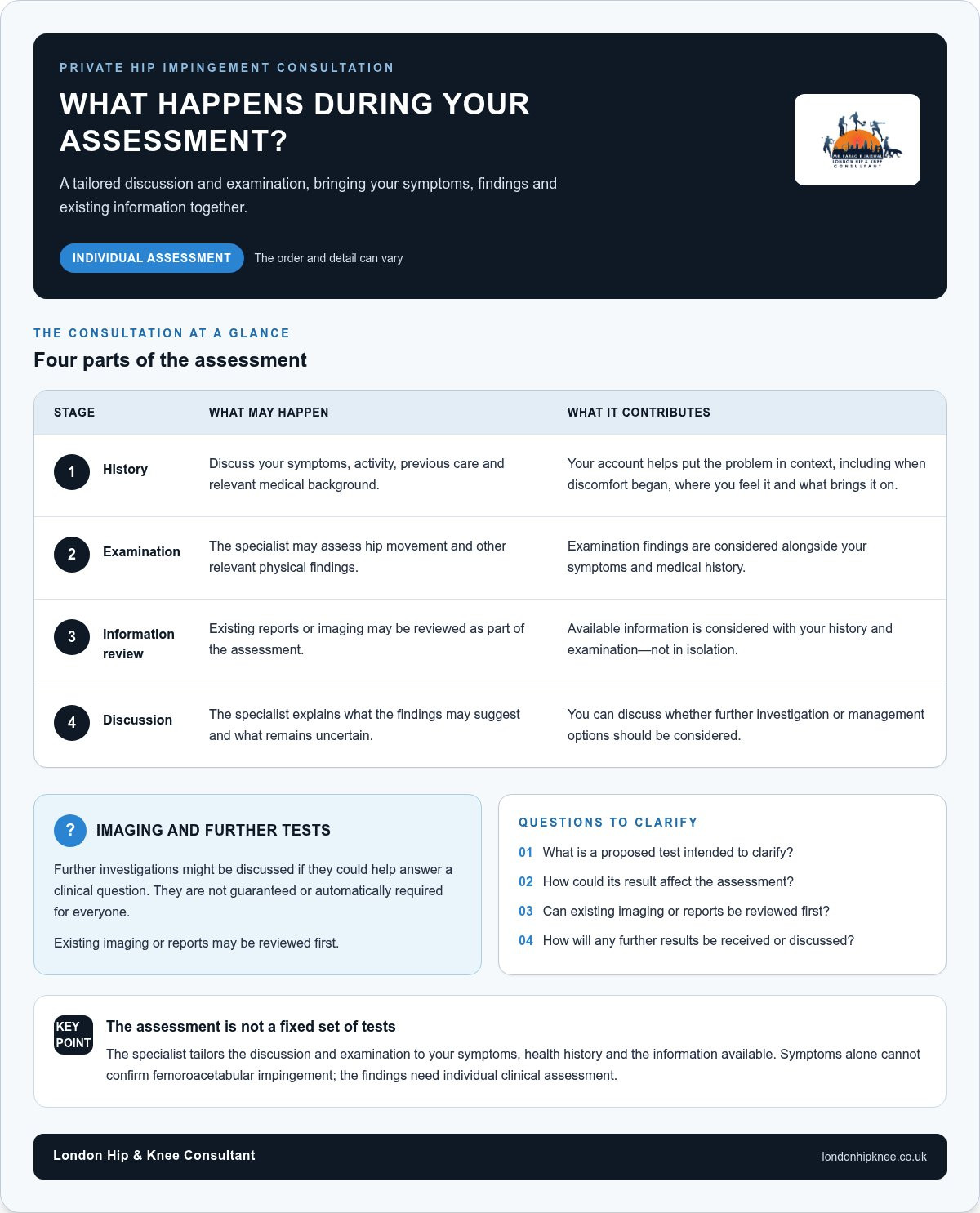
A private consultation for hip impingement is an individual assessment, not a fixed sequence of tests. The specialist will tailor the discussion and examination to your symptoms, health history and the information available. You can explain what is affecting you and ask what the assessment may clarify.
What should you expect the specialist to ask?
You may be asked when the discomfort began, where you feel it, what brings it on and how it affects daily activities, work or sport. Give practical examples, such as pain when getting out of a car, squatting or turning quickly. The clinician may also ask about previous care, relevant medical history and earlier scans or reports. No single answer confirms femoroacetabular impingement. The Femoroacetabular impingement (FAI) resource from the American Academy of Orthopaedic Surgeons provides further background on the condition and its assessment.
Will imaging or further tests be needed?
The clinician may examine how your hip moves and consider the findings alongside your history and existing records. Further investigations might be discussed if they could help answer a clinical question, but they aren’t guaranteed or automatically required for everyone. Ask what a proposed test is intended to clarify, how the result could affect the assessment and whether existing imaging or reports can be reviewed first.
The practice website provides information about hip and knee orthopaedic care. An appointment may broadly include the following stages, although the order and detail can vary:
1. History: Discuss symptoms, activity, previous care and relevant medical background.
2. Examination: The specialist may assess hip movement and other relevant physical findings.
3. Information review: Existing reports or imaging may be considered alongside the assessment.
4. Discussion: The specialist explains what the findings may suggest, what remains uncertain and whether further investigation or management options should be considered.
Before leaving, check that you understand the reasoning behind any suggested next step and how you’ll receive or discuss further results. For more information about specialist care in London, see hip and knee orthopaedic care.
Does a private hip impingement consultation mean you need surgery?
No. Booking a private consultation for hip impingement is a way to seek an assessment and discuss your concerns. It doesn’t commit you to treatment, let alone an operation. A consultation can help explain what might be contributing to your symptoms, what the findings do and don’t show, and whether further investigation or a management plan should be considered.
Treatment decisions require individual clinical assessment, taking account of your history, examination findings and relevant investigations. Discussing hip arthroscopy is not the same as recommending it. Although hip arthroscopy is among the practice’s services, it may be considered only when the clinical picture supports it. This article can explain the decision-making process, but it can’t determine which treatment is suitable for you.
How might treatment options be discussed?
A useful discussion connects the proposed explanation for your symptoms with the assessment findings, then sets out reasonable options and their limitations. Depending on your circumstances, this may include considering non-surgical approaches or discussing whether an operation is appropriate. Ask why an option is being raised, what uncertainties remain and what alternatives could be considered. The conversation should allow you to raise your priorities, concerns and questions, rather than making it seem as though one route has already been chosen.
If hip arthroscopy is mentioned, ask what the procedure is intended to address in your case and what factors might make it unsuitable. The specialist should explain potential risks as well as possible benefits, without promising a particular result. The right next step depends on your individual assessment, not simply on the name of a suspected condition.
What should you ask before deciding on a next step?
Clear questions can help you leave with a better understanding of the recommendation. Consider asking:
- Which findings support this explanation for my symptoms?
- What other possible causes or uncertainties remain?
- What alternatives are available, and what are their limitations?
- If surgery is being considered, what are the relevant risks and how would follow-up work?
You don’t have to decide before you understand the options. Take time to consider the information and ask for clarification if anything is unclear. If you’d like further discussion, ask how and when follow-up can be arranged, and what information will be available to guide that conversation.
How to prepare for a private hip impingement consultation in London
A little preparation can help you make the most of your appointment, especially if pain or uncertainty makes details difficult to remember on the day. You don’t need a complete medical file before seeking advice. Bring what you have, and don’t delay care just to track down missing documents.
What information should you bring?
Before your private consultation for hip impingement, jot down a brief timeline: when the symptoms began, how they’ve changed and which everyday activities they affect. Note what makes the discomfort better or worse, such as walking, sport, sitting or particular hip movements. Keep it concise. Useful examples matter more than a perfect record.
- Previous assessments: Bring relevant letters, reports or details of earlier appointments, if available.
- Imaging information: Note where and when any X-rays or scans were taken, and bring reports or access details if you have them. Check with the practice beforehand how existing images can be shared or reviewed.
- Treatment history: Make a note of care you’ve already tried and how you found it.
- Medication list: Bring an up-to-date list of medicines you take, including doses if known.
- Your questions: Write down the points you most want clarified so they’re easy to raise during the appointment.
Questions to ask your hip specialist
Use the discussion to understand the reasoning behind any suggested next step. You could ask:
- What other explanations might account for my symptoms, and how will they be assessed?
- Could further investigations change the recommended plan? What would each test help clarify?
- What options are relevant to my findings, and what are their limitations?
- What follow-up should I expect, and whom should I contact if I have questions afterwards?
For an appointment in London, confirm the current clinic location, arrival instructions and any arrangements for sharing records directly with the practice before travelling. Appointment details can vary, so rely on the information provided for your booking rather than an old address or message.
For information about the practice and its approach to hip care, visit the London Hip & Knee Consultant website.
Choosing a private hip impingement consultation in London
Choosing a specialist is about more than finding an appointment. Look for a clinician whose stated practice includes adult hip conditions and relevant procedures, and who can explain how your symptoms, examination and any investigations inform the options. A clear discussion should make space for uncertainty, alternatives and your questions, rather than suggesting that one test or treatment suits everyone.
Mr Parag Jaiswal is a Consultant Orthopaedic Surgeon focused on adult hip and knee care. London Hip & Knee Consultant sees patients across several London locations. Confirm the current clinic location and appointment arrangements directly with the practice.
What to look for in a hip specialist
Check the clinician’s relevant hip experience and whether their stated practice covers the type of problem you want assessed. You should be able to understand what the findings may mean, what remains uncertain and how different options might be considered. Avoid treating rankings, success-rate claims or testimonials as proof that a clinician is right for your individual needs. Focus on the quality and relevance of the information provided.
| Question to ask | What to check | Why it matters |
|---|---|---|
| Does your practice include adult hip conditions and relevant procedures? | The clinician’s stated area of practice and experience. | Helps you judge whether the consultation is relevant to your concern. |
| How will you explain the assessment and any uncertainties? | Whether findings, alternatives and limitations are discussed clearly. | Supports informed decisions rather than assumptions. |
| What happens if further investigations are suggested? | Who coordinates them and how results will be communicated. | Clarifies responsibilities and what to expect after the appointment. |
| How will follow-up work? | Who to contact with questions and how next steps are reviewed. | Helps you understand the plan beyond the initial consultation. |
What happens after the consultation?
Next steps depend on your clinical findings and preferences. They might involve discussing further investigations, considering management options or arranging follow-up to review information. If a procedure is raised, ask how its potential benefits, risks and alternatives relate to your particular case. Clarify who will coordinate investigations and explain the results, and whom you can contact if questions arise later.
If you’re comparing options for a private consultation for hip impingement, take time to choose a specialist who helps you understand the reasoning behind each proposed step. The practice website has further information about private hip consultations and specialist hip care.
Take the next step with greater clarity
A private consultation for hip impingement is an opportunity to understand your symptoms, discuss relevant findings and consider individual next steps. Preparing a clear account of how your hip affects daily life, along with any existing reports and questions, can help focus the discussion. An assessment doesn’t mean you’re committing to surgery. Options depend on your clinical circumstances, and hip arthroscopy is considered only when appropriate.
London Hip & Knee Consultant is led by Mr Parag Jaiswal, a Consultant Orthopaedic Surgeon focused on adult hip and knee conditions. Hip arthroscopy is among the practice’s specialist services. To learn more about the practice’s approach, visit the website.
With the right questions and a clear explanation of your options, you can approach decisions about your hip with greater confidence and take the next step at a pace that feels right for you.
Frequently Asked Questions
What happens at a private consultation for hip impingement?
The specialist will discuss your symptoms, activity levels, relevant medical history and any previous care, then may examine your hip and review existing reports or imaging. Further investigations could be considered if they’re clinically useful, but they aren’t automatic. The appointment should help explain what the findings may suggest and what options might be appropriate to discuss. Ask if you’re unsure how the assessment relates to your symptoms or what happens next.
Do I need a referral for a private hip impingement consultation in London?
Referral requirements can vary, so check directly with the practice before booking rather than assuming you do or don’t need one. If you plan to use private medical insurance, ask your insurer about its referral and pre-authorisation requirements too, as these may differ from the practice’s booking process. Confirm what information to provide, how to share previous records and which London clinic location applies to your appointment.
Can hip impingement be diagnosed during one consultation?
A specialist may be able to explain their clinical impression after discussing your history and examining your hip, but a diagnosis can’t be guaranteed in one appointment. They may need to review existing imaging, arrange further investigations or consider other possible causes before clarifying the findings. Ask what can be concluded at the first consultation, what remains uncertain and whether any proposed test could change the assessment or next steps.
Does a consultation for hip impingement mean I will need surgery?
No. Booking an assessment doesn’t commit you to treatment or surgery. What may be recommended depends on your individual history, examination and relevant investigations, alongside a discussion of your preferences. Hip arthroscopy is among London Hip & Knee Consultant’s listed services, but it’s only a possible option when clinically appropriate. Ask the specialist to explain alternatives, potential limitations and risks before deciding whether to proceed with any proposed treatment.
What should I bring to a hip impingement appointment?
Bring relevant previous assessment letters, investigation reports and information about any X-rays or scans, if available. A current medication list and a brief timeline of your symptoms can also help. Note when they began and how they affect activities such as walking, sitting or sport. Write down questions you want answered. Don’t delay seeking advice just because you can’t gather every document beforehand.
How do I choose a hip impingement specialist in London?
Check that the clinician’s stated practice includes adult hip conditions and relevant procedures, and look for clear explanations of assessment, options, uncertainties and follow-up. Ask who will coordinate any investigations and communicate results. London Hip & Knee Consultant is led by Mr Parag Jaiswal, a Consultant Orthopaedic Surgeon focused on adult hip and knee conditions. Confirm the current clinic location and appointment arrangements directly with the practice.
Can hip impingement symptoms have another cause?
Yes. Groin or hip discomfort can have different causes, and symptoms alone can’t confirm femoroacetabular impingement. The specialist considers how and when symptoms occur alongside your medical history, examination findings and any relevant investigations. If the assessment doesn’t clearly support one explanation, ask what other possibilities are being considered and whether further assessment is needed. This helps avoid treating a suspected condition as a confirmed diagnosis.