

What should you look for in a hip consultant: a familiar name, or an assessment that makes sense of your symptoms and sets out a considered way forward? A search for “private hip consultant central london” often begins with uncertainty about who has the right expertise and whether an appointment will lead straight to talk of surgery.
It’s reasonable to want clear answers without feeling rushed into a decision. A specialist assessment can explore how your symptoms affect daily life, review relevant findings and discuss appropriate options. These may include non-surgical care or, where appropriate, hip surgery. The next step should reflect your individual needs.
This guide explains what to look for in a consultant, what to expect at an initial private appointment and what information may be useful to bring. London Hip & Knee Consultant, led by Consultant Orthopaedic Surgeon Mr Parag Jaiswal, focuses on adult hip and knee conditions in London. Use your consultation to begin a clear, individualised discussion about appropriate hip care.
Key Takeaways
- When comparing a private hip consultant central london, look for a clinical focus that fits your concern, clear communication and a considered approach to care.
- Know the usual stages of an appointment, from discussing your symptoms and history to examination and consideration of next steps.
- Make your appointment more useful by noting when symptoms occur, which activities they affect and what you’d like to ask.
- Bring relevant records or previous investigation results if you have them, so they can inform the discussion.
- Learn about Mr Parag Jaiswal’s focus on adult hip and knee conditions and his more than 18 years as a medical professional.
Why seek a private hip consultant in central London?
Persistent hip pain can make everyday activities harder: taking the stairs, getting in and out of a car or managing a familiar walk may become uncomfortable. It can be difficult to know whether to wait, seek advice or consider treatment. A consultation helps explore what may be contributing to your symptoms; it does not commit you to surgery.
A private hip consultant assesses concerns affecting the hip, considers your symptoms and relevant findings, and discusses care options suited to your circumstances. If you’re searching for a private hip consultant central london, focus on whether the consultant’s expertise and approach fit your needs, rather than assuming an appointment means an operation.
Location matters when fitting appointments around work, home and travel. London Hip & Knee Consultant operates across several London locations. Consider how you would travel to an appointment and whether the route works for you, particularly if walking or standing is uncomfortable.
When might specialist hip advice help?
Consider seeking advice if pain persists, movement feels restricted or symptoms affect usual activities such as sleeping comfortably, walking or putting on shoes. These experiences don’t point to one cause by themselves. Hip symptoms can have different explanations, so an individual clinical assessment is needed to understand what may be relevant in your case.
If discomfort is changing how you manage daily life, specialist advice can help you understand possible next steps. You don’t need to arrive with a preferred treatment in mind. Note when symptoms began, what brings them on and which activities you’ve had to stop or change. Those details can make the discussion more useful.
What can a hip consultant help you understand?
An assessment builds a clearer picture by discussing your symptoms and relevant medical history, then considering examination findings. Where clinically appropriate, the consultant may discuss whether further investigations could help. The results and overall assessment inform a conversation about suitable next steps, which may include non-surgical care or discussion of a procedure.
In plain English, a hip consultant helps you understand what may be behind your hip symptoms and which care options could be appropriate for you. If hip replacement is discussed, ask why it may be relevant, what alternatives could be considered and what the proposed treatment involves. This Hip replacement surgery overview offers general background, but it can’t replace advice based on your own assessment.
The aim is clarity, not pressure. You should have the opportunity to discuss what matters to you, understand the reasoning behind any suggested next step and consider how it fits your priorities before making a decision.
What happens during a private hip consultation?
An appointment with a private hip consultant central london is a conversation as well as a clinical assessment. Explain what has changed, ask questions and discuss what the findings may mean. The purpose is to make sense of your concerns and consider possible next steps based on your circumstances, not to commit you to treatment or surgery.
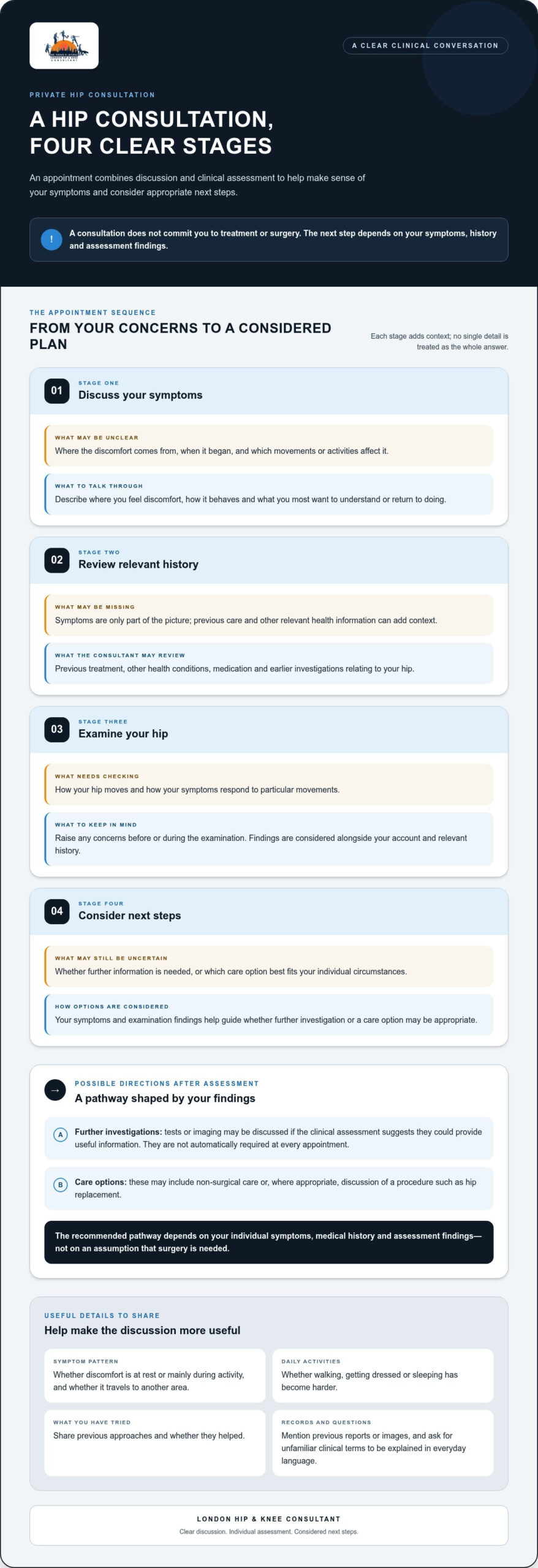
The discussion and examination will usually follow a clear sequence:
- Discuss your symptoms. Describe where you feel discomfort, when it began, how it behaves and which movements or activities affect it.
- Review relevant history. The consultant may ask about previous treatment, other health conditions, medication and earlier investigations that relate to your hip.
- Examine your hip. The examination may include assessing movement and how your symptoms respond to particular movements. Raise any concerns before or during this part.
- Consider next steps. Your symptoms and examination findings help guide whether further investigation or a particular care option may be appropriate.
How the consultant builds a picture of your symptoms
Small details can help explain the overall pattern. Note whether discomfort is present at rest or mainly during activity, whether it travels to another area, and whether walking, getting dressed or sleeping has become harder. Share what you’ve already tried and whether it helped. Your priorities matter too: explain what you most want to understand or return to doing.
If a clinical term is unfamiliar, ask for it to be explained in everyday language. Understanding the discussion is part of making an informed decision.
How assessment findings inform possible next steps
The consultant considers examination findings alongside your account, rather than treating one detail as the whole answer. Further tests or imaging may be discussed if the clinical assessment suggests they could provide useful information; they aren’t automatically required at every appointment. Mention any previous reports or images so their relevance can be considered.
Possible options depend on what the assessment indicates. These may involve non-surgical care or, where appropriate, discussion of a procedure such as hip replacement. The Mayo Clinic Hip Replacement Guide provides general information about why replacement may be considered and its potential risks. Your consultant can explain how those considerations relate to your findings.
The recommended pathway depends on your individual symptoms, medical history and assessment findings, not on an assumption that surgery is needed. Ask what each suggested step is intended to clarify, what alternatives may be suitable and when it would be reasonable to review the plan. For an assessment focused on adult hip and knee concerns, read about private hip consultation information.
How to compare private hip consultants in central London
Choosing a consultant is less about impressive-sounding claims and more about finding a clinical focus and communication style that fit your concern. Search results for “private hip consultant central london” can show a range of options, so compare practical details: the consultant’s relevant hip expertise, how they explain choices and how the next stages of care are coordinated.
Use this framework to identify what matters to you. It isn’t a league table; the right fit depends on your symptoms, priorities and circumstances.
| What to compare | Useful signs | Why it matters |
|---|---|---|
| Hip-focused expertise | The consultant’s clinical work relates to the type of hip concern you want assessed. | Relevant expertise can help keep the discussion focused on your symptoms and possible options. |
| Consultation approach | Your symptoms, history and priorities are considered, with options discussed in context. | You can understand the reasoning behind a suggested next step instead of feeling directed towards a predetermined treatment. |
| Communication | Explanations are clear, questions are welcomed and uncertainty is discussed honestly. | You need enough information to weigh up choices and make decisions at your own pace. |
| Care coordination | The process for any further investigation or treatment is explained as the plan develops. | Consultations, investigations and treatment may take place in different settings. |
| Location and access | The appointment location and practical travel arrangements suit your needs. | A convenient route can make attending appointments easier, particularly if movement is uncomfortable. |
Which experience and communication details matter?
Look for a clinical focus that matches your concern, rather than broad claims such as “leading” or “best”. London Hip & Knee Consultant is led by Mr Parag Jaiswal, a Consultant Orthopaedic Surgeon whose practice focuses on adult hip and knee conditions. Clear communication matters just as much: you should be able to follow the explanation, discuss alternatives and understand what remains uncertain.
Consider whether the consultant listens to what you hope to regain or manage, then relates the discussion to your assessment. If walking distance is your main concern, for example, the conversation should recognise that priority. Shared decision-making means your preferences inform the discussion alongside clinical judgement.
How do location and care arrangements affect your choice?
The practice operates across several London locations. Consider the appointment location, your usual route, transport options and any access needs. A consultation, further investigations and treatment can involve separate settings, so understand how these fit together as your plan develops.
Private insurance and self-pay arrangements vary. Keep consultant choice separate from hospital or facility arrangements: the consultant is responsible for clinical assessment and recommendations, while the setting is where particular investigations or treatment may be arranged. Consider both, but don’t treat one as a substitute for the other. A considered choice connects your concern with relevant expertise, clear explanations and a care pathway you understand.
How to prepare for your private hip appointment
A little preparation can help you make the most of time with a private hip consultant in London. You don’t need to arrive with a diagnosis or every detail memorised. A few notes and relevant records can help you explain what has changed, what affects you most and what you hope to understand.
What information should you bring?
Gather what’s readily available; don’t delay an appointment because you can’t locate every document. A short, organised summary is often more useful than trying to recall every detail during the conversation. Consider bringing:
- Previous imaging reports, clinic letters or investigation results relating to your hip.
- Details of treatments you’ve tried and whether they helped, including relevant medicines.
- A note of your medical history and any other health information you think may affect your care.
- Examples of activities that have become difficult, such as walking, sleeping or getting dressed.
- Your main priorities, such as understanding a change in symptoms or exploring ways to manage daily activities.
If you have imaging files as well as written reports, bring them if they’re easy to access. The consultant can consider what information is relevant; you don’t need to decide which results matter in advance.
It can also help to jot down when symptoms started, where you feel them, whether they come and go, and what seems to make them better or worse. Keep it simple. A few prompts on your phone or paper can help you remember what you wanted to discuss.
Which questions can make the consultation more useful?
Choose the questions that matter most to you. You may not need to ask every one, and it’s fine to ask for an explanation in plain English if an answer includes unfamiliar terms.
- What might the assessment findings mean in relation to my symptoms?
- Would further investigation be useful in my situation, and what would it clarify?
- Which care options could be appropriate for me, and what are the possible benefits and trade-offs?
- What would make you recommend one option over another, including non-surgical care?
- How would follow-up be discussed, and how might any further care be coordinated?
Before the appointment, review the booking information for any referral, private medical insurance or payment arrangements that apply to you. Requirements vary, so follow the relevant booking and insurer instructions. If you’re travelling to an appointment, check the location and plan a route that feels manageable, especially if walking or standing is uncomfortable.
These notes can help you take an active part in the conversation without feeling you must decide everything on the day. For information about the practice’s adult hip and knee care, explore private hip and knee care.
Meet Mr Parag Jaiswal: private hip care in London
If you’re looking for a private hip consultant in London, it can help to understand the specialist’s clinical focus and how it relates to your concerns. Mr Parag Jaiswal is a Consultant Orthopaedic Surgeon whose practice focuses on adult hip and knee conditions. He has been a medical professional for over 18 years and brings experience in these areas to individual assessments and discussions about appropriate care.
A specialist focus on hip and knee conditions
A practice focused on adult hip and knee conditions can be relevant if hip symptoms affect your movement or daily activities. The aim is to consider your concerns in context, rather than assume that one treatment suits everyone. What you discuss and what may be appropriate depend on your symptoms, clinical findings and personal circumstances. No particular diagnosis or treatment outcome can be assumed before an individual assessment.
Hip care may include discussion of hip replacement or hip arthroscopy when relevant to the assessment. These are different procedures, and neither is automatically the next step simply because you seek specialist advice. If you’re exploring what hip arthroscopy involves, the hip arthroscopy guide explains the procedure and treatment choices in more detail.
For someone searching for a private hip consultant in London, a useful question is whether the conversation connects your concern with a clear explanation of possible options. Share what matters most to you, such as understanding a limitation in movement or discussing how symptoms affect your routine, and ask how the assessment informs any recommendations.
From assessment to an informed next step
The consultation is a starting point for understanding your situation. Any suggested next step should follow from the discussion and individual clinical assessment. Depending on the findings, the conversation may include non-surgical care or a procedure such as hip replacement or arthroscopy if considered relevant. Ask what a recommendation is intended to address, what alternatives may be considered and what further information might be needed before deciding.
Care should be individualised, with space to understand the reasoning and consider your priorities. If you have both hip and knee concerns, mention how each affects you so they can be considered in the consultation. For knee-related questions, the knee replacement specialist guide is a related resource, though it addresses knee care rather than hip treatment.
When you’re ready to explore the practice’s private adult hip and knee care, explore private hip and knee care as a next step towards an informed discussion.
Take a considered next step for your hip health
You don’t need to have a treatment decision in mind before seeking advice. A useful next step can simply be discussing what has changed, what you want to understand and what matters most to you. If you’re considering a private hip consultant central london, let your questions guide the conversation and take time to consider any options explained to you.
For a discussion centred on your circumstances, explore private adult hip and knee care with a practice led by Mr Parag Jaiswal, a Consultant Orthopaedic Surgeon with more than 18 years as a medical professional. The practice focuses on adult hip and knee conditions across London, with care shaped around individual assessment.
Explore private hip and knee care in London to take the next step towards a clearer understanding of your options.
Frequently Asked Questions
Do I need a GP referral to see a private hip consultant in London?
Referral requirements can vary, so review the appointment instructions and your insurer’s policy before booking. Some routes may ask for a GP referral, while insurance arrangements can have their own requirements. If you already have a referral letter, keep a copy with your other medical information.
What happens at a first appointment with a private hip consultant?
Your first appointment gives you a chance to explain your concerns and have an assessment. The consultant may ask how symptoms affect you, review relevant medical information and examine your hip where appropriate. Mention specific examples, such as finding it harder to get into a car than to walk on level ground. You can also ask what any suggested investigation or next step is intended to clarify.
Can a private hip consultant help if I am not sure what is causing my pain?
Yes. You don’t need to know the cause before seeking specialist advice. A private hip consultant in London can consider your description of the pain alongside relevant history and examination findings. Note where discomfort occurs, whether it changes with activity and what you’ve already tried. The assessment may clarify what needs further consideration, although a diagnosis can’t be promised before your individual clinical evaluation.
Can I see a private hip consultant for a second opinion?
A second opinion can be a reason to seek a specialist assessment, particularly if you’d like another perspective on a proposed treatment or investigation. Bring any letters, test reports or imaging information you have, and explain what advice you’ve already received. You can ask the consultant to outline how they interpret the available information and whether anything further would help. A second opinion is an opportunity to understand your choices, not an obligation to change course.
Does seeing a private hip consultant mean I will need surgery?
No. Booking a consultation doesn’t mean you’ve agreed to surgery, and an assessment may lead to discussion of different approaches. Depending on your findings, options may include non-surgical care or consideration of a procedure such as hip replacement or hip arthroscopy. Ask why a particular option is being discussed, what alternatives may suit your situation and what the next decision involves. You can take time to consider the information before choosing how to proceed.
Can I use private medical insurance for a hip consultation?
You may be able to use private medical insurance, but cover and approval processes depend on your individual policy. Before arranging an appointment, check whether your policy requires a referral or authorisation, whether the consultant and relevant care are covered, and what excess or limits may apply. Keep any insurer approval details and reference numbers available. If you’re self-paying, review the relevant consultation and payment information through the booking process.
How do I choose between a hip consultant and a general orthopaedic specialist?
Consider how closely the specialist’s clinical focus matches your concern. An orthopaedic specialist may cover a broader range of musculoskeletal problems, while a consultant focused on adult hip and knee conditions may be a closer fit when your main symptoms relate to the hip. Also consider whether explanations are clear and your questions are addressed. If symptoms involve more than one area, describe the full picture so the assessment can take your concerns into account.