
The cost of private knee arthroscopy in London depends on the procedure and what your care includes. You receive the price after requesting a quote. During arthroscopy, a surgeon inserts a small camera through two or three small incisions around the knee to assess and treat selected problems inside the joint.
Although this minimally invasive approach may sound straightforward, the right treatment depends on what is causing your pain, stiffness or restricted movement. Arthroscopy is not suitable for every knee condition, so understanding how your knee will be assessed is an important part of deciding what to do next.
This guide explains what knee arthroscopy involves, how knee conditions are assessed and treated, and what can affect private costs. It also covers how recovery may influence walking, work and everyday activities, helping you approach the decision with clearer expectations.
Key Takeaways
- Understand how a camera and small incisions allow a surgeon to assess and treat selected problems inside the knee.
- Learn which knee conditions may be treated with arthroscopy and why the right option depends on the cause of your symptoms.
- See how the procedure, what is included in your care and your treatment needs can affect a private quote.
- Plan around recovery: a simple arthroscopy may allow a return to normal activities within 2 to 3 weeks, while other procedures can take longer.
- Find out what an initial consultation and diagnostic scans can help establish before treatment is considered.
How are knee conditions treated?
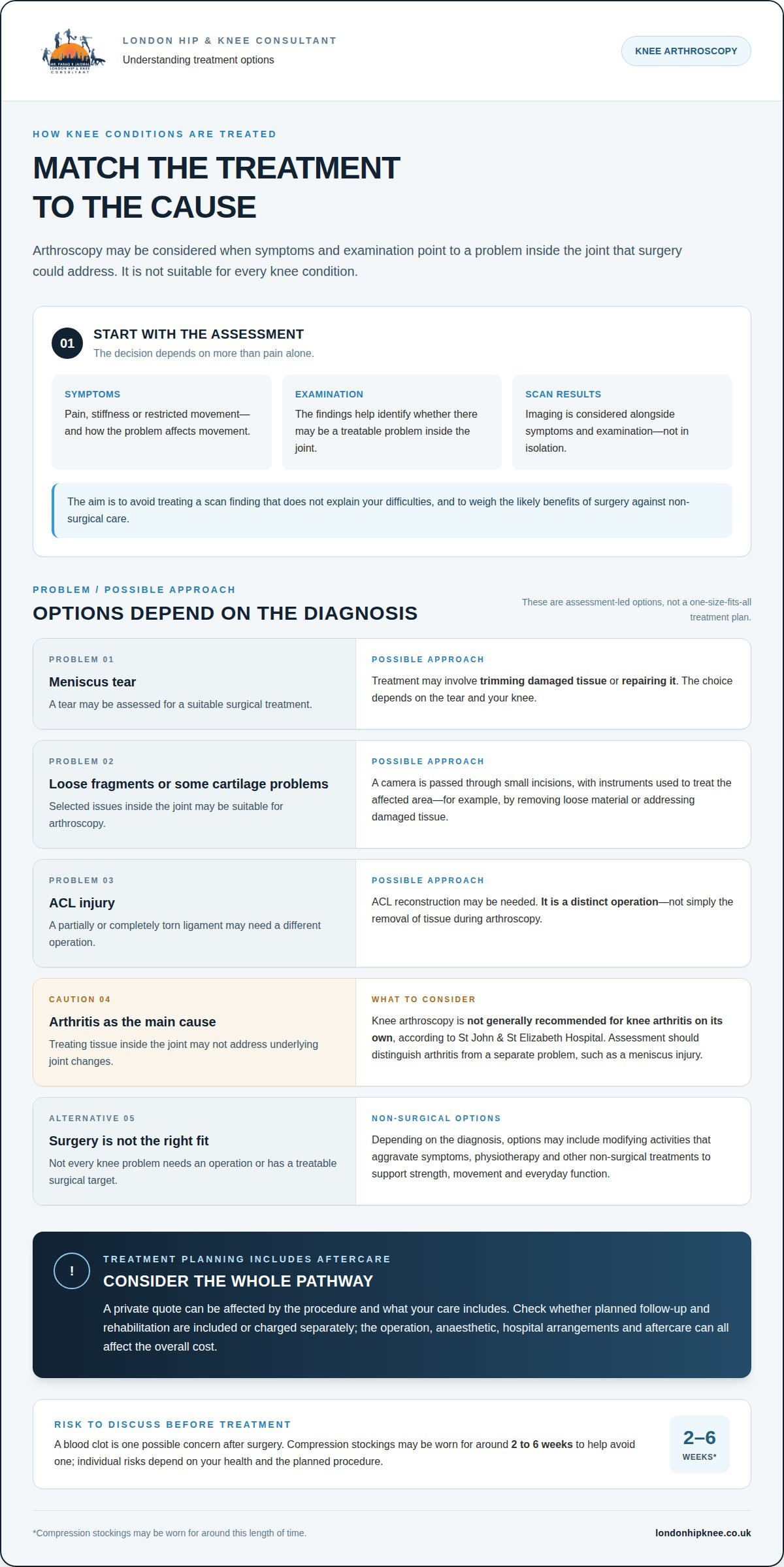
Knee arthroscopy may be considered when your symptoms and examination suggest a problem inside the joint that surgery could address. The decision depends on the condition, its effect on movement and whether non-surgical treatment is appropriate.
Conditions treated with arthroscopy
Arthroscopy can help assess and treat selected meniscus injuries, loose fragments and some cartilage problems. The surgeon inserts a camera through small incisions, then uses instruments to treat the affected area, for example by removing loose material or addressing damaged tissue. The aim is to match the procedure to the cause of your symptoms, rather than treat every painful knee in the same way.
For a meniscus tear, treatment may involve trimming damaged tissue or repairing it, depending on the tear and your knee. An ACL injury may need reconstruction if the ligament is partially or completely torn. Reconstruction is a distinct operation, not simply the removal of tissue during arthroscopy. Your symptoms, examination and scan results help determine whether treatment is suitable.
Non-surgical treatment alternatives
Not every knee problem needs surgery. Depending on the diagnosis, alternatives may include modifying activities that aggravate symptoms, physiotherapy and other non-surgical treatments. These approaches aim to improve strength, movement and everyday function without an operation. The appropriate option depends on the cause of pain or restricted movement, not the symptom alone.
Knee arthroscopy is not generally recommended as a treatment for knee arthritis on its own, according to St John & St Elizabeth Hospital. If arthritis is the main cause of pain, removing or treating tissue arthroscopically may not address the underlying joint changes. Assessment should distinguish arthritis from a separate problem, such as a meniscus injury, before surgery is considered.
Suitability also depends on the problem the surgeon expects to treat. A clear mechanical issue inside the joint may prompt a different discussion from pain without a treatable cause. Assessment brings together your symptoms, examination and imaging, then weighs the likely benefits of surgery against non-surgical care. This helps avoid treating a scan finding that does not explain your difficulties.
Arthroscopy also carries possible complications. A blood clot is one concern after surgery; compression stockings may be worn for around 2 to 6 weeks to help avoid one. Your individual risks depend on your health and the planned procedure, and should be discussed before treatment.
Aftercare is part of planning, not an optional detail. A private treatment quote should clarify whether it includes planned follow-up and rehabilitation, or whether these are charged separately. The operation, anaesthetic, hospital arrangements and aftercare can all affect the overall cost, so consider the full treatment pathway rather than the surgery alone.
How long is the recovery process, and when can I return to normal activities?
Recovery depends on what the surgeon does inside the knee, particularly whether tissue is removed or repaired. A simple arthroscopy may have a shorter recovery than a procedure involving meniscus repair or ligament reconstruction.
Recovery and rehabilitation
After a simple knee arthroscopy, most people return to normal activities within 2 to 3 weeks. Swelling may take up to 12 weeks to settle. Crutches may be needed immediately after surgery and for a few weeks, depending on your mobility and the procedure.
Rehabilitation supports movement and strength as your knee heals. Your physiotherapy plan should reflect the operation: meniscus repair can require a different pace from removing part of the meniscus. Follow instructions for exercises and increasing activity, and discuss new or worsening symptoms at follow-up. This helps align your progress with the healing tissue.
Wound care is another early recovery step. Keep the wound dry for at least 4 to 5 days, and leave the bandage on for 2 to 3 days after the procedure. If you go home the same day, arrange for someone to take you home and stay with you overnight during the first 24 hours. Compression stockings may be worn for around 2 to 6 weeks to help avoid a blood clot.
Returning to work and activities
Your return to work depends partly on how physically demanding your role is. After knee arthroscopy, people in non-physical jobs may be able to return after a week; active jobs may require up to two weeks off. Plan for reduced mobility at first, especially if your work involves prolonged standing, lifting or frequent stairs.
For a minor procedure, limit longer walks for the first 2 to 4 weeks. Avoid submerging the knee in a bath or pool for around 2 to 3 weeks after surgery. These are general timeframes; your activity plan should reflect the specific operation and recovery.
Sport and strenuous exercise need a gradual return, rather than a sudden jump to your previous routine. Meniscal repair often takes 3-6 months to recover, and returning to sport may take several months. ACL reconstruction has a longer recovery, often 6-12 months. Those procedures involve different demands on the knee, so timelines for a simple arthroscopy won’t apply to every patient.
Build your schedule around the procedure, your work and your rehabilitation plan. If you’re considering knee arthroscopy treatment, discuss how recovery could affect your daily activities before setting a return-to-work or exercise date.
What is knee arthroscopy?
Knee arthroscopy is a procedure that lets a surgeon inspect and treat problems inside the joint using a camera and small instruments. It may be considered for specific knee problems, including a meniscus injury, when assessment identifies a suitable target.
The surgeon usually makes two or three small incisions around the knee, each a few millimetres long. A camera passes through one incision and displays the joint on a screen; instruments enter through another to examine or treat the affected area. Compared with open knee surgery, arthroscopy uses smaller access cuts, but it is still surgery and requires recovery.
For meniscus surgery, suitability depends on the tear’s location and pattern, your symptoms and the condition of surrounding tissue. Repair aims to preserve and mend suitable tissue; removal trims damaged tissue when repair is not appropriate. An anterior cruciate ligament injury is assessed separately, as reconstruction is a different procedure. Knee pain or swelling alone does not determine which operation is suitable.
Before surgery, the team reviews your health, medicines, symptoms and assessment findings, then explains the planned procedure and anaesthetic. Knee arthroscopy may use local, spinal or general anaesthesia. Before the operation, patients are advised not to eat or drink for 6 to 12 hours. Patients who smoke are advised to stop several weeks before surgery.
Driving and exercise need individual planning because knee control, pain and the procedure affect readiness. Don’t resume driving until you can control the vehicle safely and have followed the surgical team’s advice. Increase exercise in stages, rather than returning straight to strenuous activity. Flights are usually restricted for six weeks for short-haul travel and 12 weeks for long-haul travel.
Private and NHS care both involve assessing the knee problem and deciding whether surgery is appropriate. The care pathway, arrangements and costs can differ, but private treatment does not make arthroscopy suitable for every cause of knee pain.
There is no single waiting time for private knee arthroscopy in London. Timing depends on completing your consultation and any diagnostic scans, confirming that surgery is suitable, and arranging the procedure and hospital admission.
Initial consultation and diagnostic scans
An orthopaedic consultation connects your symptoms with examination findings and any existing imaging. This assessment helps establish a diagnosis and decide whether further investigation or treatment is appropriate.
Consultant assessment
An orthopaedic consultant will ask how your knee symptoms began and which movements make them worse. They may assess your mobility, pain and swelling, then consider whether the findings fit a meniscus problem or another cause. In North London, a consultation gives you the opportunity to discuss how symptoms affect walking, work or exercise. Next steps should follow the overall assessment, not one symptom alone.
Diagnostic scans can provide more detail when an examination alone does not explain the problem. The consultant considers the images alongside your symptoms and physical assessment. For example, a scan finding involving the meniscus needs context: it may not, by itself, explain your knee pain. Bringing previous scan reports and relevant correspondence can help focus the consultation.
Consultation locations
Any of my clinics in London and Essex is a consultation location for discussing knee problems, possible diagnoses and treatment. A consultation there can cover your symptoms, examination findings and any available imaging. The consultation location is not necessarily the hospital where surgery takes place. When surgery is appropriate, the team operates at private hospitals across London & Essex, with arrangements suited to the planned procedure.
Getting a consultation and referral
To begin a private consultation, arrange an appointment with an orthopaedic consultant. A GP referral can provide a useful summary of your symptoms and previous care, while existing scan reports explain what has already been investigated. If you do not have either, describe when the knee problem began and which activities make it worse.
Prepare a clear account of your knee symptoms, including swelling, restricted movement or difficulty bearing weight. Bring a list of medicines and relevant medical correspondence for the consultant to consider. Ask how scan findings relate to your symptoms, whether further imaging would help and which treatment options follow from the diagnosis. These points can help you understand the reasoning behind the next step.
Private knee arthroscopy costs
The cost of private knee arthroscopy depends on the procedure and what your care includes. You receive the price after requesting a quote. The planned operation, hospital arrangements, anaesthetic and follow-up can affect the total. Ask for a breakdown to see which parts of the treatment pathway are included.
The procedure itself can vary. Using a camera and small incisions to assess a knee joint is different from repairing a meniscus or treating another problem. The type and complexity of surgery influence the resources required. Ligament reconstruction is a distinct procedure and should not be assumed to cost the same as straightforward arthroscopy.
Consider the full pathway, not just the operating fee. A quote may account for the consultant’s care, hospital and theatre charges, anaesthesia, diagnostic investigations and follow-up. Rehabilitation or physiotherapy arrangements can also affect the overall cost. Ask which elements are included, which are separate and whether assessment could lead to a change in the proposed treatment.
Private medical insurance may cover knee arthroscopy when the treatment meets your policy terms. Cover and exclusions vary, so review the benefits, authorisation requirements and exclusions that apply to your planned procedure before relying on insurance funding. For self-pay treatment, a quote request should identify the proposed operation and the care components to be costed.
When comparing costs, match like with like. Check whether each estimate covers the same procedure, such as meniscus repair or removal, and includes the same hospital care, anaesthetic and aftercare. A lower headline figure may not represent the complete cost if key parts of treatment are charged separately. Compare the total pathway and its inclusions, not a single fee.
A consultant’s assessment helps clarify what your knee needs and what the quote should cover. If the diagnosis changes, the planned procedure and associated costs may change too. The camera, incisions and instruments are only one part of care; the treatment plan, hospital arrangements and recovery support matter as well. A clear written breakdown makes these elements easier to understand before you decide.
For a quote based on the proposed procedure and care pathway, request a knee arthroscopy quote. Include relevant scan or consultation details so the cost discussion relates to the knee problem being assessed.
London Hip & Knee Consultant
Mr Parag Jaiswal, London Hip & Knee Consultant can help you understand what may be causing your knee symptoms and discuss suitable treatment options. Assessment considers your symptoms and diagnostic findings together, helping clarify whether surgery or another approach may be appropriate. You can also discuss how proposed treatment could affect recovery and everyday activities, giving you a clearer basis for your decision.
If knee pain is affecting your movement, work or exercise, specialist advice can help clarify the next step. Depending on your diagnosis, care may include ACL reconstruction, knee replacement or Arthrosamid injections. These treatments address different knee problems, so identifying the cause comes first.
Contact Mr. Parag Jaiswal to discuss your knee concerns and arrange a consultation.
Take the next step with clarity
Knee symptoms can make everyday plans harder, and uncertainty about their cause can make treatment decisions more difficult. Before deciding what to do, consider what you most want to regain, such as comfortable walking, confidence on stairs or a return to exercise. These priorities give your consultation a practical focus and connect the discussion to your daily life.
If you are considering private knee arthroscopy in London, the next step is a clear discussion of the diagnosis, the purpose of the proposed procedure and what recovery may involve. The right approach depends on whether the identified knee problem can be treated arthroscopically and how that option fits your needs. Raise questions about costs, recovery planning and alternatives so you understand the decision before moving forward.
Contact London Hip & Knee Consultant to discuss your concerns and explore a suitable way forward. Take the next step with confidence.
Frequently Asked Questions
What Is the Meniscus, and Why Is It So Important?
The meniscus is cartilage inside the knee joint. Each knee has two menisci, positioned between the thigh bone and shin bone. They help the joint manage movement and load during activities such as walking, bending and turning. A tear can cause pain or catching, but scan findings need to be considered alongside your symptoms and examination before treatment is planned.
What can I expect during surgery?
You’ll receive an anaesthetic before the surgeon examines the inside of your knee with a camera. The surgeon can use small instruments to treat the identified problem, such as a damaged meniscus. Knee arthroscopy may be carried out under general, local or spinal anaesthesia. The approach depends on the procedure and anaesthetic plan. Your surgical team will explain what is planned for your knee before the operation.
What happens on the day of surgery?
Knee arthroscopy patients are often discharged on the day of surgery. If you’re going home that day, someone should take you home and stay with you overnight during the first 24 hours. You’ll receive instructions about wound care, medicines and moving safely before discharge. Arrange your journey and overnight support in advance, and follow the hospital team’s instructions about eating, drinking and arrival.
When Is Surgery Necessary?
Surgery may be considered when assessment identifies a knee problem that an operation can treat, such as a suitable meniscus injury or a torn ACL requiring reconstruction. The decision weighs your symptoms, examination and scan findings against non-surgical options. Arthroscopy alone is not generally recommended for knee arthritis. The key question is whether the proposed procedure addresses the cause of your symptoms, rather than an image finding alone.
How much does private knee arthroscopy cost in London?
The price depends on the case and is provided after you request a quote. The planned procedure, hospital arrangements, anaesthetic, diagnostic investigations and follow-up can affect the total. Treating a meniscus problem, for example, may involve different care from a more complex operation. Consider the full treatment pathway rather than a single headline fee, and make sure the quote relates to the procedure being discussed.
What is included in a private knee arthroscopy quote?
A quote should clarify which parts of the treatment pathway it covers, so you can understand the total. Relevant elements may include the consultant’s care, hospital and theatre arrangements, anaesthetic, investigations and follow-up. Rehabilitation arrangements can also affect overall costs. Compare quotes only when they relate to the same planned procedure, and clarify which elements are included or charged separately.
How should I prepare for knee arthroscopy, and what happens on the day?
Before surgery, patients are advised not to eat or drink for 6 to 12 hours. If you smoke, you’re advised to stop several weeks before the operation. Follow the specific instructions provided for your procedure and anaesthetic. On the day, the surgical team will prepare you for the operation and explain the immediate aftercare. Plan transport home and overnight support if you’re discharged that day.
How long is recovery after knee arthroscopy, and what rehabilitation is needed?
Recovery time depends on what the surgeon does: trimming damaged meniscus tissue and repairing a tear place different demands on the knee. Rehabilitation aims to restore comfortable movement, strength and control in stages. Your exercises and activity progression should reflect your procedure, not someone else’s recovery. Repair can require a more cautious return to demanding activity than a simpler procedure, so discuss work, sport and daily tasks as part of your recovery plan.