

Private keyhole knee surgery in London usually means knee arthroscopy. A surgeon uses a small camera and instruments through small incisions to examine the joint and, where appropriate, treat a problem. Arthroscopy may be used for meniscus damage, but it is not the right answer for every cause of knee pain. The knee has two menisci, crescent-shaped pieces of cartilage that help cushion the joint.
If your knee catches, swells or hurts when you move, it is understandable to want a clear explanation and a practical way forward. The right treatment depends on what is causing your symptoms, so assessment is an important first step before considering surgery.
This guide explains how knee arthroscopy works, which conditions it may address and what recovery can involve. It also outlines how specialists assess knee problems and how to think through the available care options, helping you approach your next decision with greater confidence.
Key Takeaways
- Knee arthroscopy uses a small camera and instruments to assess and treat problems inside the joint, including some meniscus tears.
- Meniscal repair aims to preserve the torn cartilage, and recovery may take longer than after partial meniscus removal.
- Rehabilitation depends on the procedure: weight-bearing, crutch use and return to sport can differ, particularly after a repair.
- Knee surgery isn’t always the first treatment option; the cause of your symptoms helps guide whether surgery or non-surgical care is appropriate.
- Learn what can affect procedure time, anaesthetic planning and the choice of treatment for different knee conditions.
What Does Private Meniscal Surgery Involve?
Private meniscal surgery may use knee arthroscopy to examine and treat a damaged meniscus through small incisions. The suitable approach depends on the tear, your symptoms and the condition of the joint.
Arthroscopic Meniscal Repair
Arthroscopic meniscal repair uses a camera and instruments inserted through small incisions to reach torn cartilage. The surgeon positions and secures the tear, aiming to preserve the meniscus rather than remove damaged tissue.
The knee has two menisci, crescent-shaped pieces of cartilage between the thighbone and shinbone. The tear’s position and pattern help determine whether repair is suitable. The aim is to treat the damaged area while preserving the meniscus’s cushioning role.
Keyhole Knee Surgery and Arthroscopy
“Keyhole knee surgery” is the everyday term for knee arthroscopy. A small camera, called an arthroscope, sends images from inside the joint to a screen. The surgeon inspects the knee and uses instruments through separate small incisions.
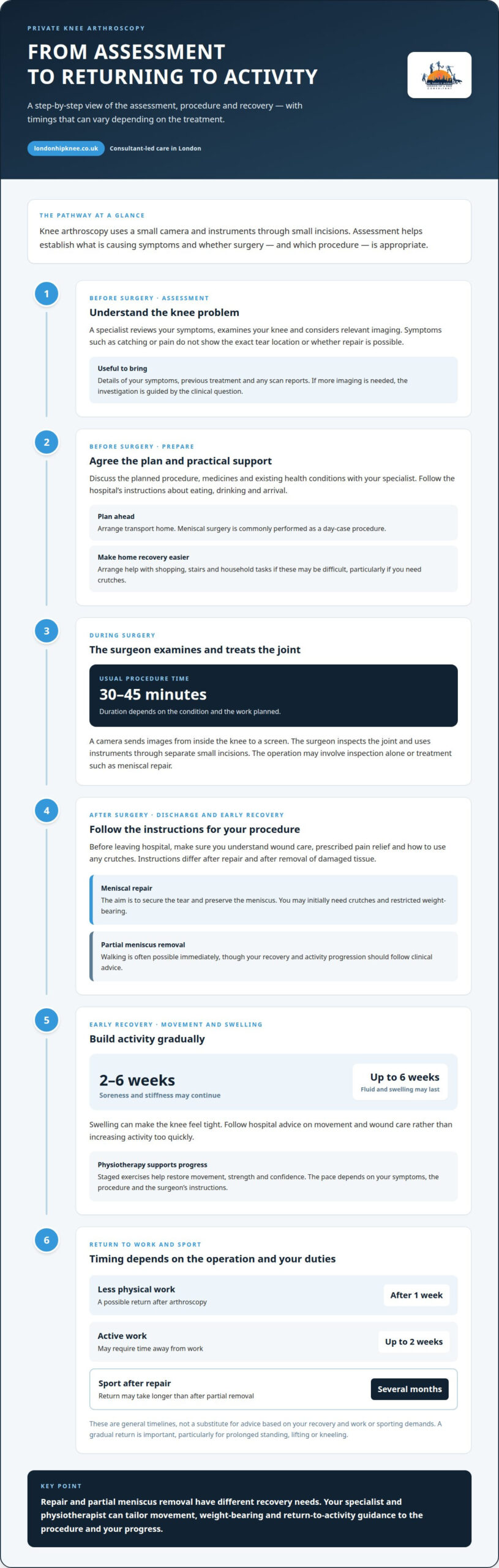
Knee arthroscopy usually takes 30 to 45 minutes, depending on the condition. The procedure may involve inspection alone or treatment such as meniscal repair. The planned work affects what happens during surgery.
Knee arthroscopy can help assess or treat some meniscal tears and other problems inside the joint. A tear, for example, may cause catching or pain during movement, but symptoms alone cannot show its exact location or whether repair is possible. Assessment brings together your symptoms, examination and imaging findings.
Arthroscopy is less invasive than an operation involving a larger incision, but it is still surgery. Complications are possible, as with any surgical procedure. Risks depend on your health and the procedure planned, and should be discussed before you consent. There is no single success rate for every arthroscopy: outcomes depend on the condition being treated and the aim of surgery, such as easing catching or repairing a tear.
Arthrosamid® is an injection treatment, not a way to repair a meniscus tear. It may be considered for knee osteoarthritis, whereas arthroscopy addresses selected problems within the joint. A knee arthroscopy within the past 6 months is a contraindication to Arthrosamid® treatment, so procedure timing matters when considering options for knee pain.
For people considering private keyhole knee surgery in London, the key question is whether arthroscopy can address the joint problem. A surgeon considers the type and position of a tear, its effect on movement, and whether repair or another approach best fits the findings.
How quickly can I be seen by a knee specialist?
Before private knee arthroscopy, a specialist reviews your symptoms, examines your knee and considers relevant imaging. During surgery, the joint is assessed and the planned treatment is carried out. Afterwards, the hospital team explains wound care, movement and follow-up. To arrange a private consultation in London, you can contact a practice directly or ask your GP to refer you.
How soon you can be seen depends on appointment availability and the assessment needed. Bring details of your symptoms, previous treatment and any scan reports to help make the consultation focused. If further imaging is needed, the investigation and clinical question guide the next step. Your specialist can explain how the results will inform your diagnosis and treatment plan.
Preparing for surgery and recovery support
Prepare by agreeing the procedure and recovery plan with your specialist. Discuss your medicines and existing health conditions, then follow the hospital’s instructions about eating, drinking and arrival. Arrange transport home in advance, as meniscal surgery is commonly performed as a day-case procedure. Plan practical support at home for the early stages of recovery.
Before discharge, make sure you understand how to care for the wound, manage prescribed pain relief and use any crutches. Instructions should reflect whether the operation involved meniscal repair or removal of damaged tissue. After a repair, you may initially need crutches and restricted weight-bearing. Arrange help with shopping, stairs and household tasks if these are likely to be difficult.
Recovery, physiotherapy and returning to activities
Swelling and stiffness are common in early recovery. After knee arthroscopy, soreness and stiffness may continue for two to six weeks. Fluid and swelling after meniscus surgery can last up to six weeks and may make the knee feel tight. Follow the hospital’s advice on movement and wound care rather than increasing activity too quickly.
Physiotherapy helps restore movement, strength and confidence through staged exercises. The pace depends on the procedure: walking is often possible immediately after partial meniscus removal, while repair can require initial weight-bearing restrictions. A physiotherapist can progress exercises in line with your symptoms and surgical instructions. Take particular care when returning to sport. After a repair, this may take several months.
Work plans also depend on your role. After knee arthroscopy, someone with a less physical job may be able to return after a week, while an active job may require up to two weeks off. These are general timelines, not a substitute for advice based on your recovery and duties. A gradual return can help, particularly if your work involves prolonged standing, lifting or kneeling.
For information about private knee arthroscopy consultation, use the consultation route to discuss assessment, treatment planning and recovery support.
What types of knee surgery do you carry out?
Private consultant-led knee care in London starts by identifying the cause of your symptoms. Depending on the diagnosis, surgical options may include knee arthroscopy, meniscal surgery or reconstruction of the anterior cruciate ligament (ACL). These procedures address different problems, so the choice follows assessment rather than symptoms alone.
At your appointment, the consultant asks when your knee problems began, which movements trigger pain and whether an injury occurred. They may examine your knee’s movement, stability and tenderness. For example, a twisting injury with instability may prompt an ACL assessment, while catching may lead to investigation of a problem inside the joint.
Imaging can help clarify the findings. An MRI can show soft tissues, including ligaments and menisci, while an X-ray can help assess bones and joint changes. The consultant considers imaging alongside your symptoms and examination. If an ultrasound or MRI is used, the findings can help refine the diagnosis and inform a suitable treatment plan.
Private knee arthroscopy is available through private hospitals and specialist orthopaedic clinics in London. The hospital setting and consultant’s assessment are parts of the care pathway. Your appointment should establish which investigations are needed, whether surgery is appropriate and where treatment would take place.
When comparing care, focus on the plan for your specific knee problem. Ask what diagnosis the examination supports, what the proposed operation aims to treat and which alternatives are relevant. Clarify who will perform the procedure, how findings may affect the surgical plan, and what follow-up and rehabilitation involve. These answers help you understand the care pathway, not just the procedure name.
The relevant specialist is an orthopaedic surgeon whose practice includes knee conditions and procedures such as arthroscopy or ACL reconstruction. Surgeons’ qualifications and experience differ, so your consultation should make clear who is responsible for your assessment and treatment, along with their relevant training and experience.
Consultant fees and appointment arrangements vary according to what the assessment includes. A consultation may involve a clinical examination and review of existing scans; further imaging may be considered if the diagnosis remains unclear. Before proceeding, establish what the appointment covers and how any recommended investigation fits into the treatment plan. Your symptoms, examination findings, imaging and treatment goals all help shape that plan.
Bring a concise account of your symptoms, details of any previous knee injury and relevant scan reports to the appointment. This gives the orthopaedic surgeon a clearer picture of how knee problems affect daily activities, work or sport. The discussion can then focus on diagnosis, suitable treatment and the next step, whether that is further assessment or surgery.
Procedure duration and anaesthetic options
Knee arthroscopy duration and anaesthesia depend on the work planned inside the joint. Non-surgical options may also suit some knee conditions, so treatment planning considers both the diagnosis and the purpose of each procedure.
Procedure Duration
Knee arthroscopy usually takes 30 to 45 minutes, depending on the condition. A straightforward inspection differs from treatment that involves repairing a meniscus, so the planned work shapes the operating time.
The quoted figure describes the procedure itself, not the entire hospital visit. Preparation, anaesthetic care and post-operative observation also take time. Ask how the expected operating time relates to your specific plan, including whether the surgeon may treat a problem found during the examination.
Anaesthesia Options
The anaesthetic plan is discussed before surgery, taking into account your health and the procedure being considered. For knee arthroscopy, choosing an appropriate approach is part of that planning; no single option suits every patient.
Arthrosamid® is different from arthroscopy: it is administered as a one-step procedure under local anaesthesia. It is an injection treatment for knee osteoarthritis, not an operation to repair damaged cartilage. Keeping the treatments distinct clarifies the purpose of the anaesthetic and what each procedure aims to address.
Surgery is not always the first or best treatment for knee pain. Depending on the diagnosis, non-surgical options may include physiotherapy, injections or changes to activities. An exercise programme, for example, may form part of care, while an injection is a separate option from an operation. Your diagnosis and symptoms help shape the discussion.
Arthroscopy and knee replacement address different problems. Arthroscopy uses a camera and instruments inside the joint; replacement is a larger operation for a damaged joint. Meniscal problems, cartilage damage and osteoarthritis are not interchangeable diagnoses, so the operation should match the condition being treated. Your consultant can explain how a proposed procedure fits the examination and imaging findings.
The price depends on the case and is provided after a quote request; factors include the procedure, anaesthetic and hospital care involved. Ask for the proposed treatment and associated costs to be explained together, so you understand what the quote covers before deciding.
Before consenting, clarify the expected procedure duration, anaesthetic plan, alternatives and recovery arrangements. These details help you compare arthroscopy with non-surgical treatment and understand the practical implications of each option. If knee replacement is being discussed instead, ask how that recommendation relates to your diagnosis and goals.
Knee conditions treated by specialists
Knee pain can come from different structures, so diagnosis matters before choosing a procedure. An orthopaedic specialist considers your symptoms, examination and imaging together. This helps distinguish a meniscal tear from a ligament injury or osteoarthritis. These conditions can cause similar movement difficulties but require different treatment plans.
The menisci are two crescent-shaped pieces of cartilage that act as shock absorbers between the thighbone and shinbone. A forceful twist or rotation can tear this cartilage. The tear’s location and pattern help guide treatment, including whether an operation might address the problem. Catching, pain or swelling can inform assessment, but symptoms alone do not identify the exact damage.
Age can also affect the meniscus. In adults over 40, it may weaken with age, making a tear possible without one clear sporting injury. A specialist therefore considers how symptoms began and what activities bring them on. A sudden twist during sport tells a different story from discomfort that has developed gradually during everyday movement.
Ligament injuries are another reason to seek specialist assessment. The anterior cruciate ligament, or ACL, is one of the ligaments in the knee. If an injury affects stability, an orthopaedic surgeon assesses the joint and considers whether ACL reconstruction is appropriate. The decision depends on the diagnosis and how the knee functions, not simply on the presence of pain.
Osteoarthritis involves wear and tear in the knee joint and becomes more common with age. It differs from a meniscal tear or ligament injury, although all can limit comfortable movement. The distinction matters: knee arthroscopy may address selected problems inside the joint, while osteoarthritis may call for a different treatment discussion. A procedure is chosen for the condition it can treat, not as a general remedy for every type of knee pain.
A consultant orthopaedic assessment helps distinguish between these possibilities. The specialist considers when symptoms began, movement, stability and imaging findings. For example, a twisting injury with catching may prompt closer assessment of the meniscus, while a knee that feels unstable directs attention to ligament function. Imaging adds detail when examination alone cannot clarify the diagnosis.
The practical takeaway is to focus on the cause of your symptoms before weighing surgical techniques. Meniscus, ligament and joint changes are distinct problems, and the treatment plan should explain which finding it addresses. If your knee pain affects movement or sport, arrange a specialist knee assessment to discuss diagnosis and suitable next steps.
London Hip & Knee Consultant: Meniscus surgery
London Hip & Knee Consultant provides meniscus surgery when assessment identifies a meniscal problem that may benefit from an operation. A consultation connects your symptoms and examination findings with suitable treatment, including whether surgery is appropriate.
Meniscal tears vary in position and pattern, so the treatment plan should address the specific damage and your knee function. Discuss the intended procedure, recovery support and how the recommendation relates to your diagnosis. If you experience catching, pain or difficulty returning to everyday activities, a specialist assessment can clarify the next step.
Contact Mr. Parag Jaiswal, London Hip & Knee Consultant to discuss your knee symptoms and meniscus surgery.
Take the next step towards a clearer treatment plan
Your next decision is not simply whether to have surgery. It is understanding what is causing your knee symptoms and which treatment fits the diagnosis. Private keyhole knee surgery in London may form part of the discussion, but the right plan also considers your priorities, daily activities and assessment findings.
Mr. Jaiswal provides care including meniscus surgery, knee replacement and Arthrosamid injections, alongside hip replacement. These options address different conditions, so a consultation can help establish which direction is relevant to your needs. If you’re ready to discuss your symptoms and possible next steps, contact London Hip & Knee Consultant.
A careful assessment can turn uncertainty into a practical plan and help you move forward with greater clarity.
Frequently Asked Questions
How does a knee arthroscopy work?
Knee arthroscopy lets a surgeon inspect the inside of your knee using a small camera. The camera passes through a small incision, while instruments can enter through other small openings to treat a suitable problem. The surgeon assesses the joint and carries out the planned treatment. Your assessment and imaging help shape the plan beforehand; afterwards, you receive instructions for wound care, movement and follow-up.
Do you offer non-surgical treatment as well as surgery?
Yes. London Hip & Knee Consultant offers Arthrosamid® injections for knee osteoarthritis alongside surgical care. An injection does not repair a meniscus tear or replace every operation. The options depend on the diagnosed condition and the aim of treatment. Osteoarthritis and a ligament injury, for example, are different problems and may call for different approaches.
How long does recovery usually take?
Recovery depends on what the surgeon does and how your knee responds. After partial meniscus removal, return to normal activities is typically 2-6 weeks; after meniscal repair, recovery is typically 3-6 months. These timelines describe different procedures, not interchangeable recovery plans. Your instructions should set out how to build activity back up, including when to progress from everyday movement towards more demanding tasks.
Is my condition serious enough for this treatment?
Suitability depends on the cause of your symptoms, not pain alone. An assessment considers how your knee moves, whether it catches or feels unstable, and what examination or imaging shows. A meniscal tear, ACL injury and osteoarthritis are different diagnoses, each with distinct treatment considerations. The key question is whether the proposed treatment addresses the problem affecting your movement and daily activities.
What is keyhole knee surgery (knee arthroscopy), and what conditions can it treat?
Keyhole knee surgery is another name for knee arthroscopy, a procedure that uses a camera and instruments through small incisions. It can assess and treat selected problems inside the joint, including some meniscal tears. It is not a general treatment for every cause of knee pain. The diagnosis matters: an ACL injury or osteoarthritis may call for a different treatment plan.
How much does private knee arthroscopy cost in London, including surgeon, anaesthetist and hospital fees?
The price depends on the case and is provided after a quote request. The total can be affected by the planned procedure, surgeon’s fees, anaesthetist’s fees and hospital charges. Ask for the proposed treatment and associated fees to be set out together, so you understand which elements are included. No single figure applies to every patient or procedure.
Does private medical insurance cover knee arthroscopy in the UK, and what exclusions or pre-authorisation rules apply?
Cover depends on the terms of your individual policy, so there is no single answer for every UK patient. Policy wording may set out exclusions, limits or pre-authorisation steps for planned treatment. Review the sections on outpatient consultations, investigations and surgery, and ask your insurer how they apply to your proposed care. Also clarify whether your policy requires approval before treatment begins.
Which London hospitals and clinics offer private knee arthroscopy?
Private knee arthroscopy is available through private hospitals and specialist orthopaedic clinics in London. Spire London East Hospital is named in connection with knee arthroscopy.