

Why does the path to pain-free movement often feel like a maze of financial jargon and hidden “top-up” fees? You’ve spent years paying into your private health insurance, yet when the time comes to address a failing joint, the actual hip replacement bupa cost can still feel shrouded in uncertainty. It’s frustrating to face the physical burden of chronic pain whilst simultaneously worrying whether your policy will cover the specific surgeon or the high-quality prosthetic you deserve.
We understand that you want more than just a surgical date; you want the peace of mind that comes with complete financial and clinical clarity. This guide provides a transparent roadmap through the Bupa authorisation process, explaining the vital distinctions between “Fee-Assured” and “Premier” consultants. You’ll learn how hospital fees and specialist charges interact in London’s premier facilities, ensuring you can choose a Bupa-recognised expert like Mr. Parag Jaiswal with absolute confidence. From understanding your policy excess to the specifics of your recovery plan, we’ll help you reclaim your mobility without the anxiety of unexpected bills.
Key Takeaways
- Understand the three-way financial relationship between patient, insurer, and surgeon to ensure total transparency before your procedure begins.
- Learn how choosing a “Fee-Assured” specialist can help manage the hip replacement bupa cost by avoiding unexpected consultant fee shortfalls.
- Identify the key factors that influence London private hospital pricing, including facility location and the technical complexity of your surgical needs.
- Navigate the Bupa authorisation process with ease, following a clear roadmap from your initial GP referral to the diagnostic consultation phase.
- Gain confidence in selecting a London-based expert who prioritises both clinical excellence and the restoration of your personal freedom.
Understanding Hip Replacement Costs with Bupa Insurance
For many patients, the decision to undergo Hip replacement surgery is driven by a desire to reclaim a life of mobility and freedom. When you’re covered by private health insurance, this clinical journey involves a unique three-way financial relationship. You, the patient, are the focus of care; your consultant, such as Mr. Parag Jaiswal, provides the surgical expertise and precision; and Bupa acts as the insurer that facilitates the funding based on your specific policy terms. Understanding how these parties interact is the first step toward a stress-free recovery.
In the London market, Bupa operates using the concept of “reasonable and customary” fees. This is a benchmark for what the insurer considers a fair price for a procedure in a specific geographical area. Because the capital often presents higher operational costs for hospital facilities, knowing how these benchmarks affect your hip replacement bupa cost is vital. Many people amongst the London population favour Bupa for orthopaedic care because of its established network of “Fee-Assured” specialists who agree to work within these predefined limits, providing patients with much-needed financial predictability.
The Difference Between Hospital and Consultant Fees
It’s helpful to view your surgical costs as two distinct streams that Bupa manages on your behalf. Hospital fees cover the “hotel” and technical aspects of your stay. This includes your private room, nursing care, theatre time, and the physical prosthetic itself. Consultant fees, however, are separate. These cover the professional expertise of your surgeon and the anaesthetist, whilst also including your follow-up care during the initial recovery phase. Bupa typically outlines these distinctions in your authorisation letter, ensuring you know exactly what’s covered before you enter the hospital centre.
Why Policy Tiers Matter for London Surgery
Your choice of hospital is often determined by your specific policy tier, such as Bupa By You, Bupa Care, or a corporate plan. For those seeking treatment in central London, a “London Upgrade” is frequently a specific requirement. Without this, your coverage might be limited to facilities outside the M25, potentially restricting your access to premier sites like London Bridge Hospital or the Bupa Cromwell Hospital. Additionally, don’t forget your annual excess. This amount acts as your initial contribution and is usually paid directly to the hospital or consultant during your first few appointments before Bupa’s full coverage begins to apply to your hip replacement bupa cost.
How Bupa Covers Hip Replacement: Fee-Assured vs. Self-Pay
One of the most common anxieties for patients considering private surgery is the fear of hidden costs or unexpected invoices arriving after the procedure. Whilst Bupa provides extensive coverage for orthopaedic care, the final hip replacement bupa cost is heavily influenced by whether your chosen specialist is part of their “Fee-Assured” network. This scheme is designed to offer financial protection, but it’s essential to understand how it interacts with the clinical decisions made during your treatment journey.
A Fee-Assured consultant is a specialist who has agreed to charge within the benefit limits set by Bupa for specific procedures. If you select a surgeon who isn’t fee-assured, you may face a “shortfall.” This is the difference between what the consultant charges and what Bupa is prepared to pay. This gap isn’t just limited to the surgeon’s fee; it also extends to the anaesthetist, whose expertise in managing pain and safety throughout the operation is a critical component of the overall cost equation. You can find general NHS information on hip replacement to understand the standard clinical pathways, but private care offers the added benefit of choosing your specific specialist and facility.
What Does ‘Fee-Assured’ Actually Mean?
In practice, “Fee-Assured” means your consultant has committed to Bupa’s pricing structure, ensuring that you won’t receive a “top-up” bill for their professional time. This agreement provides significant peace of mind, allowing you to focus entirely on your recovery rather than your finances. To verify if your London specialist holds this status, you can check the Bupa Finder tool or speak directly with the consultant’s private secretary. Mr. Jaiswal maintains a transparent approach to these agreements, ensuring patients understand their coverage from the very first consultation.
Self-Pay vs. Insurance: A Strategic Comparison
Whilst insurance is the primary route for many, some patients opt for a self-pay approach. This is often a strategic choice if a policy has specific exclusions, high premiums, or if a patient desires a particular “unrecognised” implant that falls outside Bupa’s standard approved list. Self-pay packages in London are typically “all-inclusive,” covering everything from the initial stay to follow-up physiotherapy in one fixed price. In contrast, insurance is more modular, with Bupa paying different providers for theatre time, nursing, and surgical fees separately.
Whether you are utilising your corporate insurance or considering a self-funded route to bypass long waiting lists, having a clear financial plan is vital. You can explore your options for a tailored private hip replacement in London by discussing your specific needs with a specialist who understands both the clinical and insurance landscapes. This dual expertise ensures that your path to restoration is as smooth and predictable as possible.
Factors Influencing the Final Price of Surgery in London
The total hip replacement bupa cost isn’t a single, static figure. Instead, it’s a composite of several variables that reflect the high standards of care found in the capital. London is unique amongst UK cities; it offers a concentration of world-class facilities, but this excellence comes with a geographic premium. Whether you’re treated in a central hospital centre or a facility in Greater London can significantly shift the “hospital fee” portion of your Bupa claim. This variance often dictates whether your policy covers the full theatre cost or if a top-up is required.
Beyond geography, the clinical complexity of your case plays a major role. A standard Total Hip Replacement (THR) follows a predictable pricing structure, but complex revisions (replacing a previously installed implant) require more theatre time and specialised equipment. The materials used also matter. Modern ceramic or advanced polyethylene components are designed for extreme longevity, and whilst these are clinical choices made for your long-term mobility, they influence the hospital’s billing to Bupa. Pre-operative diagnostics, such as high-resolution MRIs or weight-bearing X-rays, are also factored into the initial authorisation phase, ensuring your surgical plan is as precise as possible. It is also worth noting that not every hip condition requires a full replacement; for some patients, conditions such as femoroacetabular impingement may be addressed through less invasive means, and understanding hip arthroscopy for FAI and when it is needed can help clarify whether a hip replacement is truly the most appropriate next step.
London Hospital Networks and Bupa
Bupa organises its recognised facilities into specific lists, such as “Partnership” and “Participating” hospitals. Many elite central London hospitals are categorised in a way that requires a specific “London” or “Premier” add-on to your policy. Patients can consult resources like the Private Healthcare Information Network to compare quality and outcomes across these different facilities. Choosing a hospital within your policy’s network ensures that the environment for your recovery, from private room standards to specialist nursing care, is fully funded without financial surprises.
The Impact of Surgical Technique on Cost
Modern orthopaedic surgery has moved toward minimally invasive techniques that aim to preserve as much natural tissue as possible. These methods often involve advanced technology in the theatre, such as robotic assistance or computer-guided navigation, which can affect the hospital’s technical charges. Mr. Jaiswal’s specialised focus on hip and knee excellence ensures that these modern techniques are used to speed up your return to personal freedom. Whilst the hip replacement bupa cost may reflect the use of this high-end theatre tech, the investment often results in a more efficient recovery and a quicker return to your daily life.
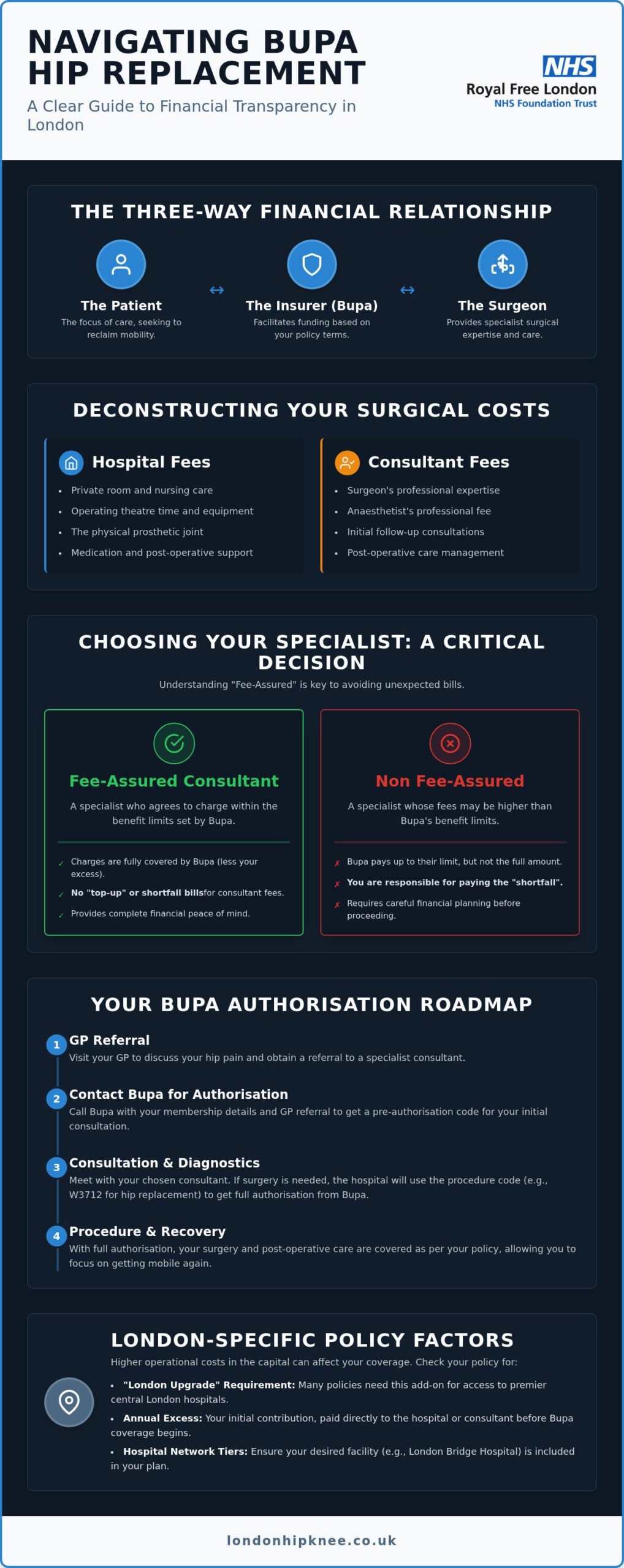
A Step-by-Step Guide to Navigating Your Bupa Claim
Securing a GP referral is your essential first step. Bupa requires this clinical recommendation to trigger the authorisation process for any specialist treatment. Whilst some policies allow for an “Open Referral” where the insurer suggests a provider, you have the right to request a specific expert like Mr. Jaiswal. Once you have this referral, your journey toward restoration begins with an initial consultation to confirm the diagnosis and discuss your surgical plan in detail. This diagnostic phase is vital for ensuring that the subsequent claim is handled efficiently.
Following your consultation, our office will provide you with the specific clinical codes required for your procedure. You must then contact Bupa to obtain a Pre-Authorisation Number. This number acts as the green light for the hospital theatre and ensures all technical and clinical fees are logged correctly. It’s best to secure this at least two weeks before your surgery date to ensure a smooth admission and to avoid any last-minute administrative stress. This number is the link between your clinical need and the financial coverage of your hip replacement bupa cost.
The Importance of the OPCS Code
Every private procedure in the UK is defined by an OPCS code. For a standard hip replacement, you’ll likely see code W3712 (Primary Total Hip Replacement). If your case involves more complex requirements, codes W3812 or W3912 for revisions may be used instead. Providing the correct code to Bupa is crucial; it ensures they pay the hospital directly and clarifies the benefit limits for your specific case. You should confirm these codes with Mr. Jaiswal’s office early in the process to ensure your authorisation matches the planned surgery perfectly.
Dealing with Shortfalls and Excesses
Most private policies include an annual excess, which is the initial portion of the hip replacement bupa cost that you pay yourself. This amount is usually settled directly with the hospital centre or the consultant’s office. If Bupa identifies a “shortfall” because a specialist’s fee exceeds their benefit limit, they will notify you during the authorisation call. Clear communication with Bupa’s claims team is essential. Don’t hesitate to ask for a “breakdown of benefits” to understand exactly how your coverage is being allocated across the hospital and consultant fees.
Your clinical journey continues well beyond the operating theatre. Managing follow-up care, including specialist physiotherapy sessions, is an integral part of reclaiming your personal freedom. Bupa typically authorises a set number of post-operative sessions, but these must be linked to your original pre-authorisation number to ensure seamless payment. If you’re ready to begin this process, you can book a consultation with Mr. Jaiswal to discuss your surgical options and obtain the necessary clinical codes for your Bupa claim.
Specialist Hip Replacement with Mr. Parag Jaiswal
Choosing the right surgeon is the most critical decision in your orthopaedic journey. Mr. Parag Jaiswal understands that for many, the primary concern isn’t just the clinical outcome, but also the clarity of the hip replacement bupa cost. With over 18 years of medical experience, he has built a practice grounded in transparent communication and surgical excellence. This ensures that you aren’t just another patient on a list, but an individual receiving a tailored recovery plan designed to restore your personal freedom and mobility.
Mr. Jaiswal provides a truly consultant-led experience. From your first diagnostic scan to the final stages of your rehabilitation, you’ll be guided by the same expert hand. This continuity is rare but essential for building the trust needed during a major surgical procedure. He specialises in both surgical interventions and non-surgical hip treatments, ensuring that every conservative option is explored before moving toward the operating theatre. This steady, methodical approach prioritises your safety and long-term joint health above all else.
A Compassionate Approach to Orthopaedic Care
His philosophy centres on your specific lifestyle goals. Whether you want to return to the golf course, enjoy long walks, or simply move through your home without discomfort, the focus remains on your restoration. By utilising modern, minimally invasive techniques, Mr. Jaiswal aims to reduce hospital stays and accelerate recovery times. This clinical precision reflects his 18+ years of specialist experience in the UK, providing you with the reassurance that your care is being managed by a seasoned expert who remains deeply approachable.
London Locations and Accessibility
Convenience is a hallmark of Mr. Jaiswal’s practice. He operates across several of the capital’s most prestigious private hospitals, including London Bridge Hospital, St John & St Elizabeth Hospital, and Nuffield Health Highgate. This wide network allows you to choose a facility that best suits your location whilst ensuring it aligns with your Bupa policy tier. His dedicated administrative team is highly experienced in coordinating with insurers, helping you manage the administrative side of your hip replacement bupa cost with minimal fuss.
Taking the first step toward a pain-free life shouldn’t feel like navigating a maze. By aligning clinical excellence with a deep understanding of the Bupa authorisation process, Mr. Jaiswal provides a clear path toward resolution. You can book your consultation with Mr. Parag Jaiswal today to begin your journey toward lasting mobility and freedom from hip pain.
Reclaiming Your Mobility with Confidence
Navigating the financial landscape of private surgery shouldn’t be a barrier to your recovery. By understanding the distinction between Fee-Assured consultants and London’s premier hospital networks, you can eliminate the fear of unexpected shortfalls. A clear grasp of the authorisation process ensures that your focus remains where it belongs: on your physical restoration and the return to the activities you love. When you align your clinical needs with the right insurance pathway, the journey toward a pain-free life becomes predictable and manageable.
Choosing a Bupa-recognised specialist who understands both the clinical and administrative complexities of your care is vital. Mr. Parag Jaiswal brings over 18 years of clinical excellence to every procedure, specialising in modern hip and knee reconstruction. When you address your hip replacement bupa cost with transparency and expert guidance, you’re investing in a future of personal freedom and movement. Don’t let chronic pain dictate your lifestyle any longer.
Book a Consultation with Mr. Parag Jaiswal today to discuss your surgical options and begin your journey toward a more active life. Your path to restoration is closer than you think, and we’re here to guide you through every step of the process with quiet confidence and expert care.
Frequently Asked Questions
Does Bupa cover the full cost of a total hip replacement in London?
Yes, Bupa usually covers the full clinical and hospital costs for a hip replacement, provided your policy is valid and you choose a Fee-Assured consultant. However, you’ll still need to pay your agreed annual excess, which is the first portion of your claim. In London, it’s also essential to ensure your hospital is on your policy’s recognised list, as some “Premier” facilities require a specific London upgrade to be fully funded.
What is a ‘shortfall’ in a Bupa hip replacement claim?
A shortfall occurs when there’s a gap between what your specialist charges and the maximum benefit Bupa is prepared to pay for that specific procedure. This most commonly happens if you choose a consultant who isn’t “Fee-Assured”. You’re responsible for paying this difference directly to the specialist. To avoid unexpected additions to your hip replacement bupa cost, always confirm your surgeon’s fee status and the relevant clinical codes with Bupa before your theatre date.
Can I choose my own surgeon if I have Bupa insurance?
You certainly have the right to choose your own surgeon, even if your GP provides an “Open Referral” letter. Whilst Bupa may suggest specific providers, you can request a consultation with a recognised expert like Mr. Parag Jaiswal. Choosing your own specialist ensures a consultant-led journey from diagnosis to rehabilitation. Just ensure the surgeon is recognised by Bupa and check whether they’re Fee-Assured to maintain full control over your financial obligations and clinical outcomes.
How long is the waiting time for a private hip replacement with Bupa?
Private waiting times are significantly shorter than the NHS, with most surgeries scheduled within four to six weeks of your initial consultation. Once Bupa authorises your procedure, the timeline is largely determined by your surgeon’s availability and your choice of London hospital. This rapid access allows you to address debilitating pain much sooner, facilitating a faster return to your normal behaviour and daily activities without the prolonged physical decline associated with long public waiting lists.
Are physiotherapy and post-operative scans covered by Bupa?
Yes, Bupa typically covers essential post-operative care, including physiotherapy and follow-up imaging. Most surgical authorisations include a specific number of physiotherapy sessions to support your initial recovery. It’s important to remember that these must be pre-authorised and performed by Bupa-recognised practitioners. Always check your specific policy limits, as some plans have a “cap” on the total amount or number of sessions allowed for outpatient rehabilitation each year, which could affect your overall recovery plan.
What happens if I need a hip replacement but don’t have Bupa insurance?
If you don’t have private insurance, you can choose to “self-pay” for your procedure. Most private hospitals in London offer fixed-price packages for self-funding patients, which include the hospital stay, surgical fees, and initial aftercare. This provides cost certainty and immediate access to specialist care. Mr. Jaiswal works with both insured and self-paying patients, ensuring that high-quality orthopaedic restoration is accessible regardless of your insurance status, helping you avoid lengthy waiting times and reclaim your personal freedom.
Do I need a GP referral to see Mr. Jaiswal for a hip consultation?
Yes, a GP referral is a mandatory requirement for Bupa to authorise your initial consultation and any subsequent treatment. This letter provides a clinical summary of your condition and ensures that your insurer recognises the medical necessity of the appointment. Once you have this referral, you can contact Mr. Jaiswal’s team to arrange a consultation at a convenient London location. This step is essential for a seamless claim process and avoids unnecessary delays in your journey toward restoration.
Will Bupa pay for a ceramic hip implant or just standard options?
Bupa generally covers the cost of standard, high-quality prosthetic components, including ceramic options, provided they’re clinically necessary and recognised by their procurement team. The choice of implant is a clinical decision made by Mr. Jaiswal based on your age, activity level, and bone quality. Whilst most modern implants are fully covered, it’s vital to confirm that the specific prosthetic proposed for your surgery is included within the hospital’s agreed technical fees to avoid any unexpected personal costs during your recovery.