

Does a torn ACL always mean you need surgery? Not necessarily. The decision about acl surgery depends on how stable your knee feels, your activity goals and whether other structures in the knee are injured. It’s understandable to feel uncertain, especially when weighing concerns about pain, time away from work or sport, and the demands of rehabilitation.
This guide explains how a specialist may assess an ACL injury and when reconstruction could be considered alongside non-surgical care. You’ll learn what ACL reconstruction generally involves, what rehabilitation can look like and why returning to sport depends on your progress, not simply the calendar.
If you’re considering specialist care in London, this guide can help you prepare practical questions about your options and personal goals. London Hip & Knee Consultant, led by Consultant Orthopaedic Surgeon Mr Parag Jaiswal, includes ACL reconstruction within its adult hip and knee service. A considered discussion can help you understand the potential benefits, risks and commitments before deciding on your next step.
Key Takeaways
- Learn what ACL reconstruction aims to do and how it differs from other knee operations.
- Understand why an ACL injury doesn’t automatically mean surgery, and what to discuss before choosing a treatment approach.
- Find out how graft options and associated injuries may influence the planning of acl surgery.
- Prepare for a conversation about assessment, surgical planning and rehabilitation after reconstruction.
- Use practical questions to focus a specialist discussion in London on your diagnosis, options and personal goals.
What is ACL surgery and what does reconstruction aim for?
A painful, swollen or unstable knee after an injury can make everyday movement feel uncertain. However, symptoms alone can’t confirm an ACL tear, and a diagnosis doesn’t automatically mean you need surgery. The term acl surgery commonly refers to reconstruction of the anterior cruciate ligament, although knee surgery may also involve treating other damaged structures.
ACL reconstruction is an operation that replaces a damaged anterior cruciate ligament with a graft, usually taken from a tendon, to help restore stability to the knee. The aim is to improve the knee’s support during movement. Whether to operate, and how to plan treatment, depends on an individual assessment.
What does the anterior cruciate ligament do?
The ACL sits inside the knee joint, connecting the thigh bone (femur) to the shin bone (tibia). It helps limit the shin bone moving too far forwards and contributes to control when the knee rotates. After an injury, you may find turning or pivoting difficult, or feel that the knee gives way. These symptoms can have other causes, so they need to be considered alongside a clinical examination and, where appropriate, imaging.
A specialist will consider how the injury happened, your symptoms and examination findings, as well as scan results where available. Your daily activities and personal goals also matter. Be specific about the movements you want to manage, such as walking, working or returning to a sport that involves turning. A torn ACL doesn’t make reconstruction inevitable. Depending on knee stability, associated injuries and your circumstances, non-surgical management may also be discussed.
What happens during ACL reconstruction?
In reconstruction, the damaged ligament is replaced with a graft secured within the knee. As healing progresses, the graft provides a structure for the body to incorporate. The choice of graft and details of the procedure are matters to discuss with the treating specialist. This overview of anterior cruciate ligament reconstruction describes the procedure and graft approaches in more detail.
Reconstruction addresses the ACL; it isn’t the same as repairing a meniscus or treating another injury inside the knee. If other structures are damaged, their assessment and treatment may form a separate part of the plan. Ask which findings the proposed operation is intended to address, what it won’t treat and how the plan relates to your activity goals.
When is ACL surgery considered or not the first choice?
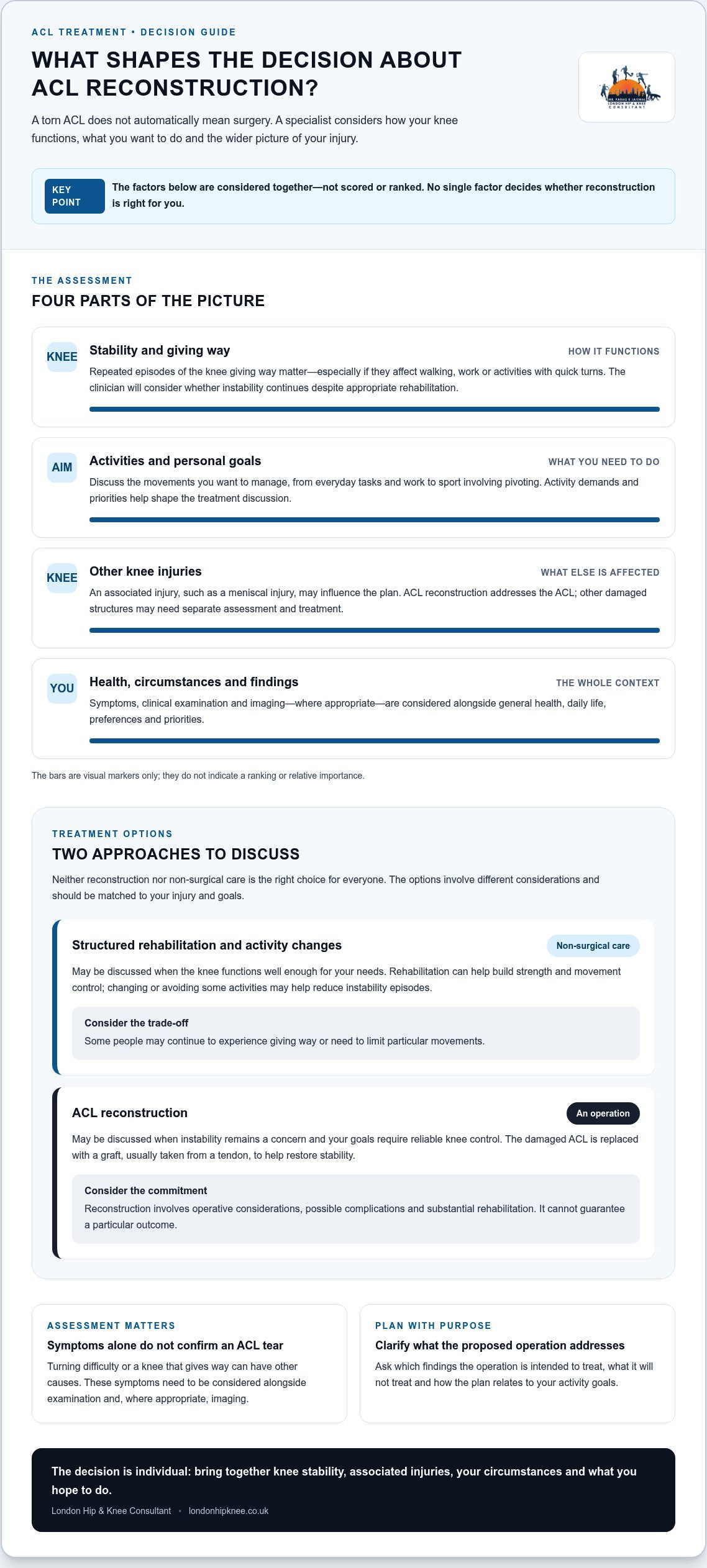
An ACL tear doesn’t automatically mean you need an operation. The decision about acl surgery is individual: the aim is to find an approach that addresses your knee’s function and fits your health, daily life and goals. Neither reconstruction nor non-surgical care is the right choice for everyone.
Which factors may influence a recommendation for reconstruction?
Repeated episodes of the knee giving way can be important, particularly if they interfere with walking, work or activities involving quick turns and changes of direction. A clinician will consider how often this happens and whether it continues despite appropriate rehabilitation. Instability is one part of the picture, not a stand-alone test for whether surgery is needed.
Other knee injuries may also affect the discussion. For example, a meniscal injury alongside an ACL tear could influence the treatment plan, but only a clinician can assess what the findings mean in your case. Your general health, activity demands, priorities and preferences may shape the recommendation too. Explain what you hope to do, whether that means managing everyday tasks comfortably or returning to a sport involving pivoting.
Reconstruction may be discussed when instability remains a concern and your goals require reliable control of the knee. It involves an operation, possible complications and a commitment to rehabilitation, and it can’t guarantee a particular outcome. An ACL Surgery Fact Sheet offers further background, but a specialist can explain how general information applies to your diagnosis.
Can an ACL tear be managed without surgery?
For some people, a clinician may discuss structured rehabilitation and activity changes as an alternative to reconstruction. This approach may suit someone whose knee functions well enough for their needs, but it isn’t appropriate for every injury or goal. Rehabilitation can help build strength and movement control. Avoiding certain activities may also be part of reducing episodes of instability.
The trade-off is that some people may continue to experience giving way or need to limit particular movements. Surgery aims to address ligament-related instability, but brings operative considerations and a substantial rehabilitation commitment. These options aren’t a simple choice between “doing nothing” and having an operation. Your symptoms, examination and imaging findings, associated injuries and functional goals need to be considered together.
Use these points to prepare questions, not to diagnose yourself or decide alone. An orthopaedic clinician can help clarify the alternatives and their implications for your circumstances. If you’re considering reconstruction, you can learn about ACL care in London and raise your goals and concerns with a specialist.
How do ACL graft choices and associated injuries shape the operation?
When ACL reconstruction is being considered, the graft and any other knee injuries help determine the surgical plan. There isn’t one graft that suits everyone. Your surgeon can explain which options are appropriate to consider, why they recommend a particular approach and what trade-offs are relevant to your circumstances.
What should patients know about ACL graft options?
A graft replaces the damaged ligament. Options commonly discussed include tissue taken from your own body, known as an autograft, or donor tissue. Autografts may use tendon from the hamstring, kneecap area or quadriceps. Donor tissue avoids taking a tendon from your own body, but its suitability depends on individual factors. The ACL reconstruction surgery overview explains the procedure and general considerations.
Each option has potential advantages and drawbacks. Using your own tendon involves an additional site where tissue is taken, which may have its own recovery considerations. Donor tissue avoids that step, but may not be appropriate for every patient. These are general differences, not a ranking. Your activity goals, health, knee findings and the surgeon’s assessment all inform the choice, alongside the recommended technique. Ask how the proposed graft may affect your recovery and what risks apply to you.
How can a meniscus injury affect ACL treatment?
The menisci are pads of cartilage that help cushion and distribute load within the knee. An ACL injury can occur alongside damage to a meniscus or other structures, but this isn’t true of every ACL tear. A clinician assesses the knee as a whole, using your symptoms, examination and imaging where appropriate, before deciding whether any associated injury needs treatment.
If a meniscus injury is present, its location and nature may influence the plan. A surgeon may discuss treating it during the same operation as ACL reconstruction or recommend a different approach. The decision depends on the findings. Meniscus treatment is a distinct part of care, not an automatic component of ACL reconstruction. Cartilage damage may also be relevant, so ask which findings matter in your case and how they affect the proposed procedure.
Before deciding, clarify what the operation is intended to address and which parts of the plan depend on findings. A clear discussion of graft source, associated injuries and individual trade-offs can help you make an informed choice about acl surgery.
What should you expect from ACL surgery preparation and rehabilitation?
ACL reconstruction is one stage of care, not the whole recovery. Preparation helps you understand the plan and organise practical support. Rehabilitation is essential for rebuilding knee movement, strength and function. Progress varies from person to person, so discuss milestones rather than relying on a promised return-to-work or return-to-sport date.
How can you prepare for an ACL surgery consultation and operation?
A consultation is a chance to review your diagnosis, discuss whether reconstruction is appropriate and understand what the proposed operation involves. Bring any imaging reports or scan details you have, a list of your medicines and questions about the activities that matter to you. Explain how your knee affects daily tasks, work and sport. If particular movements feel difficult or unstable, describe when this happens and how it affects you.
If surgery is planned, follow the instructions given by your clinical team. Preparation advice can differ according to your health and the specific plan, so check with them rather than relying on general guidance. Discuss practical arrangements in advance too, such as travel home, help with household tasks, caring responsibilities and time away from work. Ask what support you may need immediately after the operation and whom to contact if you have concerns.
Why is rehabilitation central after ACL reconstruction?
Rehabilitation supports a gradual return of movement and strength, then progresses towards more demanding functional activities as your knee allows. The stages and exercises should be tailored to your operation, other knee injuries and how you respond. Rehabilitation progression should be individualised and clinician-guided.
Follow-up appointments give your clinical team an opportunity to review healing and function, discuss difficulties and adjust the plan. Recovery doesn’t follow an identical schedule for everyone. A date on the calendar alone can’t confirm that your knee is ready for heavier work or sport. Progression should reflect clinical advice and your functional progress. Understanding what shapes your acl injury recovery time — stage by stage — can help you set realistic expectations and prepare for each phase of rehabilitation.
As you plan for acl surgery, ask who will guide your rehabilitation, how progress will be reviewed and what signs should prompt you to seek advice. You can also ask which milestones are relevant to your work, daily routine or sporting goals, and how your progress will be assessed. These questions can help you prepare for a clearer discussion about the next steps. For an individual conversation about ACL reconstruction, discuss your ACL care options with a specialist.
How can you discuss ACL surgery with a specialist in London?
A specialist consultation can help turn uncertainty about acl surgery into a clearer discussion of your diagnosis, options and priorities. Explain what you need your knee to do, whether that means managing everyday movement, work or returning to sport. Bring any scan reports or previous test results you have, along with a list of medicines and questions you want answered.
What questions should you ask an ACL surgeon?
You don’t need to have decided on surgery before your appointment. Use the conversation to understand the reasoning behind any recommendation and what the alternatives might mean for you. These questions can help:
- How was the ACL injury diagnosed, and do I need any further imaging or assessment?
- What might reconstruction help with in my circumstances, and what are its limitations and risks?
- Could structured rehabilitation or activity changes be considered instead?
- Which graft options are relevant to me, and why would you recommend one over another?
- Are there associated meniscus or other knee injuries that affect the treatment plan?
- Who will coordinate rehabilitation, and how will my progress be reviewed?
Ask for clear explanations of unfamiliar terms. Mention concerns about pain, time away from work, caring responsibilities or practical support after an operation. A useful summary to take into the appointment is: Ask how your diagnosis was reached, what treatment options and risks apply, and how rehabilitation will be planned and reviewed.
What happens at a specialist ACL consultation in London?
The clinician will discuss your symptoms, how the injury affects daily activities and your personal goals. They may review examination findings and available imaging to understand the knee and any associated injuries. The decision isn’t based on a scan alone: your overall health, preferences and expectations also matter. After an individual assessment, the clinician can explain whether reconstruction may be suitable or whether another approach should be discussed.
London Hip & Knee Consultant provides adult orthopaedic care, including ACL reconstruction, through its specialist hip and knee practice, led by Consultant Orthopaedic Surgeon Mr Parag Jaiswal. The practice operates across several London locations. Confirm current clinic locations and consultation arrangements when making an enquiry. A discussion is an opportunity to explore your options, not a commitment to have surgery.
If you’re ready to discuss your circumstances, Discuss your ACL treatment options with our London team.
Take the next step with a clearer understanding
Choosing whether to have acl surgery depends on more than an MRI result. Knee stability, associated injuries, your daily demands and personal goals all help shape the discussion. If reconstruction is considered, the graft and any other treatment should be explained in light of your circumstances, with rehabilitation planned as an essential part of care.
A specialist conversation can help you weigh potential benefits, limitations and alternatives without assuming surgery is the only answer. London Hip & Knee Consultant, led by Consultant Orthopaedic Surgeon Mr Parag Jaiswal, provides adult orthopaedic care that includes ACL reconstruction. The practice operates across several London locations. Confirm current clinic locations and consultation arrangements when enquiring.
Prepare the questions that matter most to you, whether they concern diagnosis, graft choice, risks or rehabilitation. To discuss your situation and possible next steps, Discuss your ACL treatment options with our London team. A well-informed discussion can help you decide what may suit you.
Frequently Asked Questions
Is ACL surgery always necessary after an ACL tear?
No, an ACL tear doesn’t automatically require surgery. A clinician will consider how stable your knee is, whether other structures are injured, your daily activities and your goals. Some people may discuss structured rehabilitation and activity changes, whilst reconstruction may be considered if instability continues or affects activities important to them. An assessment helps you compare the possible benefits and limitations of each approach for your circumstances.
How is ACL surgery performed?
ACL surgery commonly means reconstruction, in which a graft replaces the damaged ligament. The operation is usually performed using a camera and instruments inserted through small incisions, with the graft secured inside the knee. The graft source and surgical plan depend on clinical findings and individual circumstances. If a meniscus or another knee structure is also injured, the clinician will explain whether it needs separate or additional treatment.
How long does recovery from ACL surgery take?
Recovery varies according to the operation, any associated injuries and how your knee responds to rehabilitation. Rehabilitation after reconstruction can extend over many months, and returning to sport may take longer than resuming everyday activities. A fixed date can’t confirm readiness. Your clinical team should guide progression using your healing, strength and functional progress, and explain which milestones are relevant to your work, daily routine or sporting goals. For a detailed breakdown of what to expect at each phase, see this stage-by-stage guide to ACL injury recovery time.
Can I walk normally after ACL reconstruction?
Many people work towards walking comfortably after ACL reconstruction, but early mobility and the pace of progress vary. Your instructions may depend on the procedure, other injuries and your recovery. Follow your surgical and rehabilitation team’s advice about walking, weight-bearing and any support you need. If pain, swelling or difficulty walking concerns you, contact your clinical team for individual guidance rather than changing your plan yourself.
What are the risks of ACL surgery?
As with any operation, ACL reconstruction has potential risks, which may include infection, bleeding, blood clots, stiffness, persistent pain, problems at the graft site or failure of the graft. The likelihood and relevance of these risks vary with personal health and the surgical plan. Ask your surgeon which risks apply to you, how they may be reduced and what symptoms after the operation should prompt you to seek medical advice.
What happens if I do not have ACL surgery?
Without reconstruction, some people manage their knee with clinician-guided rehabilitation and changes to activities. Others may continue to experience instability, particularly during turning or pivoting, and may need to limit certain movements. The outcome depends on knee function, associated injuries and personal goals. Not having surgery doesn’t mean doing nothing: discuss an appropriate care plan and what to do if giving-way episodes or other symptoms persist.
How do I find an ACL specialist in London?
Look for a specialist who can assess your knee, explain treatment alternatives and discuss graft choices, associated injuries, risks and rehabilitation. Ask about their relevant experience and how follow-up is arranged. London Hip & Knee Consultant provides adult orthopaedic care, including ACL reconstruction, and is led by Consultant Orthopaedic Surgeon Mr Parag Jaiswal. Confirm current locations and consultation arrangements when making an enquiry.