

Most injectable treatments for knee osteoarthritis aim to temporarily top up joint fluid, but lasting relief requires changing the tissue lining itself. If you’re struggling with persistent joint stiffness and reduced walking tolerance, you already know the wearisome cycle of short-lived cortisone jabs and temporary lubricating injections. The thought of undergoing major knee replacement surgery and facing months of hospital rehabilitation feels daunting, yet living with chronic discomfort shouldn’t be your only alternative. Arthrosamid knee injections represent a genuine breakthrough in non-surgical joint preservation, moving far beyond fleeting symptom control.
Unlike traditional options that rapidly break down, this non-biodegradable polyacrylamide hydrogel physically integrates into the synovial membrane to provide enduring mechanical cushioning and reduce joint pain. In this 2026 guide, you’ll discover the clinical science behind this biological permanence, learn how the ultrasound-guided procedure works, and determine whether your specific grade of osteoarthritis makes you an ideal candidate. We’ll also outline what to expect during a specialist orthopaedic assessment in London, giving you the clarity and confidence needed to restore your mobility.
Key Takeaways
- Understand how a 2.5% polyacrylamide hydrogel integrates directly into the synovial lining, restoring joint elasticity through a permanent mechanical cushion.
- Learn how weight-bearing radiographs evaluate joint space preservation to determine your suitability for treatment before bone-on-bone friction develops.
- Discover why having arthrosamid knee injections administered under meticulous ultrasound guidance is vital for accurate delivery into the joint capsule.
- Compare the multi-year clinical durability of non-biodegradable hydrogels against the short-lived symptom control of conventional steroid and hyaluronic acid jabs.
- Gain practical insights into post-procedure recovery, from expected mild sensations to protective activity modifications during the initial forty-eight hours.
What Are Arthrosamid Knee Injections and How Do They Work?
Living with progressive joint pain often leaves patients trapped between short-acting steroid jabs and major joint replacement surgery. Arthrosamid knee injections introduce an entirely different pathway by addressing the mechanical environment of the joint. Classified as an intra-articular polyacrylamide hydrogel (iPAAG), Arthrosamid consists of 2.5% cross-linked polymer and 97.5% sterile, non-pyrogenic water. Rather than washing through the joint as a temporary chemical lubricant, this specialized gel functions as a permanent internal cushion. It doesn’t regrow worn bone or generate new articular cartilage; instead, it restores essential elasticity to an inner capsule compromised by knee osteoarthritis.
The Science of Polyacrylamide Hydrogel (iPAAG)
The foundation of Arthrosamid is an inert, biocompatible polymer backbone engineered specifically for load-bearing joints. Because the molecular structure permanently binds water molecules, it effectively mimics the natural viscosity and water-retaining properties of healthy synovial tissue. Traditional viscosupplements such as hyaluronic acid are broken down and cleared by the body within weeks. In contrast, polyacrylamide hydrogel is non-biodegradable; it resists enzymatic degradation, maintaining its physical integrity inside the joint long after administration.
How Arthrosamid Modifies the Joint Environment
Following delivery into the knee cavity, microscopic hydrogel droplets exchange with the synovial fluid and settle against the inner joint lining. Over the subsequent weeks, the hydrogel permeates the sub-synovial interstitial space, integrating directly into the synovial membrane without triggering a chronic foreign-body reaction. This biological integration yields three distinct physiological benefits:
- Membrane augmentation: The synovial lining thickens, creating a durable shock-absorbing layer that protects surrounding intra-articular structures.
- Restored capsule compliance: The joint envelope regains natural flexibility, reducing the stiff, rigid resistance that makes bending and weight-bearing uncomfortable.
- Dampened pain pathways: By improving overall joint mechanics, the hydrogel shields hyper-sensitised synovial nerve endings from constant friction and micro-trauma, diminishing inflammatory pain signals.
This cellular integration explains why arthrosamid knee injections provide lasting symptomatic relief rather than the transient masking of symptoms seen with conventional injectables.
Are You a Candidate for Arthrosamid? Assessing Knee Osteoarthritis Grades
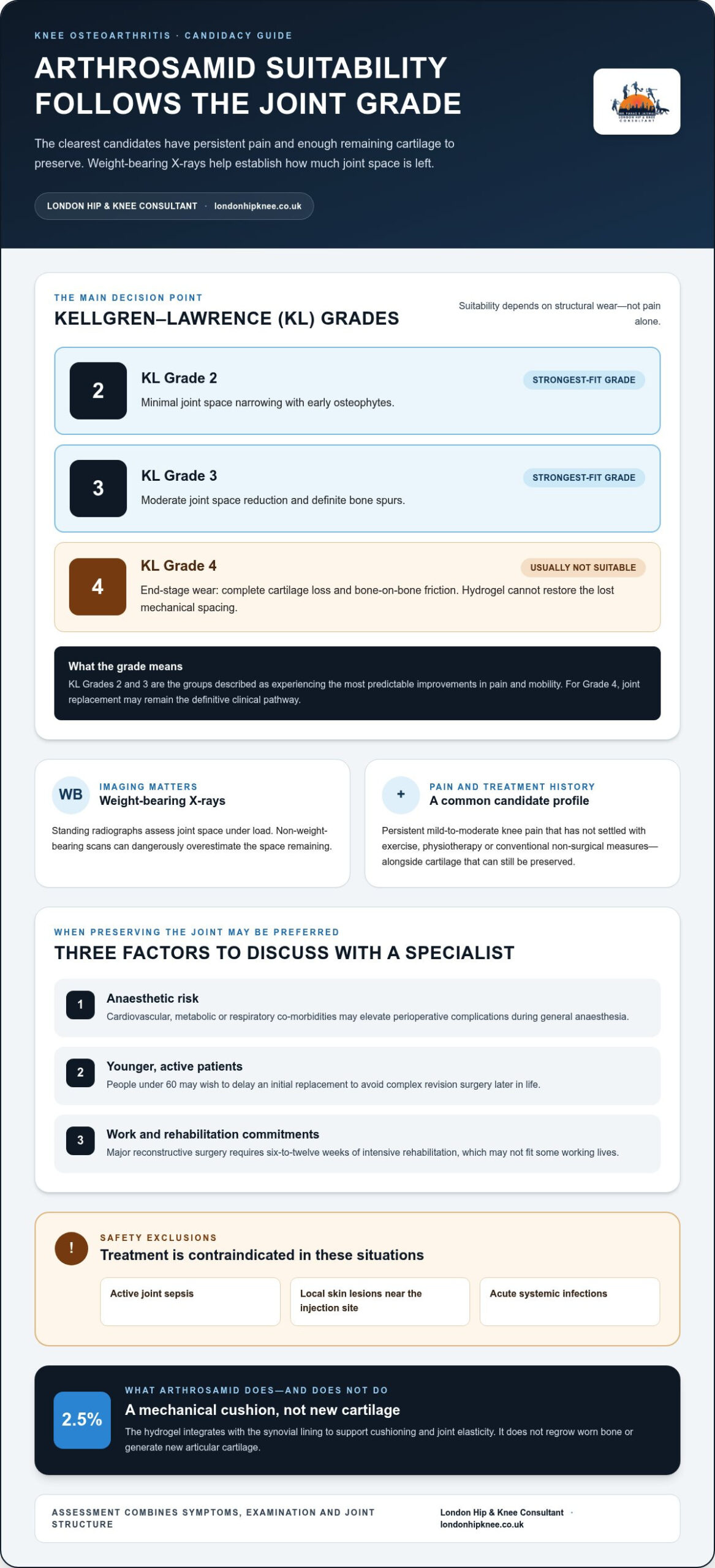
Determining your suitability for hydrogel therapy begins with an accurate diagnosis of your joint’s structural integrity. Not every painful joint responds equally to polyacrylamide treatment, which makes precise clinical grading vital. The ideal candidate typically presents with persistent, mild-to-moderate knee pain that fails to settle with exercise, physiotherapy, or conventional non-surgical measures, yet possesses sufficient remaining cartilage to preserve. Evaluating this baseline requires standing weight-bearing X-rays, as non-weight-bearing scans can dangerously overestimate remaining joint space.
Radiographic Grading and Candidacy Criteria
Orthopaedic specialists grade joint wear using the Kellgren-Lawrence (KL) classification system. Patients with KL Grade 2 (minimal joint space narrowing with early osteophytes) and KL Grade 3 (moderate joint space reduction and definite bone spurs) experience the most predictable improvements in pain and mobility. Ongoing clinical trials, including published NHS research on Arthrosamid, demonstrate significant symptom reduction in these specific cohorts. Conversely, KL Grade 4 denotes severe, end-stage osteoarthritis where complete cartilage loss results in bone-on-bone friction. At this advanced juncture, hydrogel cannot restore lost mechanical spacing, and surgical intervention, such as a partial or total knee replacement, remains the definitive clinical pathway.
Who Should Consider Arthrosamid Over Surgery?
A specialist assessment often reveals scenarios where non-surgical preservation is clearly preferable to an operation. You might consider arthrosamid knee injections if you fall into any of these clinical categories:
- Systemic anaesthetic risks: Patients with cardiovascular, metabolic, or respiratory co-morbidities that elevate perioperative complications during general anaesthesia.
- Younger, active individuals: Patients under 60 wishing to delay an initial joint replacement to avoid complex revision surgeries later in life.
- Professional commitments: Working individuals unable to undertake the compulsory six-to-twelve weeks of intensive rehabilitation required following major reconstructive surgery.
Contraindications and Safety Exclusions
Patient safety demands stringent exclusion parameters. Arthrosamid is strictly contraindicated in the presence of active joint sepsis, local skin lesions near the injection site, or acute systemic infections. Patients with severe mechanical angular deformities (advanced fixed varus or valgus malalignment) will not benefit, as hydrogel cannot correct underlying bone architecture. The treatment is also unsuitable if foreign material, such as existing metallic hardware from previous arthroplasty, is already present within the knee cavity.
Because accurate diagnosis protects you from ineffective interventions, consulting a dedicated specialist ensures your joint is evaluated thoroughly. Booking a comprehensive orthopaedic assessment with a knee specialist can confirm whether your joint grade aligns with this restorative hydrogel therapy.
The Step-by-Step Arthrosamid Procedure: What to Expect at the Clinic
Undergoing an unfamiliar medical procedure naturally brings questions, yet receiving this hydrogel is straightforward and performed entirely in an outpatient setting. The appointment begins with a thorough clinical review. Your consultant re-examines your range of movement, checks for joint effusion, and confirms that diagnostic weight-bearing radiographs align with clinical indications. Once your written consent is completed, you’ll be positioned comfortably on the examination couch with your knee slightly flexed.
Pre-Procedure Assessment and Joint Preparation
Aseptic technique is critical for intra-articular safety. The skin surrounding your knee is cleansed thoroughly using a medical-grade chlorhexidine preparation to establish a sterile field. Next, the consultant infiltrates local anaesthetic into the skin and subcutaneous tissues down to the joint capsule. This numbing step ensures you feel only minimal pressure rather than sharp discomfort during the treatment itself.
Ultrasound-Guided Injection Technique
Precision is essential. The injection should never be performed blindly by landmarks alone. A consultant utilises high-resolution ultrasound guidance to visualise the joint space and the needle tip in real time. This imaging step ensures accurate delivery directly into the joint cavity so the hydrogel can integrate into the synovial membrane as intended.
The core clinical stages follow a meticulous sequence:
- Joint fluid aspiration: If you have pre-existing fluid buildup (effusion), the specialist carefully draws it off using a syringe. Relieving this excess fluid reduces intra-articular pressure and prevents dilution of the hydrogel.
- Hydrogel delivery: Using the established pathway, the specialist slowly introduces a single 6 ml dose of sterile polyacrylamide hydrogel directly into the joint. Clinical specifications detailed on the Official Arthrosamid Website outline how this volume cushions the joint space.
- Dressing and articulation: Once the needle is smoothly withdrawn, a small sterile dressing is applied over the injection site.
Immediately after the injection, your consultant gently guides your knee through passive flexion and extension. This brief, painless movement distributes the gel evenly across the internal joint recesses. The entire clinic appointment takes roughly thirty to forty-five minutes, allowing you to walk out of the clinic shortly after treatment without crutches or an immobilising brace. Meticulous ultrasound guidance combined with specialist delivery underpins why consultant-led arthrosamid knee injections maintain such high safety standards and reliable outcomes.
Arthrosamid vs. Steroids, Hyaluronic Acid, and PRP: Treatment Comparison
Managing knee osteoarthritis often involves navigating a confusing landscape of injectable therapies. When pain flares up, corticosteroids offer rapid anti-inflammatory relief, yet their benefits typically fade within six to twelve weeks. Hyaluronic acid attempts to replenish joint fluid, but because the body naturally metabolises it, the lubricating effect rarely persists past six months. Platelet-rich plasma (PRP) uses concentrated autologous growth factors to stimulate biological repair pathways, but clinical responses vary widely depending on baseline platelet counts and preparation techniques. Arthrosamid knee injections take an entirely different mechanical approach, prioritising permanent structural augmentation over transient chemical suppression.
Longevity and Clinical Durability
The defining difference between these modalities lies in their therapeutic lifespan. Repeated clinic visits for short-acting jabs create an exhausting cycle of temporary improvement followed by painful regression. Clinical investigations tell a markedly different story for polyacrylamide hydrogel:
- Multi-year symptom reduction: Prospective European trial data presented at international orthopaedic congresses demonstrated that a single hydrogel dose maintained statistically significant pain reduction at three years post-treatment, with recent five-year extension studies confirming durable symptom relief.
- Sustained functional improvement: Standardised Western Ontario and McMaster Universities Osteoarthritis Index (WOMAC) scores reveal long-term reductions in stiffness and meaningful improvements in daily walking tolerance.
- One-and-done convenience: Unlike PRP or viscosupplementation regimens that often mandate multi-injection courses every six to twelve months, Arthrosamid delivers lasting mechanical support through a single clinic session.
Impact on Surrounding Articular Tissues
Preserving the health of remaining joint tissues is paramount. While corticosteroids effectively quell acute flare-ups, published literature increasingly highlights their chondrotoxic potential. Repeated steroid administration can accelerate articular cartilage thinning and compromise subchondral bone integrity over time. Hyaluronic acid avoids this tissue toxicity, but its rapid enzymatic degradation means it quickly clears from the joint cavity without altering capsule compliance.
Polyacrylamide hydrogel produces neither biochemical toxicity nor tissue breakdown. Because it is chemically inert and non-biodegradable, it integrates into the sub-synovial matrix without causing cartilage atrophy or cell death. It simply remains within the joint envelope, absorbing impact forces and shielding sensitised nerve fibres from mechanical irritation.
If you’re caught in a cycle of recurring injections that no longer provide adequate longevity, a specialist review can help determine your options. Before committing to any treatment, it’s also worth reading Arthrosamid reviews from patients and how to assess the evidence critically alongside clinical data. You can book a specialist consultation to compare these interventions against your imaging and explore whether permanent hydrogel cushioning suits your joint pathology.
Post-Injection Recovery, Expected Results, and Specialist Care in London
Leaving the clinic marks the beginning of your recovery journey, and knowing what to expect over the coming weeks prevents unnecessary concern. Immediately following the procedure, it’s entirely normal to experience a sensation of fullness or mild aching within the joint capsule. This response reflects the physical presence of the 6 ml volume rather than an adverse reaction. These minor post-injection sensations generally settle within a few days as the hydrogel distributes evenly across the joint space.
Immediate Aftercare and Recovery Milestones
Safeguarding the knee during the early consolidation phase promotes optimal tissue integration. Patients should observe a simple, structured timeline:
- First 48 hours: Rest the leg comfortably. Keep weight-bearing to essential indoor walking, and apply an ice pack wrapped in a clean cloth for ten to fifteen minutes at a time to soothe any localised soreness.
- Days 3 to 14: Gradually return to routine daily activities and light walking. Avoid high-impact exercises, heavy lifting, squatting, or prolonged standing during this fortnightly window.
- Beyond week two: Begin targeted low-impact physiotherapy. Strengthening the quadriceps, hamstrings, and gluteal musculature provides dynamic support that complements the mechanical cushioning of the hydrogel.
When Do Improvements in Pain and Mobility Appear?
Patience is crucial. Cortisone injections offer immediate biochemical suppression, but arthrosamid knee injections work through physical cellular integration. Most patients begin noting meaningful reductions in morning stiffness and joint discomfort between weeks four and six. The full therapeutic benefit continues to mature through weeks eight to twelve as the hydrogel anchors securely within the sub-synovial lining. A planned clinical review at this three-month milestone ensures your functional range of motion and weight-bearing tolerance are progressing as expected.
Consulting Mr. Parag Jaiswal for Expert Knee Care
Optimal clinical outcomes depend heavily on accurate diagnostic grading and consultant-led execution. Mr. Parag Jaiswal, an elite Consultant Orthopaedic Surgeon with over 18 years of clinical experience, leads the London Hip & Knee Consultant practice. Dedicated exclusively to hip and knee pathology, Mr. Jaiswal conducts thorough clinical assessments across premier London private hospitals, utilising advanced ultrasound guidance rather than delegating injections to non-specialist high-street providers.
Should your clinical grading indicate that advanced bone-on-bone disease has progressed beyond hydrogel therapy, having access to an experienced reconstructive surgeon provides total peace of mind. Patients can seamlessly transition to surgical solutions such as knee replacement london if clinically indicated, ensuring you receive the precise treatment your joint requires at every stage.
Restoring Your Knee Mobility with Specialist Guidance
Living with chronic osteoarthritis shouldn’t mean enduring endless cycles of short-term injections or rushing into invasive surgery before you’re ready. By integrating directly into the synovial membrane, arthrosamid knee injections offer a clinically validated, non-biodegradable cushion that dampens joint friction and restores natural capsule compliance over several years.
Achieving an optimal outcome begins with an accurate clinical diagnosis and consultant-delivered care. As a fellowship-trained Consultant Orthopaedic Surgeon with over 18 years of clinical excellence, Mr. Parag Jaiswal provides a full spectrum of specialist care across premier private hospitals in London, ranging from innovative hydrogels to complex joint reconstruction. If you’re ready to break free from persistent knee pain and protect your long-term joint health, book a specialist knee consultation with Mr. Parag Jaiswal to take the next confident step toward restored mobility.
Frequently Asked Questions
How long do Arthrosamid knee injections last for osteoarthritis?
Clinical trial data shows symptom relief lasting at least three to five years following a single injection. Because polyacrylamide hydrogel doesn’t biodegrade, it forms a lasting structural cushion within the synovial membrane. While individual outcomes vary depending on baseline joint wear, most patients receiving arthrosamid knee injections maintain meaningful improvements in walking tolerance and stiffness long after traditional lubricating shots would have degraded.
Is the Arthrosamid injection procedure painful to undergo?
Most patients experience minimal discomfort, often describing the sensation as a brief pinch followed by slight pressure. Prior to administering the hydrogel, your consultant infiltrates the skin and joint capsule with local anaesthetic to numb the path completely. Performing the injection under real-time ultrasound guidance ensures smooth, precise needle placement without irritating sensitive periosteal tissues, keeping the entire outpatient clinic experience calm and manageable.
How quickly can I walk and return to work after treatment?
You can walk out of the clinic immediately after treatment and generally return to desk-based work within twenty-four to forty-eight hours. While light daily indoor walking is encouraged, you should rest the limb and avoid heavy lifting, running, or prolonged standing during the first fortnight. If your job involves strenuous physical activity, your orthopaedic team will advise on a sensible, phased return.
Can Arthrosamid cure knee osteoarthritis or regrow cartilage?
No, Arthrosamid can’t cure osteoarthritis or regenerate worn articular cartilage. Osteoarthritis is a degenerative condition that alters joint architecture over time. Rather than regrowing lost tissue, the hydrogel physically integrates into the inner joint lining. This structural restoration improves capsule elasticity and cushions impact forces, providing lasting pain relief and improved function without claiming to reverse existing bone changes.
Are there any common side effects or risks associated with Arthrosamid?
Reported side effects are mild and short-lived, most commonly presenting as transient joint fullness, localized swelling, or slight aching around the puncture site. These sensations usually settle within a few days using rest and simple cold compresses. Because the polymer is chemically inert, foreign-body reactions are exceptionally rare. Strict sterile protocols maintained in our London surgical facilities ensure infection risks remain vanishingly low.
What happens if Arthrosamid does not relieve my knee pain?
If the hydrogel doesn’t provide adequate relief, your consultant will re-examine your joint mechanics to consider alternative pathways. Because the gel integrates safely within the synovium without eroding bone, it doesn’t compromise future procedures. Patients with advanced wear who eventually require definitive reconstruction can proceed to partial or total knee replacement surgery under Mr. Jaiswal’s care without technical hindrance.
Is Arthrosamid available on the NHS or through private medical insurance?
Arthrosamid isn’t routinely funded on the NHS, and major UK private medical insurers assess cover strictly on a case-by-case basis. Many private policies consider the treatment specialized, often requiring written pre-authorisation before treatment proceeds. As a result, many patients in London choose to self-fund their care. The administrative team clarifies all pathway requirements before you attend your initial consultant assessment.