

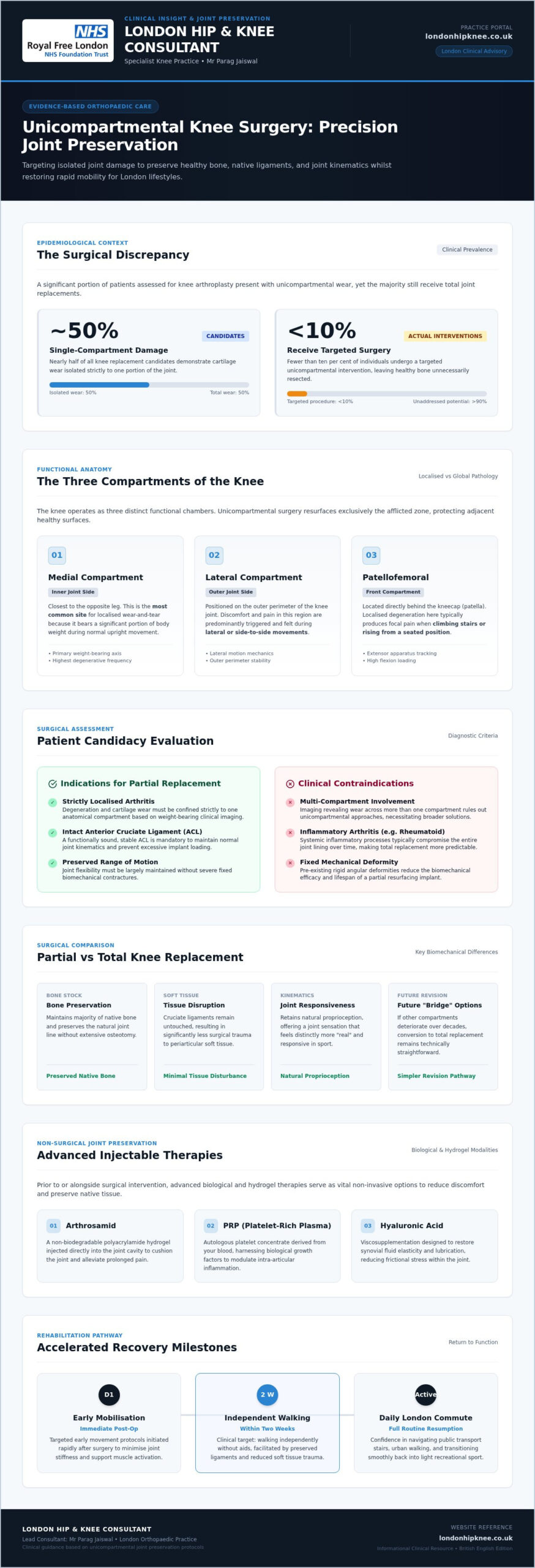
Did you know that whilst nearly 50 per cent of knee replacement candidates only have damage in one part of their joint, fewer than 10 per cent actually receive a targeted procedure to address it? If you’re struggling with persistent pain on just one side of your knee, you might feel like your only options are to endure the stiffness during your London commute or face the daunting prospect of a full joint replacement. It’s understandable to feel anxious about long recovery times and the loss of natural movement that often accompanies major surgery. However, unicompartmental knee surgery offers a precision-targeted alternative that preserves your healthy bone and ligaments.
We agree that the goal should always be to maintain as much of your natural joint as possible whilst resolving discomfort. This guide explains how unicompartmental knee surgery compares with advanced joint preservation injections like Arthrosamid, PRP, and Hyaluronic Acid to help you reclaim your mobility. We’ll preview the specific benefits of these treatments, including faster recovery times and better surgical outcomes, so you can return to walking or light sport without pain. By understanding the latest clinical evidence and recovery milestones, you can make an informed choice about your path back to an active, pain-free London lifestyle.
Key Takeaways
- Understand the anatomy of the knee and how targeting a single compartment can preserve your healthy bone and ligaments.
- Learn the specific clinical criteria, such as an intact ACL, that determine if unicompartmental knee surgery is the most effective path for your recovery.
- Discover why partial replacements often result in a more natural-feeling joint and less soft tissue disruption compared to total knee replacements.
- Gain clarity on the rapid recovery timeline, including early mobilisation strategies that aim to get you walking independently within two weeks.
- Explore how a bespoke, patient-centred approach in London can help you return to an active lifestyle and your daily commute with confidence.
What is Unicompartmental Knee Surgery?
Many patients are surprised to learn that the knee isn’t just one large hinge. It’s actually composed of three distinct areas. When arthritis or injury affects only one of these, a full joint replacement can feel like an excessive solution. This is where unicompartmental knee surgery provides a more precise, conservative alternative. Known amongst patients as a partial knee replacement, this procedure focuses on resurfacing only the damaged portion of the joint. The clinical term for this approach is unicompartmental knee arthroplasty, and it’s designed to leave your healthy bone and ligaments entirely untouched.
The primary goal of this intervention is restoration rather than total replacement. By focusing only on the specific compartment where the cartilage has worn away, surgeons can preserve the natural mechanics of your knee. This targeted approach is particularly beneficial for those who still have healthy cartilage in other parts of the joint and want to maintain a high level of activity.
The Three Compartments of Your Knee
To understand why you might be a candidate for this surgery, it’s helpful to look at how your knee is divided. The joint consists of three main compartments:
- Medial Compartment: This is the inner side of the knee, closest to your other leg. It’s the most common site for localised wear-and-tear because it bears a significant portion of your body weight during movement.
- Lateral Compartment: This is the outer side of the knee. Pain here is often felt on the outside of the joint, especially during lateral movements.
- Patellofemoral Compartment: This is the front of the knee, located behind the kneecap (patella). Arthritis here typically causes pain when climbing stairs or rising from a chair.
Localised wear differs significantly from global or “total” arthritis, where damage is spread across all three areas. If your pain is strictly confined to one of these zones, replacing the entire joint may not be necessary.
Why Surgeons Favour Bone Preservation
The decision to opt for a partial replacement often comes down to the benefits of bone preservation. By keeping the majority of your natural bone, we can maintain the natural “joint line” more effectively. This is crucial because even the most advanced prosthetics can’t perfectly replicate the exact feel of your original joint. When we preserve your own bone and ligaments, the knee tends to feel more “real” and responsive during activities like walking or light sport.
There’s also a practical long-term benefit. Whilst modern implants are incredibly durable, unicompartmental knee surgery leaves more “bridge” options for the future. If the other compartments eventually develop arthritis years down the line, a revision to a total knee replacement is technically simpler because more of your original anatomy remains intact today.
Determining Candidacy: Are You Eligible for a Partial Replacement?
While the benefits of preserving your natural joint are clear, not every patient is a suitable candidate for unicompartmental knee surgery. Success depends on precise anatomical criteria. First, your arthritis must be strictly localised. If imaging reveals wear across multiple compartments, a partial approach won’t provide lasting relief. Secondly, your ligaments must be functionally sound. A stable anterior cruciate ligament (ACL) is the foundation of a successful outcome, as it maintains the knee’s natural tracking. Without this stability, the new implant would be subject to excessive wear.
Specific exclusions apply too. If you suffer from inflammatory conditions like rheumatoid arthritis, the disease typically affects the entire joint over time, making a total replacement a more predictable choice. Similarly, if your knee has already lost significant range of motion or has developed a fixed deformity, the biomechanical advantages of a partial replacement might be lost. Understanding your candidacy for partial knee replacement is the first step in our diagnostic journey. It ensures that the intervention we choose aligns perfectly with your joint’s physical reality.
The Clinical Diagnostic Process in London
At our London clinics, the assessment begins with a thorough physical examination to test joint stability and movement patterns. We rely on weight-bearing X-rays to see how the joint behaves under pressure, looking specifically for joint space narrowing. In many cases, Mr Jaiswal will recommend an MRI scan. This allows us to verify that the cartilage in the other two compartments remains healthy whilst checking the integrity of the soft tissues. It’s this level of detail that ensures we don’t just treat the pain, but preserve the joint’s future. If you’re experiencing discomfort in knee joint and want to understand the underlying cause, you can consult a specialist to discuss your imaging results and explore your options.
Age and Activity Level Considerations
There’s a common misconception that partial replacements are reserved for older, less active individuals. In reality, younger patients often see the greatest benefit from unicompartmental knee surgery. Because the procedure is less invasive than a total replacement, the return to work and light sport is significantly faster. For a busy professional, this means less time away from the office and a quicker return to the activities they love. We focus on balancing your immediate lifestyle goals with the long-term durability of the implant, ensuring your knee supports your ambitions for years to come.
Comparison: Unicompartmental vs Total Knee Replacement
Choosing between a partial and a total knee replacement is rarely about the “size” of the surgery alone; it’s about the preservation of function. In unicompartmental knee surgery, the incision is typically much smaller, often measuring around 7 to 10 centimetres. Because we avoid disrupting the major muscle groups and don’t need to dislocate the kneecap, the trauma to the surrounding soft tissue is significantly reduced. This translates to less postoperative swelling and a more comfortable partial knee replacement recovery for the patient. The difference in the immediate aftermath is tangible.
Clinical data highlights that blood loss is minimal, and the requirement for a transfusion is almost non-existent. Most patients in our London clinics are ready to return home after just one night, and in some cases, we can even facilitate a day-case pathway. This is a marked contrast to a total replacement, which usually requires a multi-day hospital stay. While a total replacement is an excellent operation for widespread arthritis, the partial approach is a more refined tool for localised disease.
Proprioception: The “Natural Knee” Feel
Perhaps the most significant advantage of a partial replacement is the preservation of proprioception. This is your body’s subconscious ability to sense where your joint is in space. Because we retain both the anterior and posterior cruciate ligaments (ACL and PCL), the neurological feedback loop remains intact. Patients often describe the result as feeling like their “own knee” again. In contrast, total replacements can sometimes feel more mechanical or heavy during movement because the ACL is typically removed. Retaining your natural ligaments allows for a more fluid, intuitive gait when walking or climbing stairs.
Risk Profiles and Complication Rates
While the risk of infection or blood clots is statistically lower with a partial procedure, there is a known trade-off to consider. National Joint Registry data indicates a slightly higher risk of needing a conversion to a total replacement later in life compared to the revision rate of a primary total knee. However, the use of modern robotic-arm guidance has revolutionised this. By achieving sub-millimetre precision in implant alignment, we’re seeing improved longevity and better-balanced joints in 2026. Current survivorship for these modern implants sits between 90 per cent and 93 per cent at the ten-year mark, providing a highly reliable long-term solution for the active patient.
Recovery and Rehabilitation: Your Path to Mobility
Within the first 24 hours of unicompartmental knee surgery, the focus shifts immediately to movement. Unlike traditional total replacements, the tissue-sparing nature of this procedure allows for early mobilisation. You’ll likely be encouraged to stand and take your first steps with assistance on the very day of your operation. Modern pain management strategies, including local anaesthetic infiltration, ensure this initial phase is manageable. It’s a critical window where we begin to re-educate the muscles and prevent the onset of joint stiffness.
By the end of the second week, the focus moves toward wound healing and independence. You’ll transition from using crutches to walking unaided as your confidence and strength return. During this period, keeping the swelling under control is vital. We recommend a “little and often” approach to movement, avoiding the temptation to overexert the joint too soon. Most patients find that the transition to independent walking happens much faster than they anticipated.
The Role of Physiotherapy
Engaging with a specialist physiotherapist is non-negotiable for a successful outcome. A bespoke rehabilitation programme will be developed to address your specific goals, whether that’s returning to the tennis court or simply walking to the office without a limp. These sessions help monitor your progress and provide a safe environment to push your range of motion. If you have any concerns about your recovery speed or specific symptoms, book a follow-up consultation to ensure your rehabilitation is on track.
Returning to an Active London Lifestyle
For many of our patients, the true test of recovery is navigating the city. By week six, most individuals are ready to return to driving and light office-based work. We suggest planning your commute to avoid the busiest peak hours initially. The London Underground can be demanding, so start with shorter walks and gradually increase your distance. Practical tips for city life include:
- Using accessible stations with lifts during the first few weeks of commuting.
- Wearing supportive, cushioned footwear for city walking.
- Gradually reintroducing low-impact exercise classes or gym sessions from month three.
Between months three and six, you’ll likely achieve your full range of motion. This is the stage where you can return to favourite activities like golf or swimming. Whilst high-impact sports like skiing or long-distance running require a more cautious approach, the preservation of your natural ligaments during unicompartmental knee surgery provides a more stable foundation for these ambitions. Each milestone brings you closer to the active, pain-free life you’ve been missing.
Specialist Knee Surgery in London with Mr Parag Jaiswal
Mr Parag Jaiswal brings over 18 years of medical experience to every consultation, specialising in the complex restoration of adult hip and knee conditions. Choosing a consultant who performs both total and unicompartmental knee surgery is vital for receiving an unbiased recommendation. Because Mr Jaiswal is an expert in the full spectrum of orthopaedic care, he ensures the chosen path is dictated by your anatomy and lifestyle rather than a limited surgical repertoire. Patients can access these specialist services across several premier private hospital locations in London, including Nuffield Health Highgate Hospital and other leading surgical centres.
The philosophy of the practice is built on quiet confidence and a commitment to excellence. We understand that every patient’s journey is unique, which is why we provide a bespoke service that prioritises long-term well-being over quick fixes. Whether you’re a professional navigating a busy city schedule or an athlete looking to return to sport, the focus remains on restoring your freedom of movement through precise, modern techniques that respect your natural anatomy.
A Compassionate, Expert Diagnostic Journey
Your first visit to a London centre is more than just a physical examination; it’s the start of a collaborative partnership. We understand that the prospect of surgery can be daunting, so we prioritise a transparent, shared decision-making process. Mr Jaiswal takes the time to explain the nuances of your imaging results, ensuring you understand exactly why a partial replacement or a specific injection is recommended. For those planning their private healthcare journey, it’s helpful to review our knee replacement cost in London 2026 guide to understand the investment in your long-term mobility.
Beyond Surgery: Integrated Care and Support
True joint preservation often involves a multi-modal approach. If your diagnostic assessment suggests that surgery isn’t yet necessary, we offer advanced non-surgical alternatives like Arthrosamid injections. This polyacrylamide hydrogel can provide significant relief for those with moderate osteoarthritis, acting as a vital bridge before unicompartmental knee surgery becomes required. Our commitment to your well-being extends far beyond the operating theatre, with comprehensive long-term follow-up care to monitor your progress and maintain your active lifestyle.
Don’t let persistent joint stiffness limit your potential or dictate your weekend activities. Taking the first step toward a resolution is often the hardest part of the journey, but our team is here to provide clarity and support at every stage. If you’re ready to address your persistent pain, you can Book your consultation with London Hip & Knee Consultant today to explore a bespoke path toward restoration.
Reclaiming Your Active London Lifestyle
Choosing the right intervention for persistent knee pain is a pivotal decision for your long-term mobility. We’ve explored how unicompartmental knee surgery offers a sophisticated, bone-preserving alternative to total joint replacement, provided your arthritis remains localised. By retaining your natural ligaments, you maintain the joint’s intuitive feel and benefit from a significantly accelerated recovery timeline. Whether you’re aiming to navigate the morning commute with ease or return to the golf course, the goal remains the same: restoration of freedom without unnecessary trauma.
Mr Parag Jaiswal, a consultant with over 18 years of medical expertise, specialises in these joint-preserving techniques across multiple convenient London locations. His patient-centred approach ensures you receive a diagnostic journey grounded in clinical excellence and shared decision-making. If you’re ready to move beyond persistent stiffness and explore a bespoke path to recovery, it’s time to take the next step toward a pain-free future.
Book a Consultation with Mr Parag Jaiswal to discuss your surgical and non-surgical options in detail. You don’t have to let joint pain define your quality of life; expert help is available to help you get back to the activities you love.
Frequently Asked Questions
How long does unicompartmental knee surgery take to perform?
Unicompartmental knee surgery typically takes between 60 and 90 minutes to perform. The exact duration depends on the complexity of your joint anatomy and whether robotic assistance is utilised to achieve sub-millimetre precision. Whilst it is a shorter procedure than a total replacement, the focus remains on the meticulous resurfacing of the damaged compartment. This efficiency helps reduce time under anaesthesia, contributing to a smoother initial recovery phase for patients at our London clinics.
Is a partial knee replacement more painful than a total one?
Most patients find that a partial replacement is significantly less painful than a total one. Because the surgery involves a smaller incision and less disruption to the surrounding muscles and ligaments, the immediate postoperative trauma is reduced. We use advanced local anaesthetic techniques to manage discomfort effectively during the first 24 hours. This refined approach allows for earlier mobilisation, which often helps to lower overall pain levels by preventing the joint from becoming excessively stiff.
Will I be able to kneel after unicompartmental knee surgery?
Kneeling is often more comfortable after a partial replacement compared to a total one. Since your natural kneecap and the front compartment of the knee are frequently left untouched, the joint mechanics remain more familiar. Whilst some patients may experience mild pressure or a strange sensation initially, most can return to kneeling for gardening or household tasks once the soft tissues have fully healed. We provide specific exercises during your rehabilitation to help desensitise the area and improve your confidence.
How long will a partial knee replacement last in 2026?
Current data from 2026 suggests that modern partial knee implants have an excellent lifespan, with survivorship rates between 90 per cent and 93 per cent at the ten-year mark. Longevity has improved significantly due to better implant materials and the precision of robotic-arm guidance. Whilst a total replacement may have slightly higher registry survival, the functional benefits of a partial joint often outweigh this for active patients. Maintaining a healthy weight and following your physiotherapy programme will further protect the implant’s durability.
Can I have a partial knee replacement if I have had previous ACL surgery?
You can certainly be considered for a partial replacement if your previous ACL reconstruction was successful and the ligament remains stable. A functional anterior cruciate ligament is a critical requirement for unicompartmental knee surgery as it ensures the joint tracks correctly. During your consultation in London, Mr Jaiswal will perform specific stability tests and review your scans to confirm your ACL is providing the necessary support. If the ligament is intact, you can benefit from this joint-preserving approach.
What are the main risks associated with unicompartmental knee surgery?
The primary risks include standard surgical complications such as infection, blood clots, or persistent pain, though these occur at lower rates than in total replacements. There is also a specific risk that the arthritis may eventually progress into the other compartments of the knee. If this occurs, a conversion to a total knee replacement might be required in the future. However, choosing an experienced consultant and utilising modern alignment techniques significantly reduces the likelihood of early implant wear or malpositioning during unicompartmental knee surgery.
How soon can I return to work after a partial knee replacement?
Most patients returning to sedentary or desk-based roles in the city can expect to be back at work within two to four weeks. If your job involves significant walking or physical activity, you may require eight to twelve weeks before returning to full duties. We recommend a phased return to help you manage any residual swelling. Navigating the London commute is often the biggest hurdle, so we suggest avoiding peak travel times during your first few weeks back.
Is unicompartmental knee surgery covered by private health insurance like Bupa or AXA?
Yes, unicompartmental knee surgery is typically covered by major private health insurers, including Bupa, AXA, and Vitality. Most policies recognise this as a standard surgical intervention for localised osteoarthritis. It’s essential to obtain a pre-authorisation code from your provider before your procedure. Our team can provide the necessary clinical codes and documentation to assist with your claim, ensuring you can focus on your recovery at one of our specialist London hospital sites without administrative stress.